Navigating global regulatory landscapes is one of the most capital-intensive challenges for modern food manufacturers. When scaling up an industrial manufacturing facility, establishing a new processing plant, or investing in a heavy-duty production line, compliance cannot be treated as an afterthought or mere administrative paperwork. For procurement officers, plant owners, factory directors, and quality assurance (QA/QC) managers across North America, Europe, and the global market, purchasing machinery isn’t just about maximizing hourly output capacity, fine-tuning recipe flexibility, or minimizing energy consumption—it is fundamentally about managing operational and legal risk.
Two regulatory frameworks consistently dominate industrial procurement documentation, RFQs (Requests for Quotes), and international customs clearances: CE Marking and HACCP (Hazard Analysis Critical Control Point). While international buyers frequently group these terms together in their vendor questionnaires, they represent completely different pillars of industrial compliance.
CE marking is a strict legal mandate centered on mechanical, electrical, and operator safety. HACCP, conversely, is a holistic, facility-wide food safety management framework designed to identify, evaluate, and control biological, chemical, and physical hazards throughout the human food supply chain.
For a food processing company sourcing a customized extrusion line from an overseas factory, understanding how these standards translate into actual mechanical blueprints, metallurgy choices, automated controls, and factory-floor validation checklists is vital. Purchasing a machine that lacks proper engineering alignment with these systems leads to costly retrofitting, unstable production, failed factory audits, or worse, catastrophic product recalls.
This comprehensive, textbook-grade guide breaks down every precise engineering feature, material classification, automation logic, and documentation packet required to satisfy both CE inspectors and HACCP auditors, ensuring your manufacturing asset remains safe, efficient, and fully compliant for international market entry.
CE and HACCP Are Two Different Safety Pillars
One common misunderstanding among food processing buyers is viewing CE and HACCP as similar certificates that can simply be stamped onto a machine nameplate by a vendor. They are fundamentally distinct systems that address different risks, yet they converge directly at the machine level during daily factory operations.
- ✓ Protects: The Human Operator
- ✓ Domain: Mechanical & Electrical Risk
- ✓ Mechanism: Interlocks, Shrouds, E-Stops
- ✓ Protects: The Human Consumer
- ✓ Domain: Biological & Chemical Hygiene
- ✓ Mechanism: Sanitary Metallurgy, CIP
The Machinery Compliance Track: CE Marking
A CE-marked machine provides documented proof that the industrial asset has been designed, manufactured, and physically tested according to rigid essential health and safety requirements. Machinery placed on the European Union market before January 20, 2027, must comply with the well-known Machinery Directive 2006/42/EC. Past that definitive timeline, the updated Machinery Regulation (EU) 2023/1230 fully replaces the old framework, implementing stricter controls regarding digital safety, cyber-security of industrial control systems, and automated risk assessments.
CE compliance involves thorough physical guarding, emergency stop mapping, comprehensive electrical grounding, safety instruction manuals, localized warning labels, a detailed technical file, and an official signed Declaration of Conformity. Its ultimate goal is ensuring that the machine is physically safe for your factory operators during commissioning, normal production, cleaning, and preventative maintenance.
The Food Safety Track: HACCP Protocols
HACCP is not a single certificate attached to a standalone machine. As defined by the United States Food and Drug Administration (FDA) and the global Codex Alimentarius, HACCP is a systematic approach to preventing contamination within the manufacturing process. It evaluates the entire food production ecosystem: from incoming raw materials, plant water quality, employee hygiene, and pest control, to chemical cleaning schedules, allergen segregation, instrument calibration, and complete process data retention. The FDA emphasizes that HACCP systems must be individually developed by each food establishment, tailored precisely to its specific product formulation, processing tech, and distribution conditions.
Where the Pillars Converge: The Machine Interface
For food extrusion processing, these two distinct systems intersect directly at the hardware engineering level. A high-grade industrial extruder must protect factory personnel from rotating mechanical components, high-temperature barrels, electrical cabinets, and high-speed cutting blades (satisfying CE safety).
Simultaneously, that exact same equipment must actively support hygienic production and prevent product contamination (supporting HACCP). It achieves this via FDA-approved food-contact alloys, polished sanitary welds, absolute separation between gear lubricants and the product stream, and highly accurate automated process monitoring.
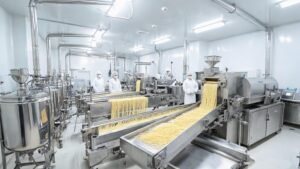
This structural convergence is especially vital for snack processing facilities operating a heavy-duty Puffed Food Machine as the central processing core of a complete, automated assembly line. Typical expanded snack manufacturing is an intensive, continuous multi-stage sequence:
If the physical machinery design is flawed in any single section of this continuous line, the factory faces not only unstable product throughput and frequent emergency shutdowns but also severe microbiological and physical contamination risks that will derail a facility-wide HACCP audit.
Deep-Dive: CE Requirements for High-Pressure Extrusion Systems
Industrial food extruders are highly complex thermodynamic systems. They combine high-torque rotational forces from massive drive motors, heavy thermal loads via induction heaters or steam jackets, and intense internal pressure zones within the processing barrel. Satisfying international safety mandates demands explicit mechanical and electrical engineering controls across four primary structural domains.
Mechanical Safety and Physical Containment
The heart of an extruder features high-strength twin or single screws designed to compress, shear, mix, and convey dense starch or protein formulations. If an operator accesses these internal moving elements while the machinery is energized, catastrophic injury will occur.
Physical Inlet Barriers: Raw material input hoppers and feeding systems must be fitted with permanent or interlocked physical grates or grilles preventing human hands from accessing the rotating feed auger. The aperture size of these mesh grates must strictly conform to EN ISO 13857 safety distance calculations, ensuring a human finger or hand cannot physically reach the internal danger point.
Dual-Channel Interlocking Safety Switches: Access doors, barrel covers, and protective shrouds covering the motor drive coupling, transmission V-belts, and processing barrel must be equipped with non-contact, tamper-resistant safety interlock switches conforming to EN ISO 14119. When an access panel is opened by a worker for cleaning or inspection, the safety circuit immediately breaks, routing a hardware-level stop signal to the primary drive inverter.
Active Braking Logic: Because heavy industrial extrusion screws possess high rotational inertia, simply cutting power to the motor is insufficient. CE-compliant control systems incorporate dynamic braking resistors or regenerative braking modules within the VFD (Variable Frequency Drive) to actively halt screw rotation within milliseconds of an interlock breach.
Shaping Cutters and Auxiliary Drives: The high-speed rotating knives used to slice puffed shapes at the die head represent a high physical risk. Cutter assemblies must be entirely enclosed within strong stainless steel hoods. These hoods must feature robust mechanical interlocks that prevent the motor from starting unless the hood is completely sealed against the die plate frame.
Emergency Stop and Safety Circuit Architecture
Emergency stop pushbuttons (E-stops) must be highly visible, palm-operated, self-latching mushroom buttons colored red with a high-contrast yellow background.
Topographical Placement: E-stops must be strategically positioned at every primary operator station, near the material mixer, adjacent to the extruder die head, at the entrance/exit of drying tunnels, and near automated seasoning drums. An E-stop must execute a hard stop of all hazardous motion across the entire integrated line, rather than simply turning off an HMI screen or pausing a software loop.
Safety Relay Integration: The emergency stop circuitry must interface with a dedicated, safety-certified monitoring relay or a safety PLC operating on a dual-channel architecture. This must conform to Category 3 or 4 under EN ISO 13849-1 standards, ensuring that a single component failure (such as a shorted wire or welded relay contact) cannot neutralize the emergency shutdown capability.
Electrical Compliance and Industrial Cabinet Design
Food processing facilities are demanding environments. They are subject to frequent washdown routines involving high-pressure water, chemical foaming detergents, localized steam, and fine organic dust (such as flour or cornmeal) that can create explosive atmospheres.
Ingress Protection Standards: All electrical enclosures, terminal junction boxes, sensors, and human-machine interfaces (HMIs) must meet a minimum rating of IP65 (dust-tight and protected against water jets) or IP69K for intense sanitation zones where high-pressure hot water washdowns are standard practice.
Electromagnetic Compatibility (EMC Directive 2014/30/EU): High-power VFDs regulating the primary extruder motor generate significant high-frequency electrical noise. Certified machinery must utilize shielded motor power cables, internal line/load reactors, and dedicated EMC filters. This prevents electrical interference with nearby sensory arrays, temperature controllers, or facility wireless networks.
Cabinet Organization and Protective Grounding: The main electrical cabinet must be constructed of neat, clean stainless steel. Internal components must be systematically organized on DIN rails, clearly labeled according to the official schematic diagram, and isolated from accidental human contact. The cabinet must integrate dedicated short-circuit protection, overcurrent circuit breakers, thermal overload relays, and a robust, single-point copper grounding busbar connected to every structural frame element of the line.
Thermal and Pressure Protection Systems
Extrusion cooking processes routinely exceed internal temperatures of 120°C to 180°C and internal pressures surpassing 50 to 120 bars ($5\text{ MPa}$ to $12\text{ MPa}$), transforming the solid steel barrel into a high-energy pressure vessel.
Mechanical Overpressure Relief: While electronic pressure transducers provide the primary software cutoff data, a purely mechanical fail-safe is legally required. Extruder barrels must incorporate calibrated rupture disks or heavy-duty, spring-loaded pressure relief valves. If a downstream die plate becomes blocked by ungelatinized starch, foreign objects, or cold material during startup, these mechanical devices safely vent localized pressure away from operator platforms.
Thermal Insulation and Guarding: All heated barrel zones, steam lines, and hot product conduits must be fully wrapped in thick, non-combustible ceramic or rockwool insulation blankets. These blankets must be fully enclosed within a secondary stainless steel protective shroud, ensuring the exterior touch-surface temperature of the machinery remains below 55°C to eliminate operator burn risks.
Deep-Dive: HACCP Infrastructure & Sanitary Design Engineering
An industrial plant cannot execute an effective HACCP plan if its underlying production machinery is fundamentally flawed from a hygienic design standpoint. When selecting a HACCP extrusion equipment array, engineering teams must evaluate the equipment through the lens of complete contamination prevention, cleanability, and material inertness.
| Material | Stainless Steel SUS304 / SUS316L |
|---|---|
| Properties |
|
| Surface Finish Specification |
|
Material Metallurgy and Contact Boundaries
Any material that makes direct physical contact with raw ingredients, intermediate moisture melts, or final cooked snack products must be completely inert, non-toxic, and non-absorbent.
Austenitic Stainless Steel Selection: All critical food-contact zones—including the flour mixer blades, screw conveyor troughs, extruder feeding hoppers, inner barrel liners, extrusion screws, die plates, cutter blades, dryer mesh belts, and seasoning drums—must be manufactured from premium austenitic stainless steel (SUS304 or SUS316L). These alloys contain high concentrations of chromium and nickel, creating a self-healing chromium oxide passivation layer that resists pitting and corrosion from organic acids, salts, moisture, and alkaline or acidic chemical sanitizers. For highly corrosive formulations containing elevated salt or acid profiles, SUS316L must be specified for product-contact zones due to its superior molybdenum content.
Surface Roughness Parameters ($R_a$): Microscopic analysis reveals that standard machined or rolled steel contains thousands of minute surface peaks and valleys. These micro-cavities shelter bacterial colonies from chemical sanitizers and cleaning solutions. All food-contact surfaces must be ground, polished, or bead-blasted to achieve a surface roughness ($R_a$) value of less than or equal to 0.8 micrometers ($\le 0.8\ \mu\text{m}$). This ultra-smooth profile prevents product adhesion and allows cleaning fluids to flow freely over the steel.
Food-Grade Polymeric Elastomers: All internal gaskets, shaft seals, O-rings, and flexible coupling sleeves must be composed of non-porous, non-absorbent polymers such as Viton, EPDM, or PTFE that comply fully with FDA CFR 21 regulations. Standard black industrial rubbers are strictly prohibited, as they tend to dry, crack, pit, and shed microscopic particulate fragments directly into the passing product stream.
Cleanability: Implementing CIP and COP Protocols
A machine that cannot be thoroughly cleaned within a reasonable operational window will inevitably fail a third-party food safety audit. Design engineers plan for two distinct sanitization methodologies based on the specific section of the extrusion line.
Clean-in-Place (CIP) Mechanics: For continuous, high-capacity snack production lines, manual teardowns of every section are highly inefficient. Advanced extruders integrate automated fluid paths, internal spray nozzles, and specialized drainage ports. The plant can execute pre-programmed sanitization cycles—pumping hot water rinses, caustic detergent washes to strip protein and grease films, acid rinses to neutralize mineral scale, and final chemical sanitizer flushes directly through the processing barrel and die assembly without requiring extensive mechanical disassembly.
Clean-Out-of-Place (COP) Accessibility: For intricate, high-precision components that require detailed visual inspection—such as complex co-extrusion die inserts, face-cutting blade assemblies, and segmented twin screws—the machinery must be designed for swift, toolless disassembly. Advanced extruders incorporate split-barrel designs or heavy-duty mechanical slide-rails. These systems allow maintenance personnel to quickly slide the entire heavy steel barrel housing away from the fixed screw shaft, completely exposing the internal flights for direct manual scrubbing, washdown, and sanitation verification.
Elimination of Hygienic Dead Zones: Traditional industrial machinery design frequently relies on standard lap joints, exposed structural fastener threads, hollow tube frames with open ends, and rough right-angle welds. In food machinery engineering, these are critical design defects. All internal corners must feature large, radiused fillets (minimum 3mm), and structural joints must be continuously welded using automated gas tungsten arc welding (GTAW / TIG) techniques. Post-welding, these joins must be ground flush and polished to match the surrounding smooth parent metal, completely eliminating any crevice or “dead zone” where organic material can lodge, ferment, and cultivate microbial risks.
Poor Design
Contamination Risk- Right angles retain moisture.
- Open threads hold organic debris.
Sanitary Design
HACCP Compliant- 3mm fillets allow fluid runoff.
- Enclosed or eliminated fasteners.
Drive Transmission Isolation and Lubrication Integrity
A classic point of failure in poorly engineered food machinery is the migration of mineral gear oils or high-load bearing greases into the product processing stream.
Atmospheric Isolation Air Gaps: The main thrust bearing assembly and heavy reduction gearbox must be physically separated from the primary extruder barrel feeding zone by an open, self-draining atmospheric air gap (often incorporating a slinger ring or isolation block). In the event that a high-pressure shaft seal degrades during operation, the lubricating oil escapes downward out of the machine housing onto a visible collection tray, rather than being forced horizontally past secondary seals into the raw raw dough matrix.
Food-Grade Lubricant Mandates: Any secondary internal bearing, cutting head shaft, or conveyor drive mechanism positioned directly above or adjacent to an open product stream must utilize NSF H1 certified food-grade lubricants. These synthetic oils and greases are completely tasteless, odorless, and formulated from specialized chemical bases that are safe for human consumption in trace quantities (not exceeding $10\text{ ppm}$), satisfying strict food safety standards snack production parameters.
Operational Alignment: Critical Control Points (CCPs) in Extrusion
Within a facility’s comprehensive HACCP framework, the extruder is rarely a passive piece of physical transport hardware; it is almost universally designated as a primary Critical Control Point (CCP). Specifically, the high-temperature, high-pressure extrusion barrel operates as the official “Kill Step” tasked with eliminating pathogenic biological hazards (such as Salmonella, Listeria monocytogenes, and E. coli) that may be present in raw agricultural flours or starches.
To satisfy regulatory criteria, processing plants must define and enforce precise, measurable Critical Limits ($CLs$). For a typical starch-based snack formulation, the critical limit may dictate that the material must maintain a continuous minimum core temperature of no less than 105°C ($\ge 105^\circ\text{C}$) with a continuous minimum residence time of 15 seconds within the high-shear zone of the barrel.
How Industrial Automation Enforces and Documents CCPs
Modern high-volume food production cannot rely on human operators manually logging temperature parameters on paper clipboards every hour. Auditors require continuous, tamper-proof, and verifiable data streams.
Compliant material continues downstream through the normal production flow.
Non-compliant material is isolated before reaching drying, seasoning, or packaging.
Dual-Element PT100 Sensory Arrays: High-accuracy, calibrated resistance temperature detectors (RTDs) are embedded directly into the solid steel walls of the final extruder barrel zones, extending flush into the internal melt stream. These sensors continuously monitor real-time thermodynamic data.
Programmable Logic Controller (PLC) Oversight: The automated system PLC continuously executes background monitoring loops checking sensory inputs against the predefined critical limits. If an industrial heating element fails or an improper moisture spike causes the melt temperature to fall to 104°C, the PLC registers a critical limit deviation.
Automated Diverter Valves: The moment a deviation is registered, the PLC generates a system alarm and activates a fast-acting pneumatic diverter valve positioned directly at the discharge of the die head. Non-compliant, potentially unpasteurized material is instantly rerouted into a waste or rework holding vessel, preventing any substandard product from reaching the downstream drying, seasoning, or packaging machinery.
Cryptographically Secure Data Logging: To satisfy compliance audits, the automation architecture saves all processing parameters (temperature curves, screw speeds, head pressures, and alarm history) into secure database architectures. These logs are exported as unmodifiable, time-stamped files, providing an unbroken audit trail for internal compliance officers and visiting regulatory inspectors.
Integrating Factory Workflow: The Role of Prerequisite Programs (PRPs)
An advanced extruder cannot guarantee food safety if it is placed into an unmanaged factory ecosystem. Under global compliance frameworks, machinery operation must be integrated into a broader set of HACCP Prerequisite Programs (PRPs). These programs establish the environmental and operational baseline required for a safe facility.
Sanitary Standard Operating Procedures (SSOPs)
Every piece of industrial equipment across the line must be paired with an explicit, step-by-step cleaning manual developed in tandem with industrial chemical cleaning specialists.
Chemical Compatibility Validation: The factory must verify that the cleaning detergents (typically alternating between alkaline caustic washes to strip proteins and organic oils, and acid washes to eliminate mineral scales) do not pit, dull, or corrode the specialized finishes of the stainless steel components.
Validation Protocols: Cleanliness must be verified using scientific testing arrays, rather than visual inspections alone. Modern operations utilize ATP (Adenosine Triphosphate) bioluminescence swabs or rapid protein residue tests taken directly from critical machine interfaces after a sanitization cycle to confirm zero biological material remains.
Preventive Maintenance and Instrument Calibration
Mechanical wear can directly compromise food safety. A worn screw flight can shed micro-particulates of metal into the food, while an uncalibrated temperature sensor can falsify a critical kill-step data point.
Scheduled Mechanical Rebuilds: High-wear components—specifically the high-shear mixing zones of the extrusion screw and the internal barrel liners—must be mapped on a strict preventive maintenance cycle. Laser measurement tools track wear metrics to ensure tolerances remain within design boundaries, preventing physical metal-on-metal friction.
Traceable Instrument Calibration: All critical sensory elements (PT100 sensors, digital pressure transducers, flow meters) must be calibrated at least biannually using instruments traceable to national measurement standards (such as NIST). Calibrated sensors receive physical tamper-evident tags detailing the date of verification and the identity of the technician.
Real-World Case Study: The Advanced Puffed Food Machine Solution
To understand how these complex design protocols work together in a real-world processing application, let’s examine a modern industrial production configuration. When configuring a comprehensive processing line for standard extruded snacks, the central processing core relies on a highly specialized Puffed Food Machine. This machine serves as an excellent case study for demonstrating the practical integration of CE and HACCP engineering principles.
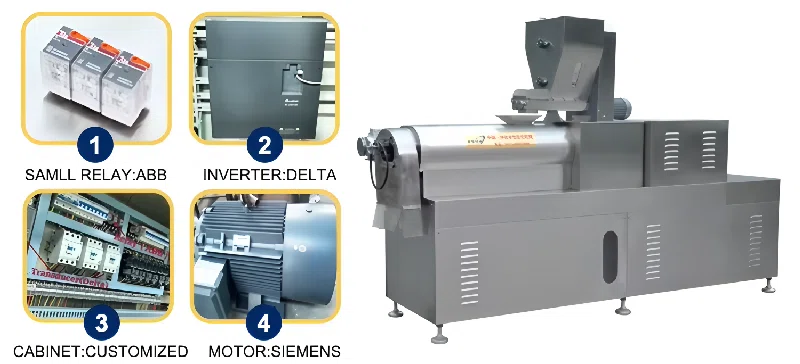
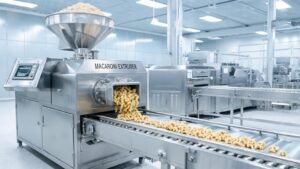
Hygienic configuration of a Twin-Screw Puffed Food Machine, featuring full SUS304 stainless steel shielding, a mobile barrel slide-rail system for COP access, an integrated IP65-rated control cabinet, and automated pneumatic product diversion valves at the die head.
In this specific manufacturing setup, engineers must manage a highly delicate balancing act: processing raw corn grits or rice flour under intense thermal energy to trigger instant vapor expansion (puffing) at the die face, while maintaining total machine and operator safety.
Applied CE Engineering Features
High-Torque Transmission Guarding: The primary drive motor transfers immense mechanical power through an advanced reduction gearbox. The entire drive train is isolated within a heavy-duty, reinforced stainless steel cabinet fitted with dual safety interlocks. If an operator attempts to access the drive assembly while the machine is active, the system shuts down instantaneously.
Barrel Thermal Shields: Because the processing barrel uses internal heating elements to reach optimal gelatinization temperatures, the entire length of the processing system is shielded behind double-walled, ventilated stainless steel guards. This ensures that while internal temperatures exceed 140°C, external surface temperatures remain completely safe for operators working nearby.
Applied HACCP and Sanitary Engineering Features
Dynamic Process Control: To maintain a highly uniform cell structure in the expanded snack while ensuring a complete biological kill step, the Snack Puffing Machine utilizes an advanced multi-zone temperature control loop. The system automatically regulates heat inputs across four independent barrel segments, guaranteeing that the raw formulation remains within optimal pasteurization parameters before it exits the forming die.
Elimination of Retention Pockets: The die holder and cutting knife assembly are designed with a smooth, streamlined interior geometry. Traditional bolt-on cutting blades are replaced with an integrated, quick-clamp cutting head that leaves zero exposed threads or crevices where starches could accumulate, ferment, or cultivate bacterial colonies.
Rapid Disassembly Slide-Rails: When transitioning production between different snack geometries or handling a scheduled sanitization shift, this modern Puffed Snack Machine relies on a robust mechanical slide-rail framework. Operators can disengage the heavy barrel locks and smoothly slide the main barrel housing backward along precision rails, exposing the twin interlocking extrusion screws for rapid, thorough cleaning and direct inspection.
Key CE Requirements Buyers Should Check Before Ordering
Before committing capital to an overseas equipment order, international buyers must proactively verify specific technical design configurations during the quotation and engineering review stages.
Machine Scope Integration
Buyers must explicitly define the exact boundary of the supplier’s safety responsibility. Is the vendor delivering a single standalone extruder, or a fully integrated production line? If the line includes a flour mixer, raw material screw conveyors, a twin-screw extruder, a high-speed shaping cutter, an automated multi-pass drying tunnel, a rotary seasoning drum, and an integrated cooling conveyor, the CE safety file, risk assessments, and Declaration of Conformity must cover the complete interconnected system, not just the individual extruder model.
Voltage Customization and Electrical Engineering Standards
Industrial power grid parameters vary significantly between regions (e.g., $460\text{V}$, $60\text{Hz}$ three-phase in North America vs. $400\text{V}$, $50\text{Hz}$ in the European Union).
Component Verification: The supplier must customize all internal electrical components—including primary drive motors, induction heating coils, internal contactors, VFDs, and circuit breakers—to match the exact voltage and frequency of the buyer’s destination facility.
Environmental Adaptation: The control cabinet design must be engineered to account for the environmental heat loads, ambient dust profiles, and intense humidity typical of food processing facilities, incorporating proper heat-dissipation sinks or closed-loop air conditioning units where necessary.
Mechanical Guarding and Toolless Access Points
Buyers should demand detailed mechanical layout drawings and high-resolution photos showing the design of all physical protective guards. Key areas requiring verification include the input hopper feeding throat, motor-gearbox drive shafts, cutter heads, dryer access doors, and seasoning drum support rollers.
Where operators must open panels frequently for sanitation or adjustments, the vendor must implement heavy-duty, interlocked safety switches that automatically drop the machine into a safe, zero-energy state upon access.
Comprehensive Multilingual Manuals and Warning Typography
A premium, compliant industrial line must be accompanied by a comprehensive, professionally translated user manual in the operator’s primary working language. This manual cannot be a generic one-page overview; it must detail exact procedures for installation, initial commissioning, daily startup, emergency shutdown, product changeover, chemical cleaning, preventative maintenance, and long-term troubleshooting. High-visibility, ISO-compliant warning labels must be permanently riveted near all high-voltage panels, rotating mechanical elements, and high-temperature thermal zones.
Pre-Shipment Factory Acceptance Testing (FAT)
The procurement contract should include a mandatory, formal Factory Acceptance Testing (FAT) clause. Before the machinery is packed into shipping containers, the vendor must assemble the complete line at their manufacturing plant and run live mechanical trials.
Buyers should request that these tests be performed using raw materials matching their actual production recipes. This allows direct verification of motor current draws, the stability of independent heating zones, the responsiveness of emergency stop networks, automated diverter valve actuation speeds, and final product metrics (such as puffing expansion rate, structural moisture, and cutting accuracy) before the equipment leaves the factory floor.
Key HACCP-Related Equipment Requirements Buyers Should Check
When evaluating a food extrusion system through the analytical perspective of a professional food safety auditor, buyers must inspect specific mechanical parameters that directly influence a plant’s hygiene integrity.
| Audit Area | Critical Specification | Verification Method |
|---|---|---|
| 1Contact Metallurgy | SUS304 / SUS316L Stainless Steel | Material Test Kit / XRF |
| 2Surface Polish | Ra ≤ 0.8 micrometers | Digital Profilometer |
| 3Welded Joints | Continuous TIG, ground flush | Visual Inspection / Dye |
| 4Sealing Gaskets | FDA-compliant Viton / EPDM / PTFE | Documentation Review |
| 5Lubrication Zones | NSF H1 Food-Grade Lubricants | Certificate Check |
Complete Verification of Product-Contact Metallurgy
Buyers should require the manufacturer to provide an explicit, component-by-component material mapping document. Every single piece of steel that touches raw ingredients or finished snack products must be verified as food-grade stainless steel.
The vendor must specify where SUS304 is utilized and where premium SUS316L is deployed. Furthermore, buyers must verify that internal structural frames, supporting legs, and non-contact panels are cleanly finished to prevent peeling paint or zinc-galvanized flaking from creating a physical contamination risk above open conveyor paths.
Realistic Cleaning Methodologies and Teardown Timelines
Buyers must clarify the exact, realistic cleaning protocols required for each section of the extrusion line. If a twin-screw extruder does not incorporate a full, automated CIP system, the supplier must demonstrate the exact COP (Clean-Out-of-Place) procedure.
Teardown Assessment: How many bolts must be removed to pull the die head?
Mechanical Aids: Does the line include built-in crane arms or sliding tracks to support heavy die plates and screw segments during disassembly?
Operational Downtime: What is the total estimated time required for two operators to execute a complete allergen-safe teardown and washdown cycle?
Understanding these metrics prevents unexpected production bottlenecks.
Structural Elimination of Stagnation Pockets
A meticulous review of the machinery’s interior layout must confirm the complete absence of physical dead zones. Product chutes, internal hopper corners, drying tunnel floor plates, and seasoning liquid injection nozzles must be free of sharp 90-degree bends or overlapping sheet metal joints. If starches or proteins pool in un-scoured corners, they quickly ferment, cultivate mold spores, generate off-odors, and contaminate pristine product streams running through the line.
High-Fidelity Process Monitoring and Calibration Routines
Because specific extrusion parameters (e.g., barrel zone temperatures, water injection rates, and drying tunnel air velocities) are critical for ensuring biological food safety and shelf stability, the machine’s automation platform must be robust and reliable.
The buyer must verify that the control system supports clear digital parameter displays, automated out-of-tolerance alarm logging, and secure data-export features. Furthermore, the supplier must provide an explicit calibration schedule detailing exactly how and when the facility’s QA team must verify the accuracy of internal sensors using traceable master instruments.
Comparative Compliance Matrix for Procurement Teams
When evaluating potential manufacturing equipment vendors or assessing an incoming RFQ, procurement managers can use this technical matrix to quickly audit whether a machine satisfies basic industrial safety and hygiene metrics.
| Engineering Focus Area | Non-Compliant / Low-Cost Standard | Industrial CE Compliance Standard | High-Level HACCP Compliance Standard |
|---|---|---|---|
| Primary Structural Metallurgy | Painted Carbon Steel or Low-Grade 200-series Stainless | Standard Stainless Steel (no specific surface roughness verification) | Premium SUS304 or SUS316L Stainless Steel with verified $R_a \le 0.8\ \mu\text{m}$ |
| Welding and Joining Execution | Spot Welds, Lap Joints, Smooth Caulking / Sealants | Continuous Structural Welds (unpolished interior profiles) | Continuous TIG Welds, ground smooth and flush, minimum 3mm internal radii |
| Drive Shaft and Bearing Isolation | Internal Seals only; direct path from gearbox to food chamber | Mechanical lip seals with external structural guards | Atmospheric isolation air gap with slinger ring; mandatory NSF H1 food-grade lubricants |
| Electrical Cabinet Construction | Painted Sheet Metal, IP54 ventilation fans | IP65 or IP69K Stainless Steel Enclosure, EMC-shielded VFD cabling | IP69K Watertight Enclosure, sloped top design to prevent water pooling during washdowns |
| Machine Guarding Architecture | Bolt-on fixed grates requiring hand tools to remove | Toolless access panels featuring dual-channel non-contact safety interlocks | Interlocked guards with sanitary, open-frame standoffs to prevent moisture trapping |
| Process Control and Data Integrity | Manual analog gauges, no centralized data collection | Digital PLC controller with basic HMI touchscreens | PLC Architecture with automated CCP tracking, secure encrypted data logging |
Technical Project Checklist: From RFQ to Audit Pass
To ensure your next equipment acquisition satisfies field inspectors and matches global safety benchmarks, execute this technical engineering workflow during the procurement cycle.
Define Engineering Requirements Before Quotation
- Mandate SUS304/316L metallurgy.
- Define Ra ≤ 0.8 micrometer surface roughness requirements.
Verify Safety and Control Architecture Before Production
- Map PLC automation paths for CCP tracking and secure data logging.
- Verify dual-channel interlock placements and pressure relief dynamics.
Confirm Machine Performance Before Shipment
- Conduct surface roughness verification via digital profilometers.
- Test all emergency stops, boundary interlocks, and diverter valve speeds.
Archive Compliance Evidence for Audit Readiness
- Execute full ATP swab validation after clean-in-place (CIP) test cycles.
- Archive formal CE Declaration of Conformity and sensor calibration documents.
Supplier Evaluation: Partnering with a Reliable Manufacturer
A reliable food extrusion equipment manufacturer must act as an experienced technical engineering partner rather than a passive machinery vendor. If an equipment supplier immediately quotes a flat price without requesting exhaustive details regarding your raw material specifications, moisture profiles, factory floor dimensions, regional grid voltages, target cleanability parameters, and regional audit pressures, they are offering a generic, unoptimized solution.
Different extrusion applications—whether producing crisp puffed corn puffs, multi-grain breakfast cereals, high-moisture textured vegetable proteins (TVP), specialized aquatic pet feeds, or precision-formed pasta shapes—demand entirely unique mechanical configurations. A highly qualified manufacturer should be fully prepared to provide explicit, data-driven explanations regarding:
The exact internal screw configuration (shear vs. transport flight ratios) optimized for your raw ingredient starch or protein profile.
The math used to calculate integrated line drying capacities and transit times to ensure stable, continuous product equilibrium.
The exact, documented metallurgy grades used for every individual bolt, sleeve, and shaft that interacts with food.
Clear engineering schematics showing exactly how lubricants are mechanically isolated from the processing chamber.
The precise sensor tolerances, safety interlock categories, and data logging capabilities embedded into the central control console.
By insisting on this high level of technical transparency during initial vendor screenings, international buyers can confidently filter out low-tier suppliers and secure a high-performing production asset that seamlessly supports long-term food safety, employee protection, and trouble-free international facility audits.
Common Mistakes When Buying Food Extruder Machines for Compliance
Mistake 1: Treating HACCP as a Machine Certificate
A standalone piece of machinery cannot possess an official “HACCP Certificate.” HACCP is an operational, facility-wide protocol. While a vendor can sell you machinery engineered with exceptional hygienic design features (such as polished SUS304 steel, zero dead zones, and CIP readiness), the equipment only serves as a tool. Your factory’s operational team must still author, validate, and execute the complete, facility-wide HACCP plan covering environmental sanitation, worker tracking, and raw ingredient handling.
Mistake 2: Restricting Inspection Solely to the Extruder Core
Many procurement teams focus exclusively on the primary extruder barrel and screw assembly, completely ignoring auxiliary upstream and downstream hardware. In continuous industrial processing, physical or microbiological contamination is just as likely to occur inside an un-polished raw flour mixer, along an open vertical bucket elevator, within the deep un-cleared floor of a multi-pass conveyor dryer, or inside an un-sealed seasoning drum frame. The entire integrated line must be audited with equal scrutiny.
Mistake 3: Underestimating Automated Sanitation Timelines
An industrial extrusion line that requires extensive, complex hand tools and hours of manual physical labor to tear down for basic sanitization will cripple your facility’s operational efficiency. Excessive cleaning complexity leads to extended operational downtime, inflated labor costs, and an elevated risk that cleaning personnel will skip critical internal surfaces, causing catastrophic bacterial cultivation. Buyers should always mandate quick-clamp mechanisms, sliding support rails, and clear COP/CIP documentation before final project sign-off.
Mistake 4: Sourcing Low-Cost, Generic Electrical Systems
Attempting to reduce initial equipment acquisition costs by selecting non-branded, generic electrical components or basic analog control panels is a costly long-term mistake. Low-grade VFDs and unshielded lines lead to frequent electrical faults, component burnout under heavy start loads, and erratic barrel heating. In extrusion cooking, unstable temperature regulation directly compromises your kill-step validation metrics, leading to batches of unpasteurized product that must be entirely rejected by quality control teams.
Mistake 5: Omitting Material-Specific Pre-Shipment Product Trials
Accepting an overseas machinery shipment based purely on a dry mechanical run (turning the motors on with an empty barrel) introduces substantial operational risk. Food formulations behave with extreme complexity under high temperature, intense mechanical shear, and variable moisture inputs. Omitting a live material trial can result in a machine arriving at your facility that mechanically operates, yet fails to properly expand your recipe, binds up at the die head, or dries the finished snack unevenly. Always insist on a formal material trial during Factory Acceptance Testing.
Comprehensive Regulatory FAQ Area
-
1. Is CE certification a legal requirement for food processing equipment operated outside of Europe?
A: While CE marking is a strict legal mandate for any machinery sold or operated within the European Economic Area (EEA), it is not a direct legal requirement in non-EU countries like the United States (which relies on OSHA regulations and UL/NFPA standards). However, because CE standards are so comprehensive regarding mechanical interlocks, electrical grounding, and pressure containment, many global corporate buyers mandate a CE certified food machine in their procurement specifications as proof of superior mechanical safety and risk mitigation.
-
2. Can an extrusion machine receive an official "HACCP Certification" stamp?
A: No. A machine itself cannot be "HACCP Certified," because HACCP is an operational management system applied to an entire production facility, including its raw materials, operational staff, environment, and cleaning processes. Instead, a manufacturer purchases machinery built with hygienic design characteristics (such as $R_a \le 0.8\ \mu\text{m}$ stainless steel surfaces, an absence of dead zones, and CIP capabilities) that allow the equipment to successfully pass a facility-wide HACCP audit.
-
3. What happens to a production line if an extruder falls below its critical limit temperature for even a few seconds?
A: In a fully automated, compliant production facility, a temperature drop below the critical limit triggers an immediate, automated safety response. The system's PLC flags a CCP violation, triggers a visual and audible alarm tower, and activates a pneumatic diverter valve at the discharge of the extruder. This instantly isolates any under-processed material from reaching the downstream drying or packaging stages, ensuring zero contaminated product ever enters the consumer supply chain.
-
4. Why are standard lubricants forbidden in food extruders if the bearings are sealed?
A: Even the most advanced mechanical seals experience degradation and wear over thousands of operational hours under high pressure and temperature. If a seal fails on a machine using standard petroleum-based industrial lubricants, the oil can silently migrate directly into the food matrix, causing severe chemical contamination. Utilizing NSF H1 certified food-grade lubricants ensures that if micro-leakage occurs before a seal can be replaced during scheduled maintenance, the contamination risk remains controlled.
-
5. How do automated CIP systems handle complex extrusion components like the main processing screws?
A: For everyday production cleaning, specialized CIP programs route targeted chemical flushes, high-pressure sanitizing rinses, and hot water cycles directly through the internal barrel paths while the screws rotate at low speeds. This action generates localized hydraulic scrubbing forces that strip away cooked starches and organic residues. However, for a deep sanitization shift or product changeovers involving allergens, operators will use the machine's mechanical slide-rails to split the barrel open, exposing the screws for complete validation swabs.
-
6. What features should the automated control system (PLC) include to support facility record-keeping?
A: To satisfy advanced facility audits, the PLC should incorporate user access control logs, automated time-stamped recording of critical process parameters (temperatures, pressures, feed rates), and an immutable data logging architecture. The system should allow quality control personnel to seamlessly export unmodifiable production data files (such as CSV or secure PDF logs) to provide third-party inspectors with an absolute audit trail validating that all product lots successfully maintained required critical limits.
-
7. Are 304 and 316 stainless steel both suitable for food extrusion equipment?
A: Yes, both are excellent austenitic alloys, but their deployment must match the specific operational environment. SUS304 is highly durable, easy to clean, and perfectly suited for the vast majority of standard grain-based flour mixing, extrusion, and conveying zones. However, for processing formulations containing highly corrosive ingredients, elevated sodium profiles, or strong acidic additives, SUS316L should be specified for direct food-contact components due to its superior molybdenum content and enhanced resistance to localized pitting.
-
8. Does extrusion cooking automatically eliminate all biological safety hazards?
A: Not automatically. Simply passing material through an extruder does not constitute a verified "Kill Step." Pasteurization of the food matrix is a precise thermodynamic equation requiring a specific core temperature maintained for a verified duration under specific moisture pressures. The facility's internal HACCP team must scientifically validate that the machinery's automated temperature settings and material residence times are mathematically sufficient to consistently neutralize targeted biological hazards for their specific product recipe.
-
9. What mechanical configurations help minimize cross-contamination during flavor changes?
A: The production line should incorporate quick-release seasoning drum panels, completely open-frame conveyor beds that prevent product fines from building up inside enclosed sheet metal channels, and toolless spray nozzle removals. For factories running different recipes featuring known food allergens (e.g., soy, wheat, dairy), the seasoning and liquid application systems must be highly accessible, enabling operators to easily verify complete cleanliness via automated swabbing routines before starting a new production run.
-
10. How should an international buyer verify machinery compliance during a remote factory audit?
A: If a physical facility visit is impossible before shipment, buyers should mandate a detailed, live video-conferencing Factory Acceptance Test (FAT). The buyer's engineering team should direct the remote technician to physically demonstrate the functionality of every emergency stop button, open access panels to verify interlock responses, inspect internal weld finishes via high-resolution digital cameras, use a digital profilometer to verify surface roughness ($R_a$) parameters, and review live electrical schematics to confirm proper component grounding and terminal labeling.