Introduction
Modern food manufacturing enterprises operate under rigorous cost pressures, strict food safety regulations, and shifting consumer preferences. To maintain profitability, snack food processing facilities must optimize raw material usage, minimize unplanned downtime, and maintain high consistency across consecutive production shifts.
For high-throughput operations utilizing equipment such as an advanced Puffed Food Machine, the mechanical build of the hardware is only one part of the efficiency equation. The operational life, energy profile, and waste metrics of the machinery depend heavily on its underlying electrical control architecture.
As an experienced food extrusion line manufacturer, Zhuoheng Machinery does not treat PLC and VFD control as optional, third-party accessories added after the fact. We design the mechanical structure, motor configuration, sensor layout, custom electrical control cabinet, and HMI recipe logic together from the very beginning of the project. This unified engineering approach ensures that your machinery functions as a synchronized, high-performance system rather than a collection of mismatched components.
Transitioning from manual or legacy hardware to a custom-engineered automated food production line managed by Programmable Logic Controllers (PLCs) and Variable Frequency Drives (VFDs) is a standard industrial approach to stabilizing product quality and lowering total cost of ownership (TCO). Whether you run a complete puffed snack production line, a pet food production line, or a specialized line for fish feed and modified starch, understanding this integration is key to factory modernization.
Hidden Cost Drivers in Legacy Fixed-Speed Lines
Operating a processing line with traditional direct-on-line (DOL) starters or fixed-speed motor configurations introduces several operational variables that increase overhead and maintenance costs.
1. Electrical Inrush and Thermal Stress
Standard alternating current (AC) induction motors started directly across the line experience high inrush currents, often reaching six to eight times the nominal full-load current rating. This transient current surge generates severe thermal stress within the motor stator windings. If a production process requires frequent starting and stopping—such as a feeding conveyor or a batch mixer—this recurring thermal loading degrades winding insulation, causing premature motor burnout and unplanned line stoppages.
2. High Transient Torque and Mechanical Shock
When a fixed-speed motor is energized, it delivers maximum torque almost instantly. This sudden rotational force applies high shock loads to the entire mechanical drivetrain:
Bearing Degradation: Sudden acceleration forces rotating elements to slide before rolling, creating micro-pitting on races.
Gearbox and Coupling Shear: Rapid torque spikes strain gear teeth and flexible coupling inserts, accelerating mechanical wheel backlash.
Shaft Misalignment: Continuous structural vibrations can loosen motor mounting bolts over time, causing parallel or angular misalignment that requires regular maintenance intervention.
3. Material Handling Degradation and Product Breakage
Fragile snack profiles, such as puffed rings, tortilla chips, or brittle pellets, are highly sensitive to sudden changes in transport velocity. Fixed-speed conveyor belts cannot adjust their speed to match changing throughput rates from upstream equipment. When a bottleneck occurs, fixed belts continue feeding material at a constant rate, causing product accumulation, overlapping, or physical crushing at transfer chutes and packaging entries.
Where PLC and VFD Control Matters Most (Process Mapping)
Implementing automation requires a clear understanding of which process parameters need monitoring and which motors require variable speed control. This level of control is what separates basic machinery from a high-efficiency, turnkey food production line.
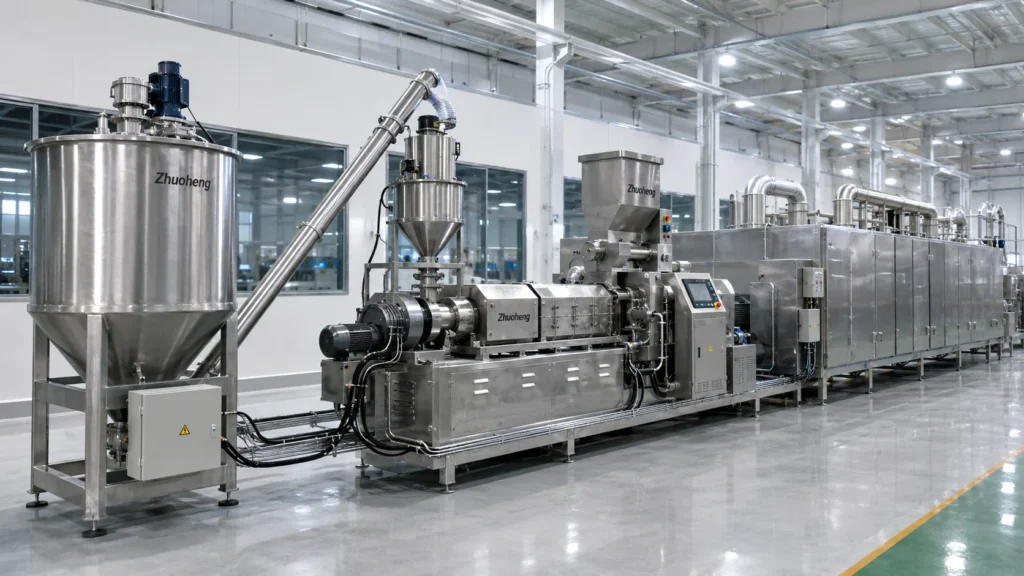
The table below outlines how these two systems distribute functions across a standard snack processing line to improve overall equipment effectiveness (OEE).
| Line Section | PLC-Controlled Parameters | VFD-Controlled Motors | Direct Business Benefit |
|---|---|---|---|
| Raw Material Mixer | Mixing time sequences, liquid injection volume, water-to-dry ratio. | Main drive mixer motor, liquid dosing pump. | Consistent dough hydration; elimination of dry pockets. |
| Extrusion Unit | Barrel zone temperatures, head pressure, melt temperature profile. | Main screw drive motor, feeder screw, rotary cutter. | Uniform product expansion, stable bulk density, precise piece length. |
| Continuous Dryer | Zone temperatures, exhaust air humidity levels, residence time. | Circulation fan motors, exhaust blowers, main mesh belt. | Even moisture removal, lower fuel gas consumption, elimination of case hardening. |
| Continuous Fryer | Oil temperature control, sediment removal cycles, continuous oil replenishment. | Main transport belt, submersion belt, oil circulation pump. | Controlled oil pickup percentage, consistent color, uniform crunch profile. |
| Seasoning Drum | Slurry spray rate, dry powder application rate, coating time cycles. | Drum rotation motor, liquid flavor pump, powder auger feeder. | Even seasoning coverage without over-flavoring or under-flavoring. |
| Cooling & Transfer | Ambient air cooling time, multi-tier belt sequencing. | High-volume cooling fans, transfer conveyor motors. | Controlled cooling to safe packaging temperatures; reduction in product breakage. |
The Technical Role of PLCs in Recipe and Process Control
The Programmable Logic Controller (PLC) serves as the central control unit for the machinery line. It reads data from field devices—such as thermocouples, pressure transducers, proximity sensors, and load cells—and executes a structured control program to maintain real-time process stability.

1. Digital Recipe Management and Automation
In snack processing, minor variations in process inputs can alter the texture, density, and flavor profile of the final product. A centralized PLC extruder control system eliminates human error by storing all processing parameters within digital memory blocks as structured recipes.
When an operator selects a specific product code on the Human-Machine Interface (HMI), the PLC automatically distributes parameters to various modules. It sets the precise PID loops for barrel heating zones, configures the water injection rates, and sets the base speeds for the processing motors. This automation allows plants to switch production runs without manually adjusting individual machine controls.
2. Precise HMI Parameter Monitoring
The HMI panel provides real-time visualization of the system’s status. A well-designed control interface for a Snack Puffing Machine displays real-time operational data, allowing operators to oversee the process from a single station.
A standard HMI screen developed by our automation team provides real-time access to several critical parameters:
A standard HMI screen developed by our automation team provides real-time access to several critical parameters:
Screw & Feeder Frequencies: Real-time feedback on motor RPM and electrical current draw to optimize how to control snack machine speed.
Multi-Zone Temperature Configuration: Setpoint versus actual values for independent induction or band heaters along the processing barrel.
Die Head Pressure Metrics: Continuous pressure readings to protect the extrusion die from clogging or over-pressurization.
Alarm Logs and Diagnostics: Active notifications indicating exact fault locations, such as sensor wire breaks or motor overcurrent faults.
3. Batch Traceability and Food Safety Compliance
To comply with international standards such as HACCP, the FDA’s Food Safety Modernization Act (FSMA), or BRCGS guidelines, manufacturers must maintain records of processing conditions.
PLCs support compliance by continuously exporting critical control points (CCPs) to local data loggers or centralized Enterprise Resource Planning (ERP) databases via OPC UA or industrial Ethernet protocols. If a raw material variance occurs, the plant can check data logs to identify the exact processing parameters, batch timestamps, and temperature curves associated with that specific production run.
The Engineering Value of VFDs: Energy Savings and Mechanical Soft Starts
While the PLC manages process logic, the Variable Frequency Drive (VFD) regulates electrical power to the motors to control speed and torque.
1. Fluid Dynamic Energy Efficiency (The Affinity Laws)
In snack production lines, centrifugal loads like drying oven circulation fans, exhaust blowers, and oil filtration pumps regularly run below maximum capacity. VFDs leverage the Affinity Laws of fluid dynamics, which state that the power consumption of a centrifugal fan or pump is proportional to the cube of its rotational speed:
P₁ / P₂ = (N₁ / N₂)³
Because of this cubic relationship, a minor reduction in motor speed can yield significant power savings:
Reducing a fan’s motor speed by 10% reduces required power by approximately 27%.
Reducing a fan’s motor speed by 20% reduces required power by approximately 49%.
By using VFDs instead of mechanical dampers or valves to regulate airflow or liquid flow, processing facilities can reduce energy consumption on auxiliary fan and pump systems by 20% to 30%, depending on the baseline operating hours and motor sizing.
2. Controlled S-Curve Soft Starts
VFDs replace high-current, direct-on-line starting sequences with controlled acceleration ramps, often configured as a smooth S-curve.

By gradually ramping voltage and frequency from 0 Hz up to nominal operating levels (e.g., 50 Hz or 60 Hz), the VFD controls how the motor delivers torque to the drivetrain. This smooth power delivery significantly reduces mechanical shock loads on gearboxes, minimizes belt stretch on conveyors, and reduces structural stress on motor shafts and bearings.
Closed-Loop Integration: How PLC and VFD Systems Work Together
The highest gains in efficiency occur when the PLC and VFD operate in a synchronized, closed-loop network. Rather than running as isolated components, the VFDs communicate their operational data back to the PLC, which can then dynamically calculate speed balances across the entire line.
For example, in a complete puffed snack production line, the largest energy-consuming sections are usually the multi-zone drying system, frying oil circulation system, high-volume cooling fans, and long-distance conveyors. When these motors run at a fixed speed, operators can only control airflow or material movement through manual dampers, mechanical valves, or manual timing adjustments.
In a customized setup engineered from the ground up, VFDs are integrated directly into these high-load motor systems, while the central PLC collects real-time feedback from temperature sensors, belt scales, and product flow sensors.
If the product flow sensor registers a reduction in material throughput from the Puffed Snack Machine extruder, the PLC automatically calculates the required adjustment. It doesn’t just alter one machine; it instantly commands the VFD on the dryer belt to modulate its transit speed to maintain exact residence times. Simultaneously, it adjusts the drying fan blowers to prevent over-drying, and scales down the seasoning drum’s rotation velocity along with the liquid oil spray rate.
This closed-loop interaction protects your final product quality from human error and raw material variations, converting independent machines into a highly responsive, single-entity production ecosystem.
How We Customize PLC and VFD Control for Your Food Processing Line
We recognize that no two food factories share identical requirements. Raw materials differ in viscosity, factory climates vary, and electrical grids carry unique local parameters. Therefore, our engineering team follows a structured, seven-step workflow to customize the automated electrical system for every custom food processing line we deliver:
1. Product and Raw Material Analysis
We analyze your formulation’s behavior—such as the moisture absorption of corn grits, rice flour, or potato starch. This data determines the required torque profile of the mixing and extrusion motors, ensuring the system provides sufficient low-end torque without stalling.
2. Capacity and Process Flow Design
Whether you require an entry-level output of 100–150 kg/h or a heavy industrial scale of 800–1000 kg/h, we layout the line’s process flow. We match the physical machine dimensions with the target throughput to calculate the exact speed synchronization constraints required between processing modules.
3. Motor and VFD Sizing
We compute the necessary mechanical kilowatt (kW) ratings for every drive motor on the line. We then pair each motor with a correctly sized VFD that accounts for continuous duty cycles, ambient factory operating temperatures, and peak overload requirements.
4. Sensor and Control Point Layout
We map out all critical control points along the line. This includes positioning PT100 thermocouples in the extrusion heating jackets, placing precise pressure transducers before the die face, and installing photo-electric proximity switches at conveyor junctions to monitor for product blockages.
5. PLC Program and HMI Recipe Design
Our software engineers develop custom control logic using standardized languages (such as Ladder Logic or Structured Text). We program the HMI screen layout, establish secure recipe storage blocks, and can integrate a multi-language HMI system (e.g., English, Spanish, Arabic, French, Russian) to ensure your local operators can manage the line easily.
6. Electrical Control Cabinet Customization and Testing
We assemble all electrical control enclosures within our own specialized panel shop. We integrate high-quality components according to your preference—whether that involves standard Delta configurations or upgraded Siemens and Rockwell Automation hardware. Every completed enclosure undergoes full insulation, grounding, and simulated I/O loop testing before it is paired with the mechanical hardware.
7. Installation, Commissioning, and Operator Training
We support every machinery deployment with comprehensive overseas service support. Our service engineers travel directly to your production site to manage physical machine installation, complete terminal wiring, fine-tune PLC PID parameters under full load conditions, and deliver technical operator training to your manufacturing and maintenance personnel.
What to Consider Before Upgrading Control Cabinets
Integrating advanced PLC and VFD control architectures involves more than just mounting components inside an electrical cabinet. To ensure long-term reliability on the production floor, plant engineers must account for several industrial environmental factors.
Harmonic Distortion Mitigation: VFDs use non-linear, pulse-width modulation (PWM) switching networks that can introduce electrical harmonics back into the facility’s power grid. To prevent voltage distortion from affecting sensitive sensors, control systems should include line reactors or passive harmonic filters on the incoming power supply.
Cable Shielding and Grounding: The high-frequency switching inside a VFD can generate electromagnetic interference (EMI). Industrial installations require symmetrical, shielded VFD-rated power cables and proper grounding rings to protect motor bearings from stray shaft currents.
Ingress Protection (IP Ratings) for Washdown Environments: Food processing facilities require regular cleaning, often involving high-pressure water and chemical sanitation. Electrical control enclosures must carry appropriate ratings, such as IP65 or NEMA 4X stainless steel, and include integrated cooling systems or heat exchangers to handle internal thermal loads without introducing humid ambient air.
Industrial Scenario Selection Matrix
Selecting the right automation configuration depends on your plant’s operational goals, budget range, and infrastructure age. The matrix below categorizes standard automation configurations for different processing requirements.
| Buyer Category / Scenario | Main Technical Concern | Recommended Automation Focus | Equipment Configuration Example |
|---|---|---|---|
| New Greenfield Snack Factory | Simple operation, high long-term scalability, data integration. | Full PLC system with centralized HMI and networked VFD drives. | Siemens S7-1500 PLC + SEW-Eurodrive VFDs via PROFINET. |
| Existing Mechanical Factory Upgrade | Reducing high utility bills and lowering mechanical failure rates. | VFD retrofits on high-load fans, thermal oil pumps, and heavy drives. | Schneider Altivar VFDs integrated into existing relay control networks. |
| Multi-Product Processing Brand | High product diversity, frequent recipe changes, high product changeover waste. | Multi-recipe PLC management system with quick-change mechanical tooling. | Allen-Bradley CompactLogix PLC + Rockwell PowerFlex VFDs. |
| High-Volume Export Operations | Strict tracking compliance, international export auditing. | PLC data logging coupled with an active MES/ERP software bridge. | Omron Sysmac Platform + integrated SQL database connector modules. |
Questions to Ask Before Ordering a Production Line
Before finalizing machinery specifications with a food extrusion line manufacturer, your procurement and engineering teams should review this technical checklist to prevent deployment bottlenecks:
What are the local plant utility specifications? Verify exact input parameters (e.g., 3-phase 380V/50Hz, 415V/50Hz, 440V/60Hz, or 480V/60Hz) to ensure all internal VFD components and transformer sub-assemblies are properly rated for your regional power grid.
Which industrial communication protocol matches your existing plant infrastructure? Ensure the new equipment’s PLC natively supports your plant’s communication standard, whether it is Modbus TCP, EtherNet/IP, or PROFINET.
What are the specific sanitation and washdown protocols? Clarify whether the control cabinets will be placed directly in high-pressure washdown zones or isolated in a separate electrical room.
Is remote diagnostic support required? Verify if the PLC system should include an industrial VPN router (such as an Ewon module) to allow the machinery manufacturer to perform remote troubleshooting and software updates.
Typical Industrial Retrofit Experience
When evaluating the transition to an automated food production line, quantifying the return on investment (ROI) helps prioritize capital allocation. While precise efficiency gains depend on baseline machinery age, motor sizes, and annual operating hours, typical results from industry retrofits follow clear patterns.
In a standard modernization scenario where fixed-speed fans, pumps, and conveyor drives are replaced with synchronized PLC and VFD architectures on a snack line, facilities generally see a predictable reduction in energy usage. Throttling large auxiliary fan motors electronically rather than mechanically typically lowers power demand for those specific drives by 20% to 30%.
Furthermore, replacing traditional direct-on-line starters with S-curve VFD soft-starts minimizes sudden drive torque spikes. Over long-term monitoring windows, this mechanical protection typically reduces common maintenance issues—such as worn bearings, coupling failures, and gearbox leaks—extending component life and decreasing unplanned mechanical downtime. Similarly, stabilizing product transport speed across conveyor junctions reduces product drop forces, helping lower material scrap and line breakage rates compared to uncoordinated, fixed-speed alternatives.
Technical Equipment Solutions: Zhuoheng Machinery
Engineering reliable processing lines requires balancing robust mechanical components with precise electrical controls. At Zhuoheng Machinery, we design and build complete processing solutions tailored to the production requirements of modern food manufacturing enterprises.
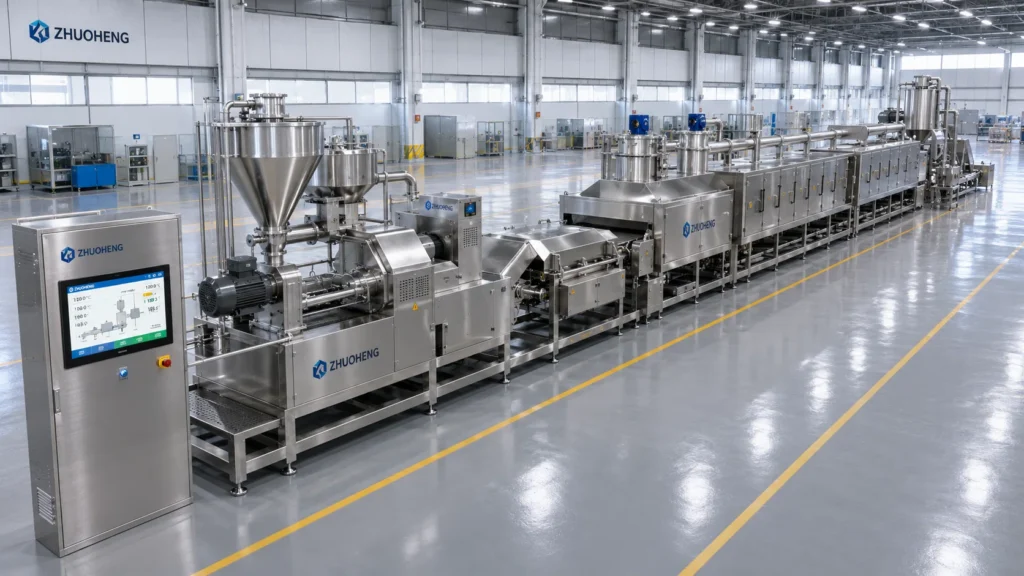
We integrate industrial automation systems directly into our machinery frameworks. From high-output twin-screw extrusion systems to complete, turnkey Puffed Snack Machine lines, our engineering team designs equipment to handle demanding production schedules.
The Zhuoheng Engineering Standard
Global Component Standardization: We wire our control panels using reliable, internationally supported electrical components from brands such as Siemens, Schneider Electric, and Delta. This ensures your local technical teams have easy access to spare parts and documentation.
Industrial-Grade Ingress Protection: Our machine-mounted sensors, junction boxes, and control enclosures are engineered to withstand rigorous food plant cleaning cycles, protecting sensitive electronics from moisture and dust.
Custom Software Programming: Every line is delivered with custom PLC logic tailored to your specific product parameters. The intuitive HMI layout simplifies recipe management, alarm tracking, and real-time process tuning.
Comprehensive Project Execution: Zhuoheng Machinery manages the complete equipment lifecycle—from initial factory space mapping and mechanical engineering to on-site mechanical installation, electrical commissioning, and technical training for your operators.
Comprehensive FAQ Section
-
Can an existing manual or semi-automated snack production line be retrofitted with modern PLCs and VFDs, or is a completely new machinery purchase required?
A completely new machinery purchase is not required. If your existing stainless steel mechanical structures—such as extruder barrels, drying conveyor frames, frying vats, and seasoning drums—are physically sound, the mechanical line can be retrofitted with modern automation controls.
The retrofitting process involves removing legacy manual switch boxes, push-buttons, and direct-on-line motor starters, and installing a centralized electrical control enclosure housing the PLC, VFDs, circuit breakers, and network switches. Existing motors are rewired to the VFD outputs, and field sensors are added along the line to provide real-time process feedback to the PLC.
This type of automation retrofit allows processing facilities to improve efficiency, reduce energy use, and implement digital recipe management at a significantly lower capital cost than purchasing entirely new mechanical hardware.
-
Which stages of a snack processing and extrusion line benefit most from VFD speed modulation?
While variable speed control improves overall process flexibility, specific stages yield the highest returns:
Extruder Screw and Feeder Drives: Inside a PLC extruder control system, precise speed matching between the material feeder screw and the main extrusion screw is critical. VFDs ensure consistent material delivery into the barrel, stabilizing head pressure. Additionally, using a VFD on the rotary cutting face allows operators to adjust cutter RPM precisely to maintain uniform product length.
Oven Circulation Fans and Oil Frying Pumps: Centrifugal fan blowers and oil circulation pumps operate against fluid friction. Regulating these large motors via VFDs based on actual process demand, rather than running them at full speed against mechanical dampers, significantly reduces energy consumption.
Transfer Conveyors: Conveyors moving delicate snacks into drying, seasoning, or packaging systems require smooth velocity matching. VFDs allow these belts to adjust their speed dynamically, reducing product pile-ups and breakage at transfer points.
-
How do automated PLC architectures assist food manufacturers in maintaining compliance with safety standards such as HACCP, FDA, or BRCGS?
Maintaining food safety compliance requires accurate, verifiable process data. Manual record-keeping on paper logs is prone to human error, missing entries, and loss.
An automated PLC system addresses this by continuously logging critical control points (CCPs)—such as barrel melt temperatures, pasteurization values, frying oil temperatures, and metal detector verification cycles—directly to a secure digital database with accurate timestamps.
When an internal quality team or external regulatory inspector audits the facility, unalterable digital reports can be exported quickly. This automated tracking simplifies compliance verification, improves data integrity, and helps protect the manufacturing brand during quality reviews.
-
How do PLC systems manage product changeovers for facilities producing multiple snack shapes and flavors on a single line?
For facilities producing a varied product catalog, manual line changeovers often introduce considerable downtime and material waste. Operators typically have to manually adjust temperature controllers, mechanical speed dials, and cutter timings through trial and error until the product dimensions stabilize.
With a modern Snack Puffing Machine control design, all product variables are saved within the PLC as independent digital recipe profiles. During a product changeover, the operator selects the new product profile on the HMI touchscreen.
The PLC then automatically updates the PID parameters for all barrel heating zones, shifts the target frequencies for the feeder and cutter VFDs, and syncs downstream conveyor speeds. This automated configuration reduces changeover times from hours to minutes, reduces startup material waste, and allows the plant to manage short production runs efficiently.
Optimize Your Production Infrastructure Today
Don’t let legacy control systems limit your factory’s true output capacity, waste expensive electricity, and cut into your profit margins. Get in touch with the industrial engineering team at Zhuoheng Machinery today to request a comprehensive technical consultation. Let us design a high-performance, automated processing solution tailored specifically to your business goals.