So, you’re thinking about investing in a fully automatic pasta production line. Maybe you’ve been watching the market, seeing the demand for high-quality pasta surge, and you’re ready to move from manual or semi-automated processes to a fully integrated solution. Or perhaps you’re starting from the ground up. Either way, the prospect can feel a bit like stepping into a control room for the first time—a lot of knobs, dials, and unfamiliar processes.
But here’s the good news: understanding the workflow of an automatic pasta plant is far less complex than it seems. It’s a beautifully orchestrated dance of engineering and food science. This guide is designed to walk you through every phase, from the initial planning stages to the moment perfectly dried pasta emerges, ready for packaging.
We’ll go beyond the simple “flour in, pasta out” narrative. We’ll answer the real questions you have: How many people do I actually need to run this line? What’s the industrial pasta manufacturing line setup steps? What kind of maintenance is required? Consider this your complete roadmap.
Assessing Your Production Needs: The Blueprint for Your Pasta Manufacturing Line
Before a single grain of flour hits the mixer, you need to ask some critical questions. A successful industrial pasta manufacturing line setup is built on a foundation of careful planning. This isn’t about buying a machine; it’s about engineering a solution for your specific production goals.
Defining Output Volume and Pasta Varieties
The first step is to define your target capacity. Are you planning for 100 kg/hour or 1000 kg/hour? This answer dictates the size and configuration of nearly every component in your line, from the mixer to the dryer. A smaller setup might use a batch mixer, while a high-capacity line will require a continuous mixing system.
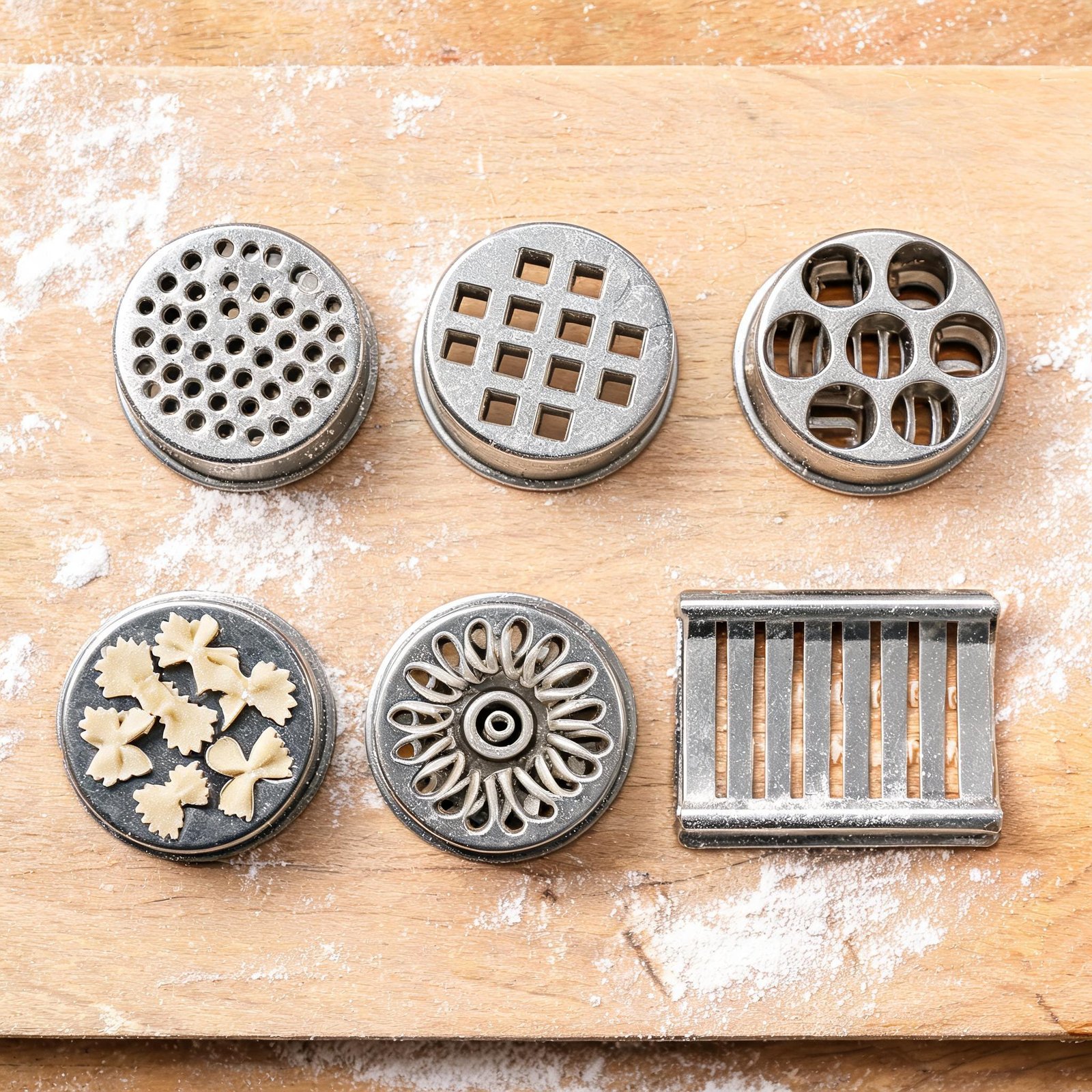
Simultaneously, consider your product portfolio. Will you be producing long-cut pasta like spaghetti and linguine? Or short-cut shapes like penne, fusilli, and macaroni? Each shape requires a specific extrusion die, and the machine itself needs to be designed for the specific dough rheology. A versatile system might include interchangeable cutter assemblies for different shapes.
Key takeaway: A clear vision of your product mix and daily output is the single most important factor in selecting the right automatic pasta plant components. Trying to retrofit a line later is far more expensive than getting it right the first time.
The Core Workflow: A Step-by-Step Breakdown of the Pasta Production Line Process
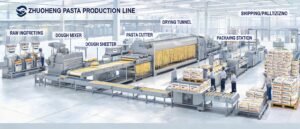
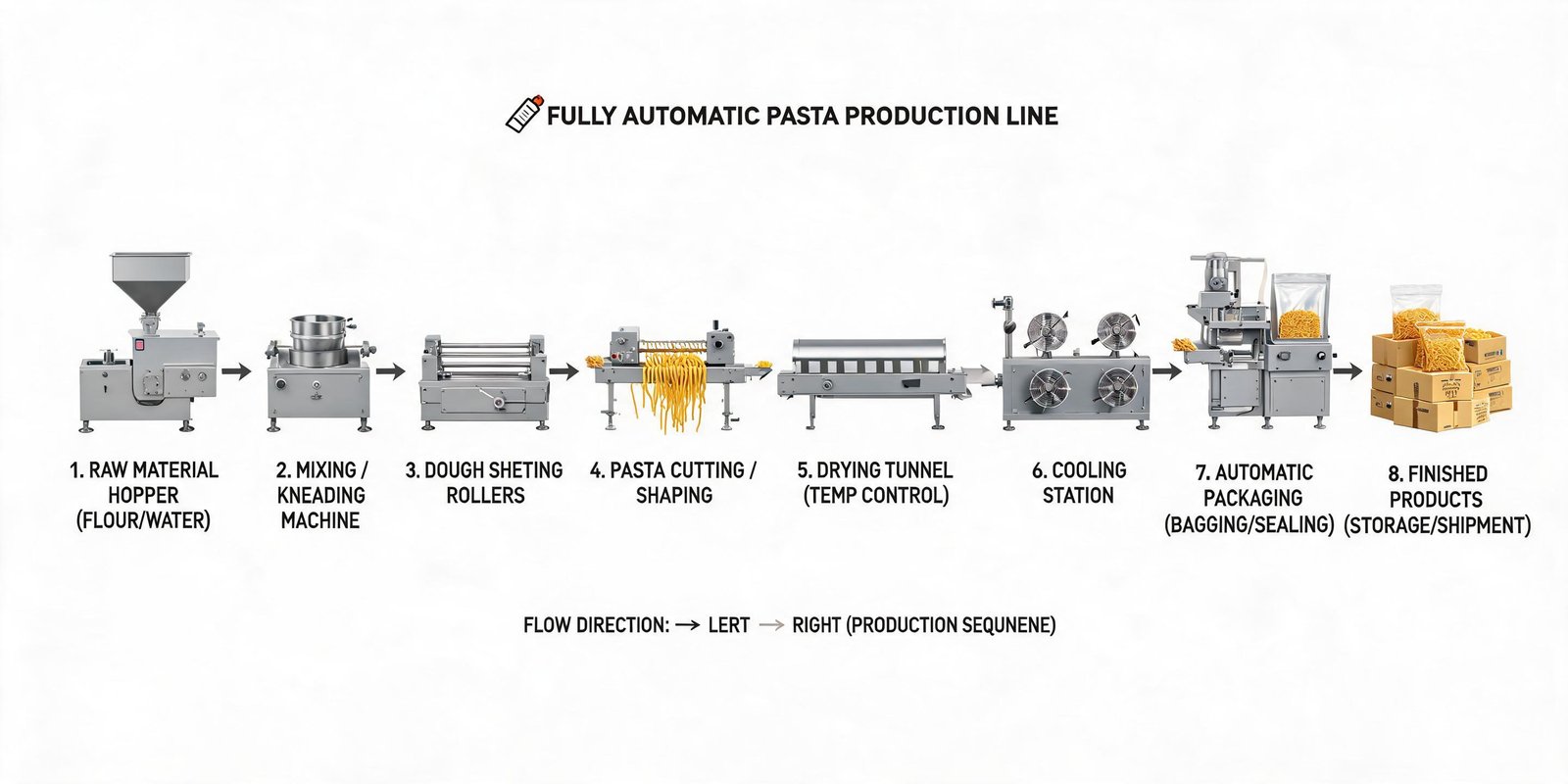
Now, let’s get to the heart of the operation. We’ll follow the journey of the raw materials as they travel through a typical fully automatic pasta production line process. We’ll break down the role of the operators, the key equipment, and the critical process parameters for each stage.
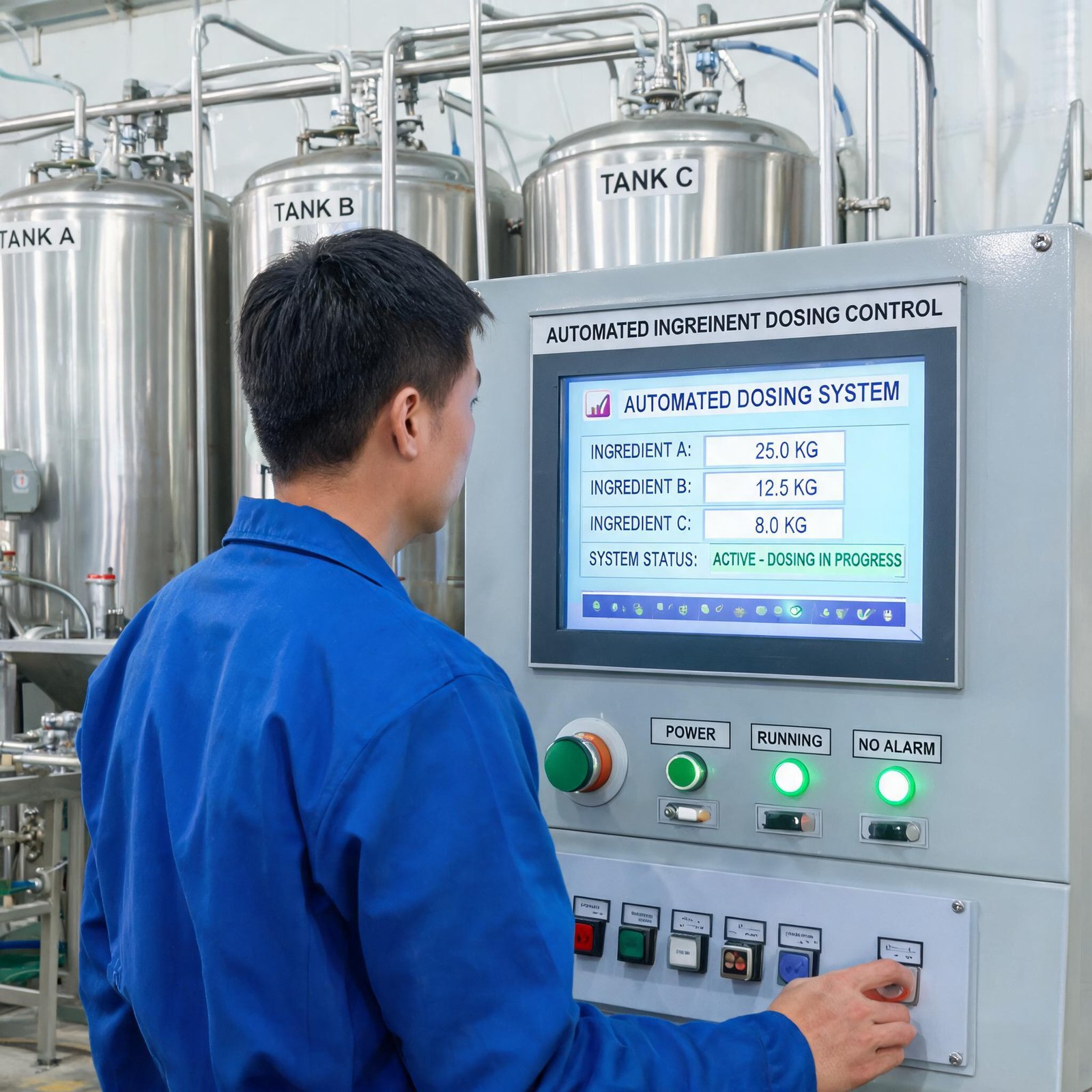
1. Raw Material Preparation & Dosing (1 Operator)
The quality of the final product starts here. Forget simply “pouring flour in.” This stage is about precision.
Operator Tasks:
- Ingredient Inspection: High-quality durum wheat semolina is the gold standard, but other flours are used for specific pasta types. The operator ensures the raw materials meet your quality specs.
- Sieving: Flour is passed through a sifter to remove any foreign matter or lumps, ensuring a clean feed to the mixer.
- Dosing and Mixing (Dry): In a modern line, ingredients like semolina, water, and any enrichment (e.g., spinach powder, eggs) are precisely metered into the mixer based on a pre-set recipe. This can be done manually or automatically.
Key Equipment: Flour Sifter, Ingredient Weighing System
Critical Parameters: Flour protein content (12-14% is ideal for durum), water temperature (usually cold water around 15-20°C to control gluten development).
2. Mixing & Kneading (Monitored, Not Hands-On)
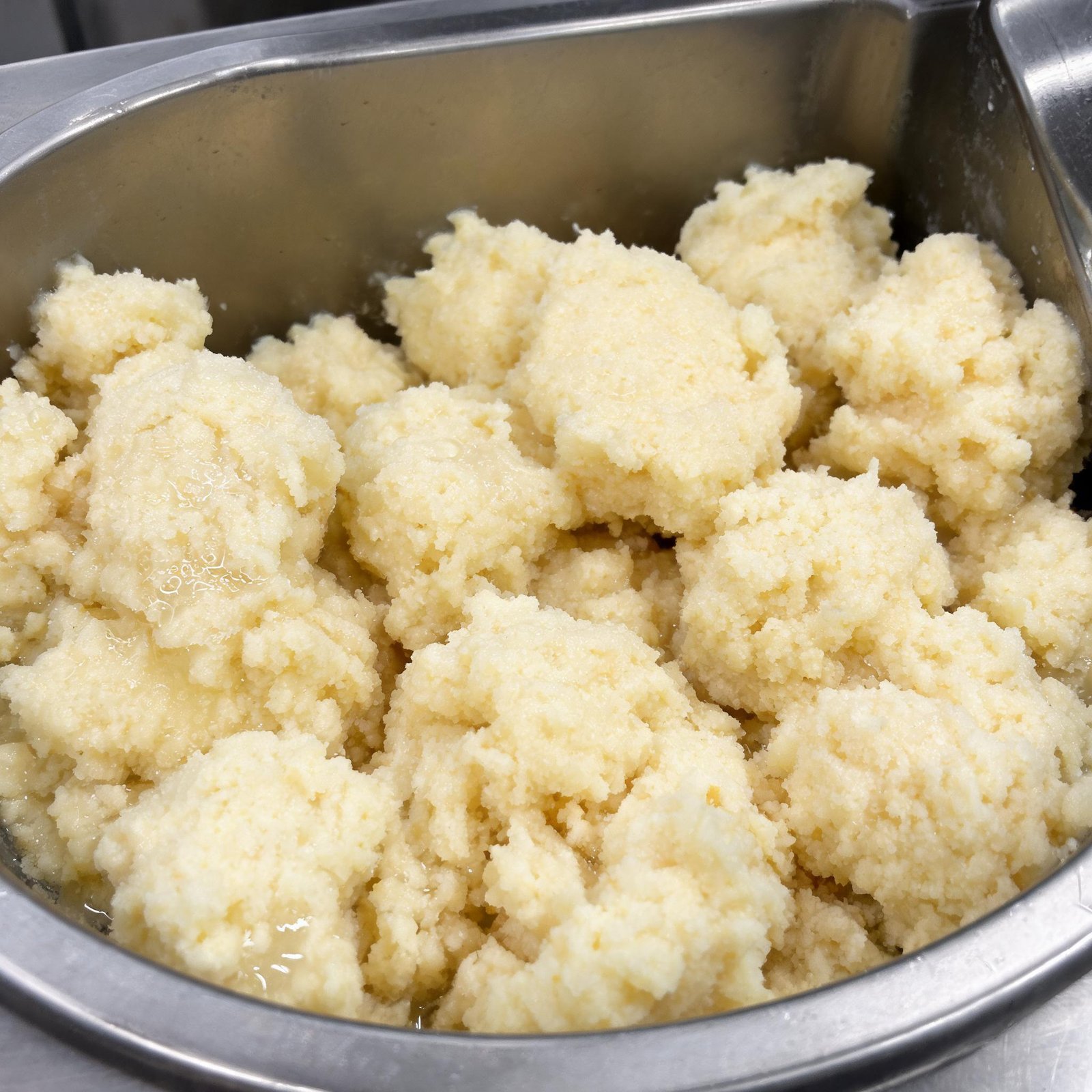
This is where the magic of gluten formation happens. The goal is to create a homogeneous, crumbly dough with the correct moisture content (around 30-31%). The dough should not be a cohesive ball but rather a collection of small, uniform granules called “curds.”
Operator Tasks: The operator’s role shifts from active handling to monitoring. They watch the mixer’s ampere meter and timer to ensure consistency.
Key Equipment: Heavy-duty dough mixer (continuous or batch)
Critical Parameters: Mixing time (15-20 minutes for a typical batch), water temperature, mixer speed. Under-mixing leads to a sticky dough; over-mixing can lead to a dough that is too tough.
3. Extrusion: Shaping the Pasta (Monitored)
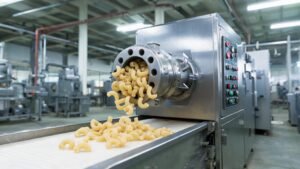
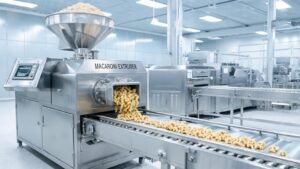
The dough curds are conveyed to the extrusion machine. This is the heart of the pasta production line. A powerful screw conveys the dough into a vacuum chamber, which removes air pockets that would cause white spots or blistering on the finished pasta.
The dough then moves to the extrusion head, where it’s forced through a die—a bronze or Teflon-coated plate with the desired shape. Bronze dies are prized for creating a rougher surface that holds sauce better. The extruded pasta emerges in a continuous ribbon or as individual strands, depending on the shape.
Operator Tasks: This stage is highly automated. The operator checks for uniform extrusion, proper shape definition, and no visible cracks or surface imperfections.
Key Equipment: Pasta extruder with vacuum pump and interchangeable dies.
Critical Parameters: Extrusion pressure (typically high for long goods), dough temperature (should remain below 50°C to protect gluten), screw speed.
A Note on Technology: The extrusion process makes or breaks your yield. Here at ZhuoHeng, our extruders are engineered with precision-ground screws and robust gearboxes for consistent, high-pressure extrusion. The vacuum system is critical; a good vacuum pulls out air, resulting in a dense, brilliant, and defect-free pasta.
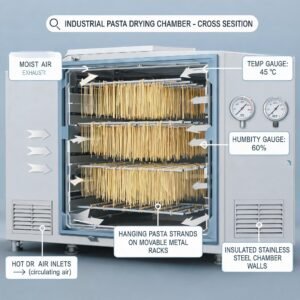
4. The Drying Process: The True Art of Pasta Making (Monitored, Highly Automated)
This is the most critical and energy-intensive phase. Improper drying is the #1 cause of poor pasta quality (cracking, checking, bad texture). The goal is to reduce the moisture content from ~30% down to a stable 12.5% for a long shelf life.
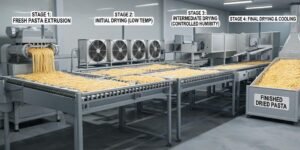
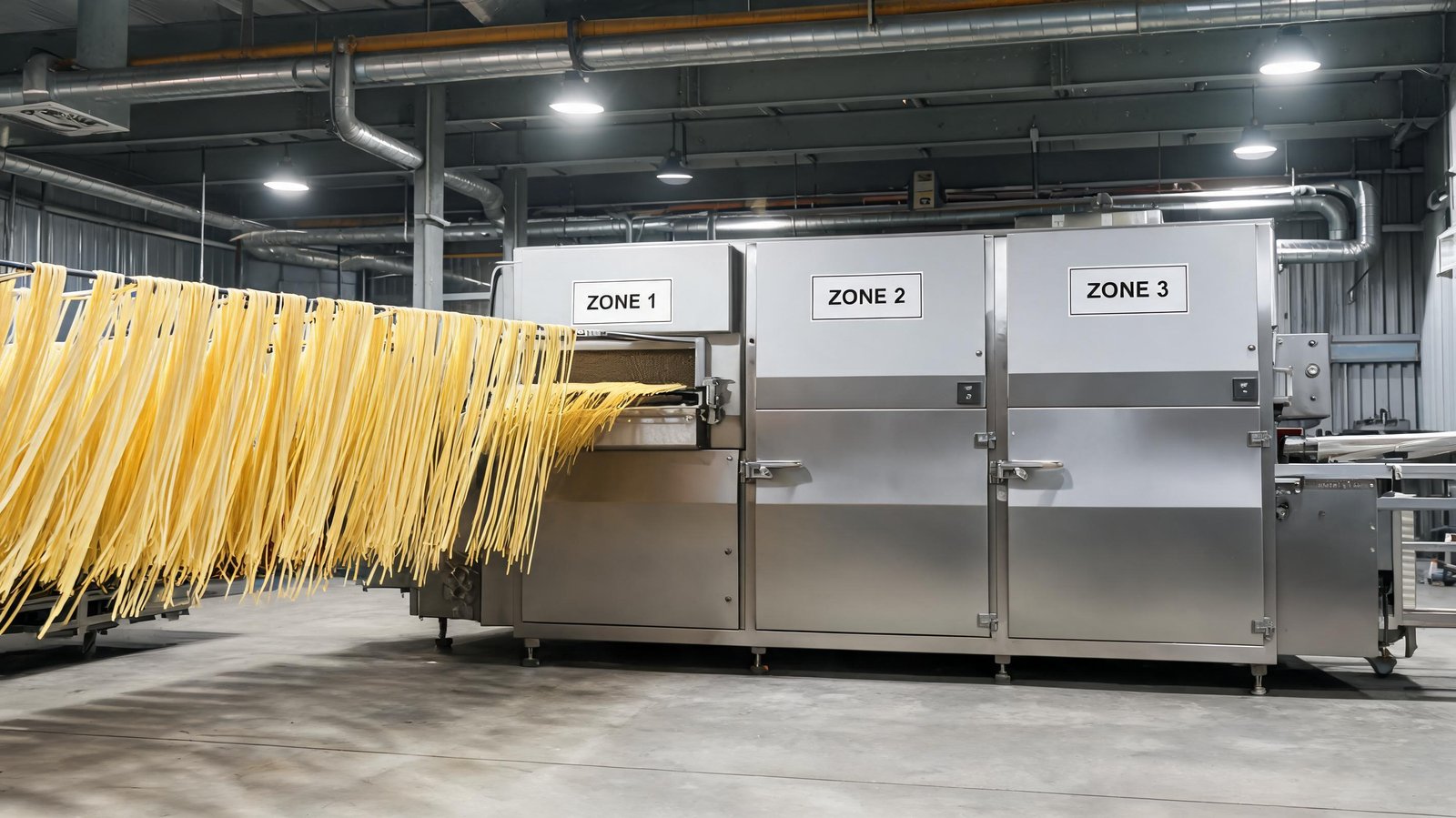
A fully automatic pasta production line uses a multi-stage, tunnel-style dryer.
Step A: Pre-Drying (High Heat, Short Time):
The freshly extruded, moist pasta enters a pre-dryer. Here, a strong airflow at a high temperature (80-90°C) rapidly removes surface moisture. This “case-hardens” the pasta, giving it a stable outer layer that prevents it from sticking together or deforming during the main drying process.
Step B: Main Drying (Controlled Temperature and Humidity):
This is where the magic happens. The pasta enters the main drying chamber, which is a multi-zone, temperature- and humidity-controlled tunnel. It’s not a simple linear process. The pasta goes through cycles.
- Sweating Zone: Hot, humid air to keep the pasta moist on the surface.
- Drying Zone: Hot, dry air to pull moisture from the inside out.
This controlled cycling prevents the outer layer from drying too fast and cracking while the center is still wet. This step can take 6-10 hours for long goods.
Operator Tasks: The operator’s primary job is to oversee the control system. They monitor temperature, humidity, and airflow in each zone. They also check the finished pasta’s moisture content with a moisture analyzer.
Key Equipment: Multi-zone tunnel dryer, steam or hot water heat exchangers, air handling units.
Critical Parameters: Temperature (40-85°C), relative humidity (60-80%), drying time (6-14 hours depending on shape).
5. Cutting, Cooling & Packaging (1 Operator)
After drying, the pasta must be cooled to near-room temperature before packaging to prevent condensation in the bag.
- Cutting: The dried pasta proceeds to a guillotine or rotary cutter, which crops it to the precise, standardized length.
- Screening: A vibrating screen or air classifier removes any broken pieces, dust, and undersized or oversized pieces. These are often recycled into a secondary product stream.
- Packaging: The finished pasta can then be sent to a bagging machine for packaging in bulk (e.g., 25kg polybags) or retail bags (e.g., 500g pillows). A metal detector often sits right before the packaging station for final quality assurance.
Operator Tasks: The operator packages the product, labels each box/bag with the production date and batch number, and stacks the finished goods on pallets for the warehouse.
Key Equipment: Guillotine cutter, vibratory screen, checkweigher, packaging machine
Critical Parameters: Cutting length accuracy, cooling time.
A Comprehensive Pasta Production Line Workflow Diagram (Conceptual)
Imagine the flow:
- Raw Material Input (Floors & Water) -> 2. Sifter -> 3. Mixer (Dough Curds) -> 4. Extruder (Shaped Pasta) -> 5. Pre-Dryer (Case-Hardening) -> 6. Main Dryer (Moisture Control) -> 7. Cooler -> 8. Cutter/Screener -> 9. Packaging -> 10. Finished Goods
This flow is only possible with precise synchronization of belt speeds, temperature controls, and material handling.
Addressing Common Pain Points in an Automatic Pasta Plant
Let’s tackle some of the most frequent questions and worries you might have.
How Much Labor Do I Need? (A Realistic Breakdown)
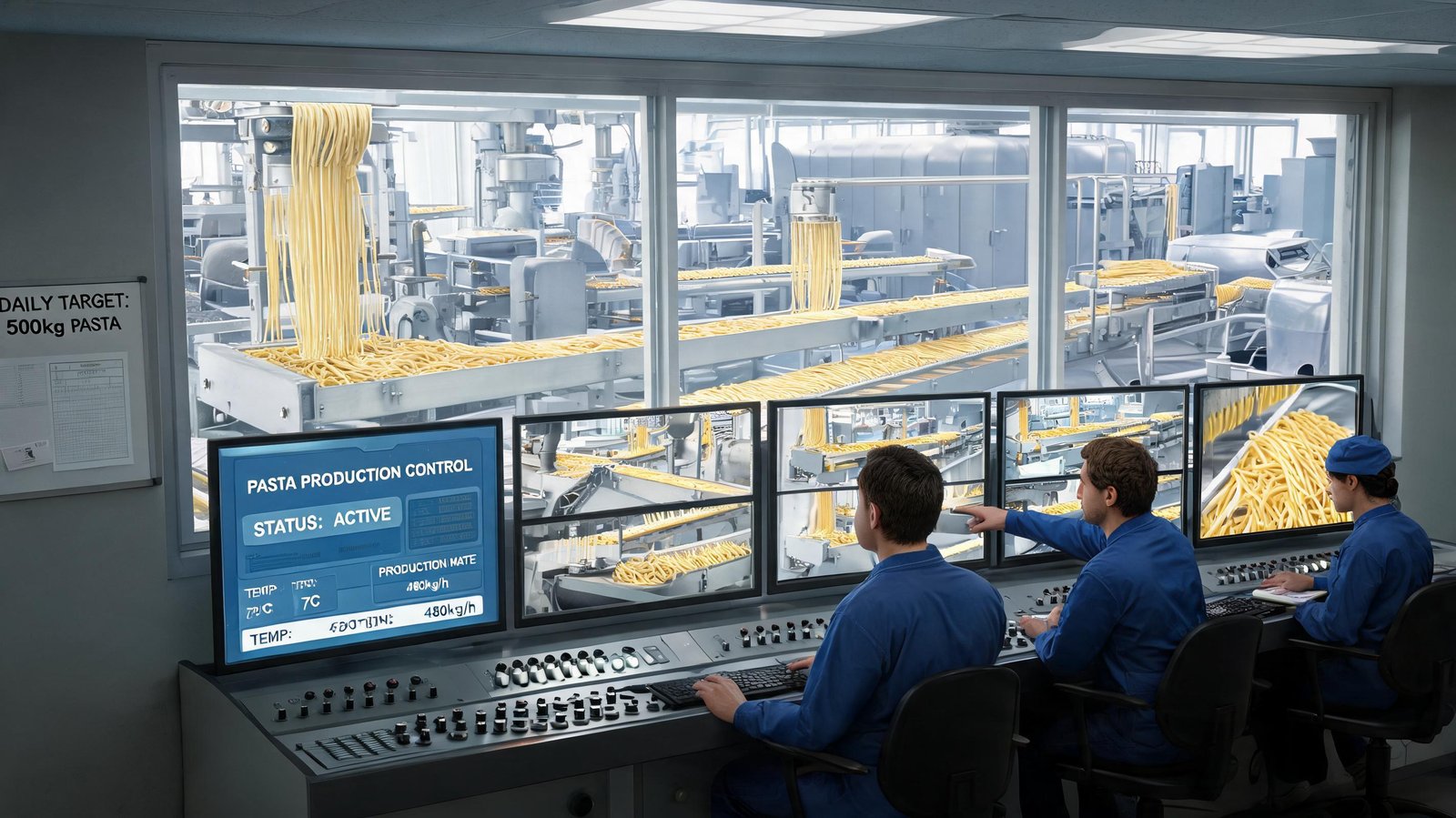
You’ve seen the “3 operators” note in other guides. In a fully automatic pasta production line, 3-4 skilled operators is the sweet spot for a typical medium-volume line.
- Operator 1 (Line Lead/Extrusion): Manages raw material feeding, pre-checks, and oversees the extrusion and forming process.
- Operator 2 (Dryer Technician): Monitors the dryer’s control system, takes moisture readings, and adjusts parameters. This is a skilled role.
- Operator 3 (Packaging & Quality): Operates the packaging line, performs final inspections, and labels the product.
- Operator 4 (Maintenance/Material Handler): Handles raw material pallets, operates a forklift for finished goods, and performs minor maintenance tasks.
What About Cleaning and Maintenance?
Cleaning an automatic pasta plant is a non-negotiable step for food safety and equipment longevity.
Daily Cleaning (End of Shift):
- Flush the Line: Run a small batch of dry semolina or a specialized cleaning compound through the extruder to push out residual dough.
- Clean the Dies: Remove dies and soak them in warm water (never hot, to prevent burning on the dough). Clean with a brass or nylon brush. Do not use steel wool.
- Wipe Down: Wipe all food-contact surfaces (hoppers, conveyor belts) with a food-safe sanitizer.
- Lubricate: Apply food-grade oil to all moving parts (chains, bearings, gears) per the manual.
Weekly Maintenance:
- Deep clean the dryer. Remove any dust accumulation.
- Check and replace worn seals on the extruder.
- Inspect conveyor belt tension and tracking.
- Check the moisture analyzer calibration.
Monthly Maintenance:
- Inspect the extrusion screw and barrel for wear.
- Check gearbox oil levels.
- Test all safety systems (e-stop, guards, door locks).
What is the ROI for an Automatic Pasta Line?
This is the million-dollar question. The payoff comes in three key areas:
- Labor Savings: A fully manual line might need 10 people to produce 200 kg/hour. An automatic line needs 3-4 for 500+ kg/hour.
- Product Consistency: Automation eliminates human error. Every batch is identical, building your brand reputation.
- Reduced Waste: Precise dosing and controlled drying minimize scrap. The vacuum extrusion reduces breakage and off-spec product.
The initial investment in an Zhuohengextruder line is quickly recouped through reduced labor costs, higher output, and less product loss. For many of our clients, the payback period is under 18 months.
Final Thoughts: Navigating Your Own Pasta Production Journey
Stepping into the world of fully automatic pasta production is a significant move, but it’s one of the most rewarding investments a food processing business can make. By understanding the step-by-step process—from the pre-startup checks and recipe development to the precision of extrusion and the delicate balance of the drying curve—you are not just buying a machine; you are acquiring a complete manufacturing system.
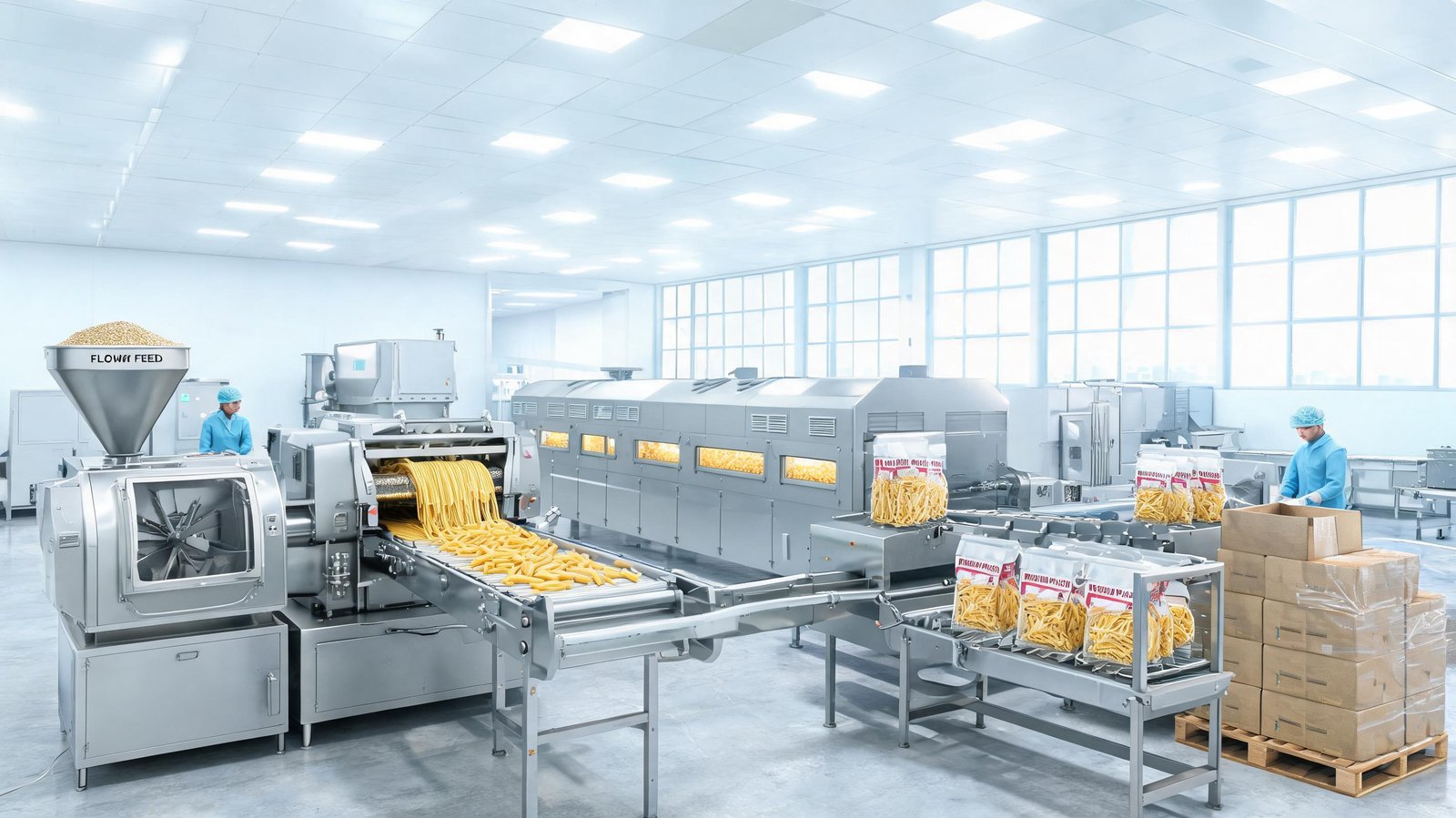
The key is to partner with a manufacturer who can support you every step of the way. At ZhuoHeng, we don’t just supply equipment; we help you design the layout, train your team on the industrial pasta manufacturing line setup steps, and provide ongoing technical support.
The future of pasta manufacturing is automated, precise, and efficient. And with the right plan and the right partner, your production goals are not just achievable—they are inevitable.
Frequently Asked Questions (FAQ)
How Much Labor Do I Need? (A Realistic Breakdown)
You’ve seen the “3 operators” note in other guides. In a fully automatic pasta production line, 3-4 skilled operators is the sweet spot for a typical medium-volume line.
- Operator 1 (Line Lead/Extrusion): Manages raw material feeding, pre-checks, and oversees the extrusion and forming process.
- Operator 2 (Dryer Technician): Monitors the dryer’s control system, takes moisture readings, and adjusts parameters. This is a skilled role.
- Operator 3 (Packaging & Quality): Operates the packaging line, performs final inspections, and labels the product.
- Operator 4 (Maintenance/Material Handler): Handles raw material pallets, operates a forklift for finished goods, and performs minor maintenance tasks.
What About Cleaning and Maintenance?
Cleaning an automatic pasta plant is a non-negotiable step for food safety and equipment longevity.
Daily Cleaning (End of Shift):
- Flush the Line: Run a small batch of dry semolina or a specialized cleaning compound through the extruder to push out residual dough.
- Clean the Dies: Remove dies and soak them in warm water (never hot, to prevent burning on the dough). Clean with a brass or nylon brush. Do not use steel wool.
- Wipe Down: Wipe all food-contact surfaces (hoppers, conveyor belts) with a food-safe sanitizer.
- Lubricate: Apply food-grade oil to all moving parts (chains, bearings, gears) per the manual.
Weekly Maintenance:
- Deep clean the dryer. Remove any dust accumulation.
- Check and replace worn seals on the extruder.
- Inspect conveyor belt tension and tracking.
- Check the moisture analyzer calibration.
Monthly Maintenance:
- Inspect the extrusion screw and barrel for wear.
- Check gearbox oil levels.
- Test all safety systems (e-stop, guards, door locks).
What is the ROI for an Automatic Pasta Line?
This is the million-dollar question. The payoff comes in three key areas:
- Labor Savings: A fully manual line might need 10 people to produce 200 kg/hour. An automatic line needs 3-4 for 500+ kg/hour.
- Product Consistency: Automation eliminates human error. Every batch is identical, building your brand reputation.
- Reduced Waste: Precise dosing and controlled drying minimize scrap. The vacuum extrusion reduces breakage and off-spec product.
The initial investment in a Zhuohengextruder line is quickly recouped through reduced labor costs, higher output, and less product loss. For many of our clients, the payback period is under 18 months.