The global demand for puffed snacks continues to grow as consumers seek convenient, affordable, and innovative snack products. From corn curls and cheese balls to multigrain puffs, breakfast cereals, pellet snacks, and protein-enriched extruded foods, manufacturers are constantly expanding production to meet market demand.
However, investing in a puffed snack production line is only part of the equation. Many factories purchase high-quality equipment but fail to achieve the expected production efficiency, product consistency, or profitability because of one critical oversight: poor factory layout planning.
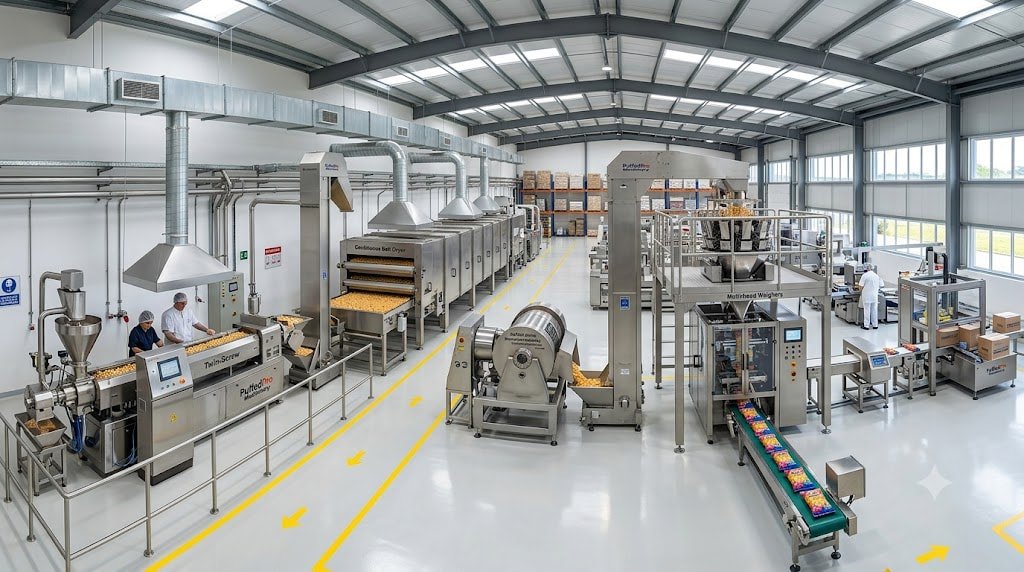
A well-designed puffed snack factory is much more than a building filled with machines. It is a carefully engineered production environment where materials move efficiently, workers operate safely, utilities are optimized, hygiene risks are controlled, and future expansion remains possible.
For food manufacturers, private-label brands, investors, and processing companies planning a new facility, understanding proper snack factory layout design can significantly improve operational performance while reducing long-term costs.
This comprehensive guide explains every stage of factory planning—from production flow and hygienic zoning to utility engineering, maintenance access, automation strategies, and future scalability.
Why Factory Layout Has a Direct Impact on Profitability
When discussing snack manufacturing projects, many investors focus on production capacity, machine specifications, and equipment pricing.
While these factors are important, experienced manufacturers know that factory layout directly affects:
- Production efficiency
- Labor requirements
- Product quality
- Food safety compliance
- Energy consumption
- Maintenance costs
- Future expansion opportunities
Two factories operating the same equipment can achieve completely different results depending on how the production line is arranged.
Poor factory planning often causes:
- Excessive internal transportation
- Material cross-contamination
- Production bottlenecks
- Higher labor costs
- Difficult cleaning procedures
- Reduced operational flexibility
By contrast, a professionally engineered layout creates a smooth, uninterrupted workflow that supports long-term growth.
For this reason, successful food processors usually begin with factory planning before selecting machinery.
Understanding the Complete Puffed Snack Manufacturing Process
Before designing the factory, manufacturers must understand how puffed snacks are produced.
Although product formulations may vary, the basic manufacturing sequence remains largely consistent.
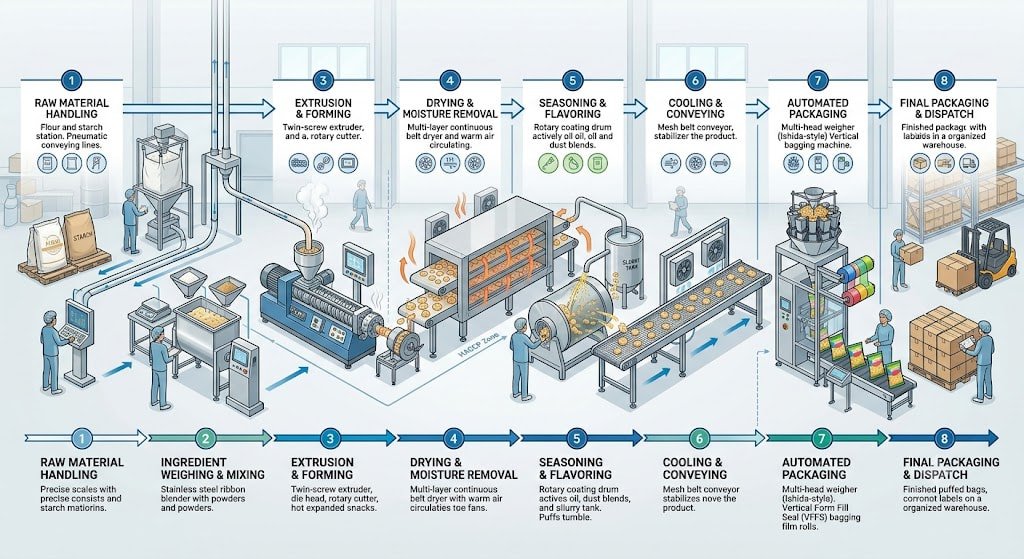
Every section of the factory should support this natural production flow.
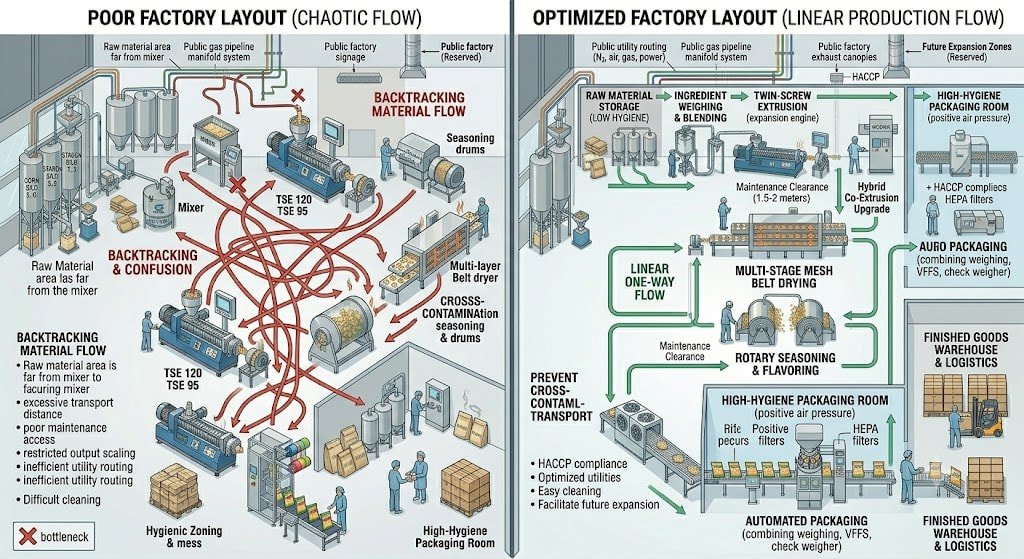
Materials should always move forward.
Backtracking materials, intersecting pathways, and unnecessary transportation increase costs while introducing contamination risks.
Step 1: Determine Production Capacity Before Designing the Factory
One of the most common mistakes made by new investors is designing a building before defining production requirements.
Factory dimensions should always be based on:
- Product type
- Production capacity
- Packaging formats
- Number of shifts
- Future expansion plans
Typical capacity categories include:
| Production Capacity | Recommended Factory Area |
|---|---|
| 120–150 kg/h | 300–500 m² |
| 250–300 kg/h | 500–800 m² |
| 500–800 kg/h | 800–1,500 m² |
| 1,000–1,200 kg/h | 1,500–3,000 m²+ |
The larger the capacity, the more space required for:
- Raw material storage
- Processing equipment
- Utility systems
- Packaging operations
- Finished goods warehousing
A factory producing 150 kg/h and a factory producing 1,000 kg/h will require entirely different engineering approaches.
Before creating any floor plan, manufacturers should calculate both current demand and projected future growth.
Step 2: Designing the Ideal Material Flow
ndustrial food factories should follow one fundamental rule:
Materials Must Move in One Direction
Every movement should contribute toward finished product completion.
The recommended production sequence is:
This linear arrangement minimizes:
- Internal transportation
- Product handling
- Contamination risks
- Labor requirements
It also simplifies supervision and process management.
Many modern facilities utilize straight-line layouts whenever building dimensions allow.
Where space limitations exist, U-shaped configurations can achieve similar efficiency while reducing travel distances.
Step 3: Raw Material Storage Area Design
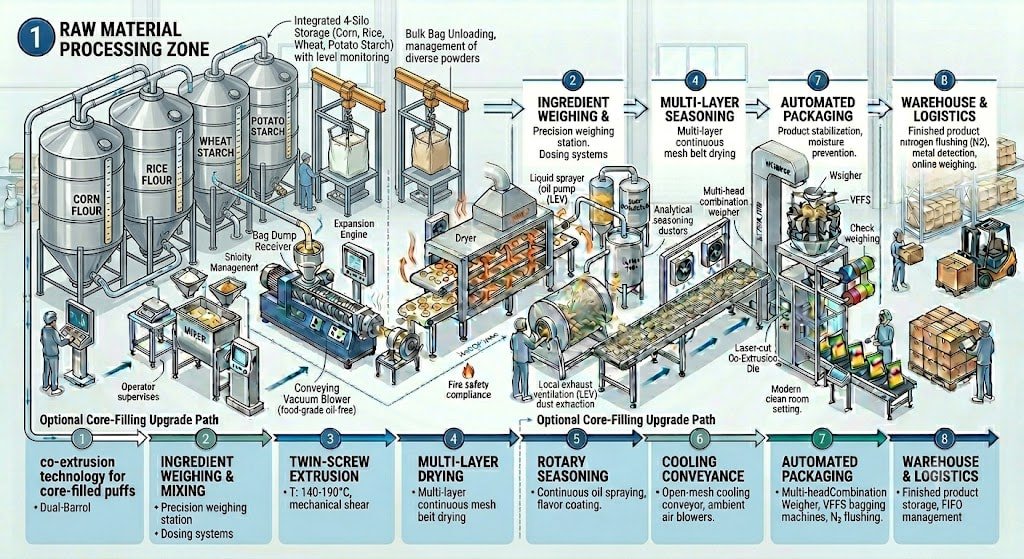
The raw material warehouse forms the starting point of the entire operation.
Typical ingredients include:
- Corn flour
- Rice flour
- Wheat flour
- Potato starch
- Multigrain blends
- Protein powders
- Functional additives
- Flavoring ingredients
Because these materials directly influence product quality, storage conditions must remain carefully controlled.
Humidity Management
Most starch-based ingredients absorb moisture easily.
Recommended relative humidity:
40%–60% RH
Excessive moisture can result in:
- Ingredient caking
- Reduced shelf life
- Microbial growth
- Poor extrusion performance
Temperature Stability
Stable storage temperatures help maintain ingredient consistency.
Where possible:
15°C–25°C
is generally preferred.
FIFO Inventory Control
Factories should implement a First-In-First-Out inventory system to prevent raw material aging.
Dust Control
Large quantities of corn flour and starch can generate dust.
Recommended solutions include:
- Dust extraction systems
- Enclosed unloading stations
- Pneumatic conveying systems
Step 4: Mixing and Conditioning Area Design
After storage, ingredients enter the mixing section.
This stage prepares raw materials for extrusion by achieving uniform moisture distribution and ingredient consistency.
Most industrial facilities utilize:
- Ribbon mixers
- Paddle mixers
- Continuous mixing systems
Water and liquid additives are introduced during this stage.
One of the most important process parameters is moisture content.
For most puffed snack applications:
Recommended Feed Moisture
14%–18%
This moisture range supports proper starch gelatinization during extrusion.
If moisture levels are too low:
- Product expansion decreases
- Screw wear increases
- Product burning may occur
If moisture levels are too high:
- Expansion becomes unstable
- Product texture deteriorates
Modern facilities often integrate automatic dosing systems to maintain consistent formulations.
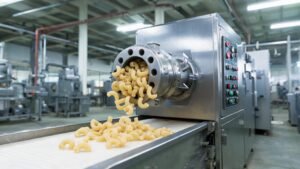
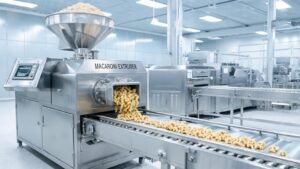
Step 5: Designing the Extrusion Zone – The Heart of the Factory
The extrusion section is the most important area within the facility.
This is where raw ingredients transform into expanded snack products.
Twin-screw extrusion technology uses:
- Mechanical shear
- Pressure
- Heat
- Controlled moisture
to create the desired puffed structure.
Inside the barrel, temperatures commonly range between:
140°C–190°C
depending on:
- Product type
- Formula composition
- Desired texture
As material exits the die, pressure drops instantly.
The moisture trapped inside the dough flashes into steam, creating expansion and producing the characteristic puffed structure.
Maintenance Clearance Requirements
One of the most overlooked factory planning considerations is maintenance access.
The twin-screw extruder requires periodic:
- Screw replacement
- Barrel inspection
- Cleaning
- Die changes
For this reason, manufacturers should maintain:
Minimum Clearance
1.5–2 meters around the machine
For larger industrial systems, 2.5 meters in front of the screw extraction area is recommended.
Without sufficient clearance, routine maintenance becomes difficult and costly.
Utility Requirements Around the Extruder
The extrusion area requires access to:
- Electrical power
- Water supply
- Compressed air
- Ventilation systems
- Control wiring
All utility routing should remain organized and accessible.

Selecting the Right Extrusion Equipment
Choosing the right extrusion system is critical for long-term success.
Manufacturers should evaluate:
- Production capacity
- Product variety
- Automation level
- Expansion requirements
- Utility availability
For companies planning industrial-scale snack production, investing in a high-performance Puffed Food Machine can provide greater flexibility, improved product consistency, and long-term production reliability.
A properly engineered extrusion system can produce:
- Corn curls
- Cheese balls
- Rings
- Stars
- Pellet snacks
- Breakfast cereals
- Nutritional snacks
- Protein-enriched products
all from a single platform through die and formulation adjustments.
Step 6: Rotary Cutting and Product Forming
Immediately after extrusion, products pass through the rotary cutting section.
High-speed knives rotate across the die face, cutting the expanding product into the desired shape and length.
The final product appearance depends on:
- Die design
- Cutting speed
- Product formulation
- Moisture content
- Extrusion parameters
Common shapes include:
- Balls
- Rings
- Stars
- Tubes
- Curls
- Sticks
Because freshly extruded products are fragile, the transfer distance between extrusion and drying should remain as short as possible.
Recommended transfer distance:
Less Than 3–5 Meters
This helps prevent product deformation and sticking.

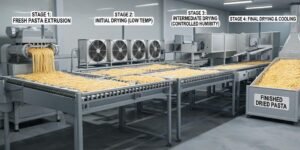
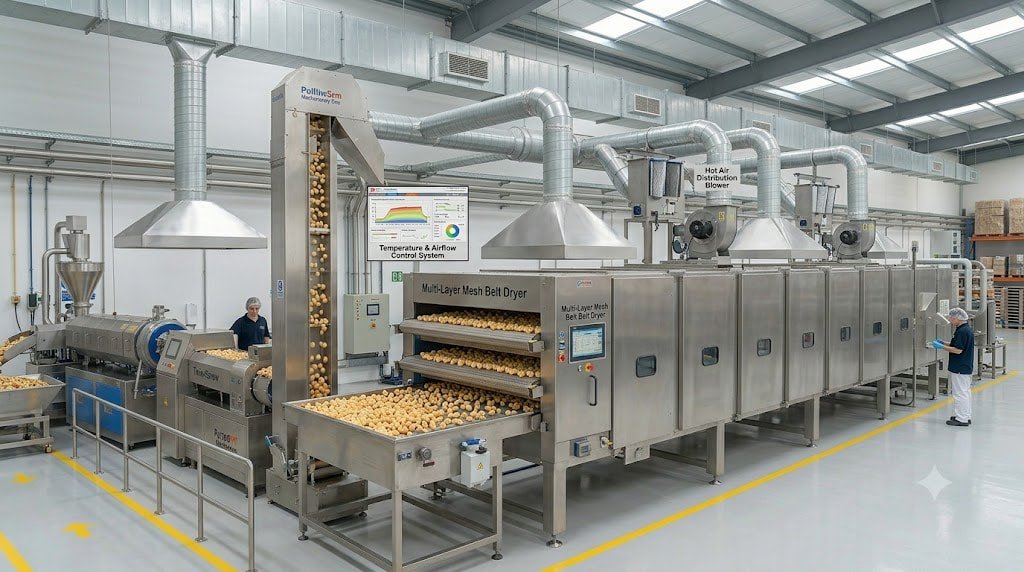
Step 7: Designing the Drying System Area
After extrusion, products contain excess moisture.
Typical moisture levels:
| Stage | Moisture Content |
|---|---|
| Raw Mix | 14–18% |
| After Extrusion | 8–12% |
| After Drying | 2–3% |
Reducing moisture is essential for:
- Product crispness
- Shelf stability
- Packaging performance
- Product quality
Industrial drying systems may use:
- Electric heating
- Natural gas
- LPG
- Steam
For medium and large-scale production, gas-fired dryers often provide the most economical operating costs.
Step 8: Hygienic Zoning and Food Safety Design
Food safety is one of the most important considerations when planning a puffed snack production facility.
Regardless of whether your target market is North America, Europe, the Middle East, Southeast Asia, or South America, customers increasingly expect compliance with standards such as:
- HACCP
- GMP
- ISO 22000
- BRCGS
- FDA requirements
- Local food safety regulations
A well-designed factory layout should separate different production activities into clearly defined hygiene zones.
Recommended Factory Zoning Structure.xlsx
| Zone | Area | Hygiene Level |
|---|---|---|
| Zone 1 | Raw Material Storage | Low Hygiene |
| Zone 2 | Mixing & Extrusion | Medium Hygiene |
| Zone 3 | Drying & Seasoning | Medium-High Hygiene |
| Zone 4 | Packaging | High Hygiene |
| Zone 5 | Finished Goods Warehouse | Controlled Hygiene |
This zoning approach helps prevent contamination while simplifying sanitation procedures.
Zone 1: Raw Material Area
This section handles:
- Flour storage
- Starch storage
- Ingredient receiving
- Bulk material unloading
Major risks include:
- Dust generation
- Pest activity
- Moisture absorption
Recommended features:
- Separate warehouse entrance
- Dust collection systems
- Palletized storage
- Humidity monitoring
Zone 2: Processing Area
This area contains:
- Mixers
- Feeders
- Extruders
- Rotary cutters
The environment should support:
- Easy cleaning
- Good ventilation
- Organized utility routing
Floors should be durable, non-slip, and resistant to cleaning chemicals.
Recommended flooring:
- Food-grade epoxy
- Polyurethane concrete
Zone 3: Drying and Seasoning Area
The drying and seasoning section generates:
- Heat
- Moisture
- Oil mist
- Seasoning dust
Proper extraction systems are essential.
Recommended solutions:
- Local exhaust hoods
- Dust collection systems
- Controlled airflow design
Zone 4: Packaging Area
Packaging represents the most sensitive processing environment.
Once snacks leave the dryer, they are essentially ready for consumption.
Protecting products at this stage is critical.
Recommended features include:
Positive Air Pressure
Maintain:
+15 to +25 Pa
relative to surrounding areas.
This prevents contaminated air from entering the packaging room.
HEPA Filtration
HEPA filters help remove airborne particles before they reach finished products.
Personnel Control
Restrict access through:
- Hygiene stations
- Hand sanitization points
- Protective clothing requirements

Step 9: Designing the Packaging Area for Maximum Efficiency
The packaging section is often the highest-value area in the factory.
Every minute of downtime here directly affects production output.
Modern puffed snack facilities commonly utilize:
- Multihead weighers
- Vertical form fill seal (VFFS) machines
- Nitrogen flushing systems
- Metal detectors
- Check weighers
The recommended production flow is:
This arrangement minimizes product breakage while maintaining packaging efficiency.
Why Nitrogen Flushing Matters
Many puffed snacks contain oil-based seasonings.
Oxygen exposure accelerates:
- Oxidation
- Flavor degradation
- Shelf-life reduction
Nitrogen flushing helps:
- Preserve freshness
- Protect product texture
- Reduce breakage during transport
This feature is particularly valuable for export-oriented manufacturers shipping products long distances.

Step 10: Utility Planning – The Hidden Foundation of Production Efficiency
Even the most advanced equipment cannot perform properly without stable utility infrastructure.
A professional extrusion line setup guide should always include utility planning.
The primary utility systems include:
- Electricity
- Compressed air
- Water
- Ventilation
- Fuel supply
Electrical System Design
Power requirements vary according to production capacity.
Typical installed power requirements include:
| Capacity | Installed Power |
|---|---|
| 120 kg/h | 80–120 kW |
| 250 kg/h | 150–220 kW |
| 500 kg/h | 250–400 kW |
| 1000 kg/h | 450–700 kW |
Proper power distribution improves reliability and reduces operational interruptions.
Compressed Air System
Compressed air is required for:
- Pneumatic valves
- Packaging machinery
- Automatic controls
- Conveying systems
Food factories should ideally use:
Oil-Free Air Compressors
Benefits include:
- Improved food safety
- Reduced contamination risk
- Lower maintenance requirements
Recommended compressed air quality:
- Dry air
- Filtered air
- Stable pressure
Ventilation Design
Extrusion and drying processes generate significant heat.
Without proper ventilation:
- Worker comfort decreases
- Equipment temperatures rise
- Production efficiency suffers
Recommended systems include:
- Roof exhaust fans
- Local extraction hoods
- Air exchange systems
Dryer Fuel Selection
Drying systems consume more energy than most other equipment.
Common fuel options include:
| Fuel Type | Operating Cost |
|---|---|
| Electricity | High |
| LPG | Medium |
| Natural Gas | Low |
| Steam | Low (where available) |
For continuous industrial production, gas-fired dryers often offer the most economical solution.

Step 11: Maintenance-Friendly Factory Design
Maintenance accessibility is frequently overlooked during initial planning.
However, maintenance directly impacts:
- Equipment lifespan
- Production uptime
- Operating costs
All major equipment should have sufficient access space.
Recommended clearance:
1.5–2.0 Meters
around:
- Extruders
- Dryers
- Seasoning systems
- Packaging machinery
This allows technicians to perform:
- Inspections
- Repairs
- Cleaning
- Component replacement
without disrupting nearby operations.
Centralized Control Room Design
Modern production lines increasingly utilize:
- PLC systems
- SCADA monitoring
- Remote diagnostics
A centralized control room offers several advantages:
- Better environmental protection
- Easier monitoring
- Improved operational efficiency
Sensitive electronics should remain isolated from:
- Dust
- Heat
- Moisture
generated during processing.
Step 12: Factory Layout Examples by Production Capacity
One layout does not fit every manufacturer.
Production requirements determine the ideal factory configuration.
Example 1: 150 kg/h Small Commercial Line
Suitable for:
- Start-up snack brands
- Regional processors
- Pilot production facilities
Recommended area:
300–500 m²
Layout style:
Straight-Line Layout
Advantages:
- Simple operation
- Lower investment
- Easy supervision
Example 2: 300–500 kg/h Industrial Line
Suitable for:
- Established snack manufacturers
- Contract production companies
- Export-oriented businesses
Recommended area:
500–1,500 m²
Layout style:
U-Shaped Layout
Advantages:
- Efficient logistics
- Reduced transport distance
- Better warehouse integration
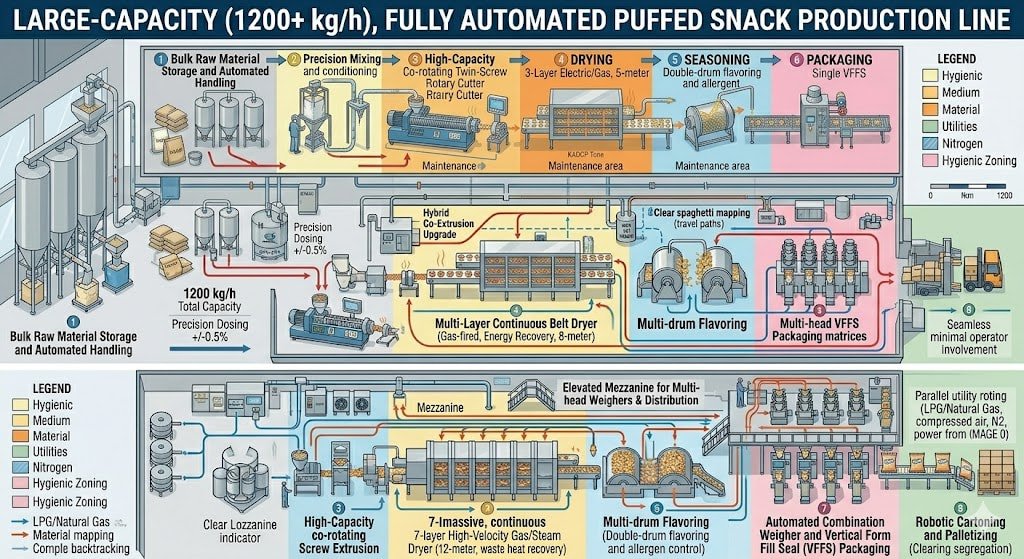
Example 3: 800–1200 kg/h High-Capacity Factory
Suitable for:
- Large food groups
- National brands
- International exporters
Recommended area:
1,500–3,000 m²+
Layout style:
Integrated Automated Layout
Features:
- Multiple packaging stations
- Automated conveying systems
- Advanced process control

Step 13: Reducing Labor Costs Through Better Layout Design
Labor costs continue to increase worldwide.
Fortunately, efficient factory design can significantly reduce labor requirements.
Strategies include:
Minimize Transportation Distance
Position raw material storage close to mixing systems.
Position packaging film storage close to packaging equipment.
Utilize Automatic Conveying
Examples include:
- Vacuum conveyors
- Screw conveyors
- Bucket elevators
Centralize Operations
Grouping equipment logically reduces operator movement.
Increase Automation
Modern Snack Puffing Machine systems can significantly reduce manual intervention while improving production consistency.
Factories that optimize layout often reduce labor requirements by 15–30% compared with poorly designed facilities.
Step 14: Planning for Future Expansion
One of the biggest mistakes in factory planning is designing only for current production needs.
Many snack manufacturers expand production within a few years.
Without expansion planning, growth becomes expensive and disruptive.
Reserve Additional Floor Space
A common recommendation is maintaining:
20–30% Future Expansion Capacity
This space can later accommodate:
- Additional extrusion lines
- Larger dryers
- Additional packaging machines
Oversize Utility Infrastructure
Where possible, plan for:
- Additional electrical capacity
- Larger air compressors
- Future gas supply expansion
This approach reduces future upgrade costs.
Step 15: Common Factory Layout Mistakes That Reduce Efficiency
Even with high-quality equipment and a strong product concept, poor factory planning can significantly reduce profitability.
Over the years, food processing engineers have observed several recurring layout mistakes that negatively impact productivity, sanitation, and operating costs.
Avoiding these mistakes can save substantial time and money during both construction and operation.
Mistake #1: Designing the Building Before Selecting the Production Line
Many investors construct a building first and then attempt to fit equipment inside.
This often leads to:
- Insufficient production space
- Poor workflow
- Utility constraints
- Expansion limitations
The recommended approach is the opposite:
Production Process First, Building Second
Factory dimensions should be determined based on equipment layout and production requirements.
Mistake #2: Ignoring Future Expansion
Many factories are designed only for immediate production needs.
However, successful snack manufacturers frequently increase capacity within 3–5 years.
Without expansion planning, future growth may require:
- Building modifications
- Utility upgrades
- Production interruptions
A good layout should support future expansion from the beginning.
Mistake #3: Poor Material Flow
Material movement should always follow a logical direction.
Common problems include:
- Raw materials crossing finished goods pathways
- Employees walking through production zones unnecessarily
- Packaging materials stored too far from packaging equipment
Efficient layouts reduce unnecessary movement and improve productivity.
Mistake #4: Insufficient Maintenance Access
Equipment that cannot be easily maintained eventually becomes expensive to operate.
Always provide adequate access around:
- Extruders
- Dryers
- Packaging systems
- Electrical cabinets
Maintenance teams should never need to dismantle surrounding equipment simply to access a machine.
Mistake #5: Underestimating Warehouse Requirements
Many projects allocate excessive space to processing equipment while neglecting storage requirements.
In reality, manufacturers need sufficient space for:
Raw Materials
- Flour
- Starch
- Packaging materials
- Seasonings
Finished Products
- Export inventory
- Domestic inventory
- Shipping preparation
Warehouse congestion often becomes a major bottleneck as production volumes increase.
Mistake #6: Poor Utility Routing
Utilities should be organized and accessible.
Messy utility layouts create:
- Safety hazards
- Maintenance difficulties
- Operational inefficiencies
Professional engineering drawings should clearly define:
- Electrical pathways
- Compressed air routing
- Gas supply lines
- Water systems
Mistake #7: Insufficient Hygiene Separation
Food safety risks increase dramatically when production zones are poorly separated.
Typical issues include:
- Packaging areas exposed to seasoning dust
- Raw material traffic entering finished product zones
- Inadequate personnel hygiene controls
Proper zoning helps protect both product quality and regulatory compliance.
Step 16: How to Calculate Return on Investment (ROI) Before Building a Factory
Before investing in a new puffed snack facility, manufacturers should estimate expected returns.
While every project differs, several key factors influence profitability.
Production Capacity
Higher capacity generally lowers unit production costs.
However, over-investing in capacity can create underutilized assets.
The ideal production line should match realistic market demand.
Product Selling Price
Premium snack products often achieve higher margins through:
- Unique flavors
- Health-oriented formulations
- Functional ingredients
- Private-label manufacturing
Operating Costs
Major operating costs include:
- Raw materials
- Labor
- Utilities
- Packaging materials
- Maintenance
Efficient factory design can significantly reduce these expenses.
Equipment Utilization
Factories operating one shift per day will have different ROI calculations than facilities operating:
- Two shifts
- Three shifts
- Continuous production
When evaluating investment opportunities, manufacturers should calculate total cost per kilogram rather than focusing solely on equipment purchase price.
Step 17: Why Turnkey Solutions Are Becoming Increasingly Popular
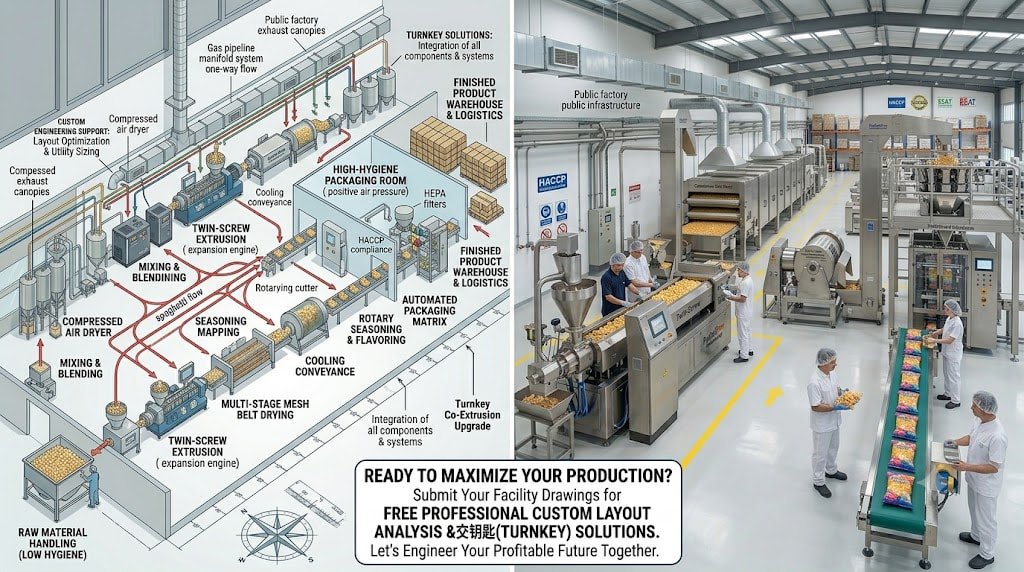
As food manufacturing becomes more complex, many companies prefer purchasing a complete turnkey food processing plant rather than sourcing equipment from multiple suppliers.
A turnkey project typically includes:
- Factory layout design
- Equipment manufacturing
- Utility planning
- Installation supervision
- Commissioning
- Operator training
This approach reduces project risk and simplifies management.
Benefits of a Turnkey Food Processing Plant
Faster Project Completion
Equipment and layout are designed together.
Better Equipment Integration
All systems are engineered to operate as one production line.
Lower Technical Risk
Manufacturers avoid compatibility issues between equipment suppliers.
Simplified Communication
One supplier manages the entire project.
For companies entering the snack processing industry for the first time, turnkey solutions often provide the most efficient path to commercial production.
Step 18: Choosing the Right Equipment and Engineering Partner
Selecting an equipment supplier is one of the most important decisions in any snack manufacturing project.
The best suppliers provide more than machinery.
They contribute expertise throughout the project lifecycle.
When evaluating suppliers, consider:
Engineering Capability
Can they provide:
- 2D factory layouts?
- 3D factory drawings?
- Utility requirements?
- Installation guidance?
Industry Experience
Have they successfully completed similar projects?
Experienced suppliers often identify potential problems before construction begins.
Customization Ability
Every factory is unique.
A capable supplier should adapt solutions according to:
- Product requirements
- Local regulations
- Utility availability
- Budget constraints
After-Sales Support
Reliable technical support is critical after startup.
Consider:
- Spare parts availability
- Technical training
- Remote troubleshooting
- Field service capability
Long-term support often proves more valuable than a small difference in equipment price.
Customized Puffed Snack Production Solutions
No two snack factories are exactly alike.
Production requirements vary based on:
- Product types
- Capacity goals
- Factory dimensions
- Local utility costs
- Future expansion plans
For this reason, customized engineering solutions typically deliver better long-term results than standardized layouts.
Whether you are manufacturing:
- Corn curls
- Cheese balls
- Breakfast cereals
- Nutritional snacks
- Protein puffs
- Multigrain extruded products
- Pellet snacks
a properly engineered factory layout can improve efficiency, product quality, and profitability.
For manufacturers seeking reliable production performance and operational flexibility, integrating a high-quality Puffed Food Machine into a professionally designed production environment can create a strong competitive advantage in both domestic and international markets.
Conclusion
Designing a puffed snack production line factory layout is far more than arranging equipment within a building.
A successful facility requires careful planning across multiple areas:
- Material flow
- Production efficiency
- Food safety
- Utility engineering
- Maintenance accessibility
- Labor optimization
- Future scalability
The most profitable factories are built around logical production flow, hygienic zoning, efficient utility systems, and flexible expansion strategies.
Whether you are planning a new snack manufacturing facility, upgrading an existing plant, or investing in a complete turnkey food processing plant, taking the time to create a professional layout can significantly improve long-term operational performance.
By combining advanced processing technology, efficient factory planning, and a comprehensive extrusion line setup guide, manufacturers can reduce operating costs, improve product quality, and position themselves for sustainable growth in the increasingly competitive global snack market.
If you are planning a new project and require customized factory layout recommendations, equipment selection assistance, or a complete processing solution, our engineering team can help you develop a tailored production plan based on your products, capacity requirements, and facility dimensions.
Frequently Asked Questions (FAQ)
-
1. How much space is required for a puffed snack production line?
The required space depends on production capacity. Small commercial lines may require 300–500 m², while industrial facilities producing over 1 ton per hour may require 1,500–3,000 m² or more.
-
2. What is the ideal factory layout for a puffed snack production line?
A linear production flow is generally recommended:
Raw Materials → Mixing → Extrusion → Drying → Seasoning → Cooling → Packaging → Warehouse
This minimizes transportation and contamination risks.
-
3. What moisture content is recommended before extrusion?
Most puffed snack formulations perform best with feed moisture levels between 14% and 18%.
-
4. What temperature does a twin-screw extruder operate at?
Typical operating temperatures range from 140°C to 190°C depending on product formulation and desired texture.
-
5. How much clearance should be left around the extruder?
A minimum of 1.5–2 meters is recommended around most equipment, with additional clearance at the screw extraction end.
-
6. How much electricity does a puffed snack production line consume?
Power consumption varies according to capacity but typically ranges from 80 kW for smaller systems to over 700 kW for large industrial facilities.
-
7. How many workers are required to operate a production line?
Modern automated lines often require only 3–8 operators per shift depending on production capacity and automation level.
-
8. What is the most economical dryer fuel source?
For medium and large-scale production, natural gas and LPG are often more economical than electric heating.
-
9. Why is hygienic zoning important?
Proper zoning helps prevent contamination while supporting HACCP, GMP, ISO 22000, and other food safety requirements.
-
10. What is positive air pressure in a packaging room?
Positive air pressure keeps clean air flowing outward, preventing contaminants from entering the packaging environment.
-
11. Can one production line manufacture different snack shapes?
Yes. By changing dies and adjusting process parameters, a single line can produce balls, rings, curls, stars, sticks, and many other shapes.
-
12. What is the difference between direct-expanded snacks and pellet snacks?
Direct-expanded snacks expand immediately after extrusion, while pellet snacks require additional frying or hot-air expansion after pellet production.
-
13. How can labor costs be reduced in a snack factory?
Automation, optimized material flow, centralized operations, and efficient equipment integration can significantly reduce labor requirements.
-
14. Is a turnkey food processing plant better than purchasing individual machines?
For many manufacturers, turnkey solutions provide better integration, faster startup, simplified project management, and lower technical risk.
-
15. How should future expansion be planned?
Reserve 20–30% additional floor space and design utility systems with extra capacity for future equipment additions.
-
16. How long does it take to install a puffed snack production line?
Depending on project size, installation and commissioning typically require several weeks to a few months.
-
17. What certifications are commonly required for snack production facilities?
Common standards include HACCP, GMP, ISO 22000, FDA compliance, and market-specific food safety certifications.
-
18. How do I choose the right production capacity?
Capacity selection should be based on market demand, growth projections, available factory space, and investment budget.
-
19. Can a production line be customized for local ingredients?
Yes. Modern systems can be engineered to process various regional grains, starches, and specialty formulations.
-
20. What is the best way to start planning a puffed snack factory?
Begin by defining product types, target capacity, factory dimensions, utility availability, and future expansion goals before finalizing equipment selection.