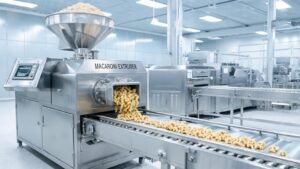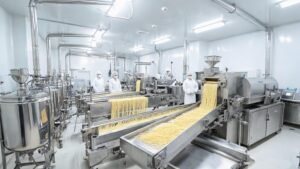
Building a successful food manufacturing business requires more than purchasing individual machines. A modern food production line is an integrated processing system that connects multiple machines, automation controls, and material handling equipment to transform raw ingredients into finished food products.
Whether you are starting a new food factory, expanding production capacity, or upgrading outdated equipment, understanding how production lines work helps manufacturers make better investment decisions.
This guide explains what a food production line is, how the process works, what equipment is required, different production line types, capacity planning, cost factors, and how manufacturers choose the right solution.
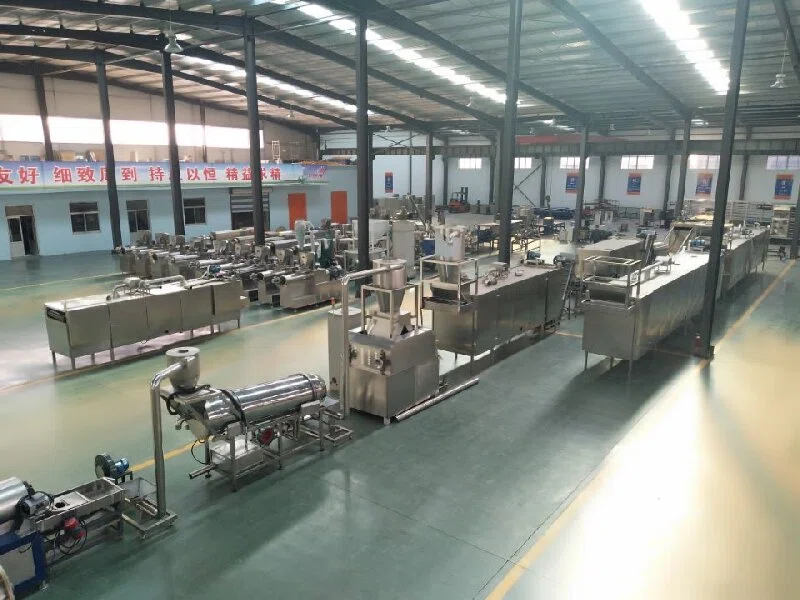
What Is a Food Production Line?
A food production line is a connected system of specialized food processing equipment designed to automatically convert raw materials into finished packaged products through multiple production stages.
Unlike traditional batch processing, where operators manually move materials between separate machines, an industrial production line creates a continuous workflow including:
- Raw material preparation
- Mixing and conditioning
- Cooking or processing
- Product forming
- Drying or cooling
- Flavoring
- Packaging
A complete production system improves:
- Production efficiency
- Product consistency
- Food hygiene
- Labor utilization
- Manufacturing scalability
Modern food production lines are widely used for manufacturing:
- Puffed snacks
- Breakfast cereals
- Pasta and macaroni
- Pet food
- Fish feed
- Textured vegetable protein
- Bread crumbs
For manufacturers planning a new factory, choosing the correct food production line configuration depends on product type, required capacity, available factory space, and future expansion plans.
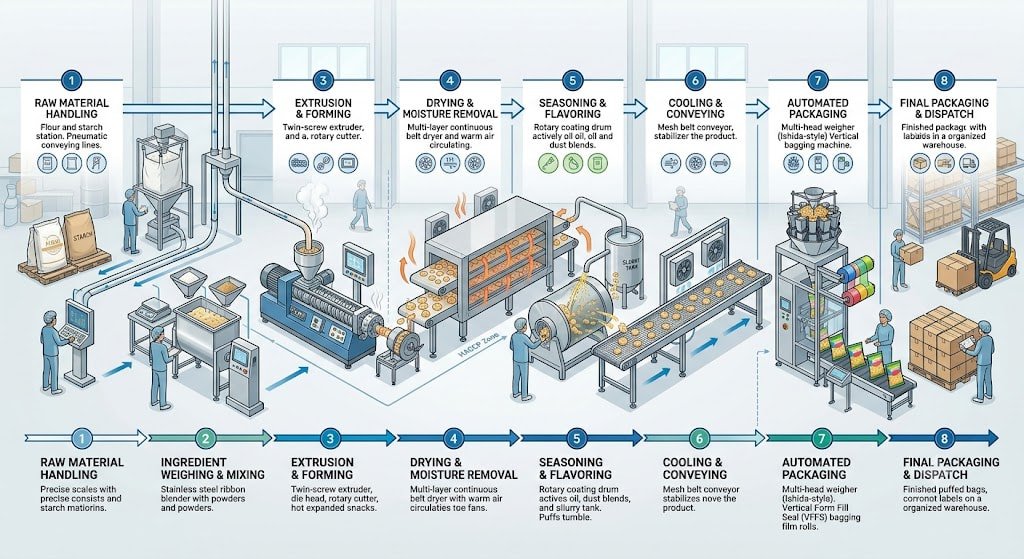
How Does a Food Production Line Work?
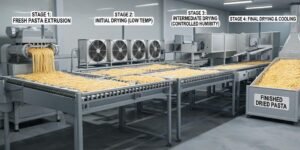
Although different products require different processing technologies, most modern automated food manufacturing systems follow a similar production workflow.
For extrusion-based food applications, the process usually includes the following stages:

Raw Material Dosing and Feeding
The production process begins with accurately measuring and feeding raw ingredients.
Common materials include:
- Corn flour
- Rice flour
- Wheat starch
- Potato starch
- Soy protein
Automatic dosing systems ensure that ingredients are supplied according to the correct formula, improving product stability and reducing material waste.
Mixing and Moisture Adjustment
After dosing, ingredients enter an industrial mixer where raw materials are evenly combined with controlled moisture levels.
Proper mixing is important because inconsistent moisture distribution can affect:
- Product expansion
- Texture
- Shape accuracy
- Processing stability
Material Conveying and Conditioning
After mixing, materials are transported through:
- Screw conveyors
- Pneumatic conveying systems
- Conditioning units
The conditioning stage prepares materials by controlling moisture and temperature before further processing.
This improves:
- Cooking performance
- Extrusion stability
- Final product quality
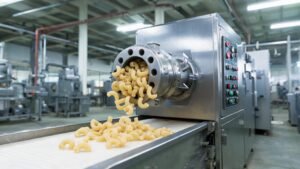
Cooking, Extrusion and Product Forming
For many modern food applications, the main processing unit is a food extruder machine.
During extrusion, materials are processed under controlled:
- Temperature
- Pressure
- Mechanical shear
The extrusion system cooks and shapes materials through customized dies.
By adjusting:
- Screw configuration
- Processing parameters
- Product molds
manufacturers can produce different shapes and textures.
Common applications include:
Drying and Moisture Control
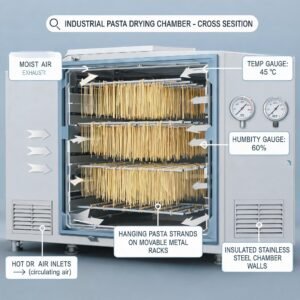
After forming, products enter drying equipment to remove excess moisture.
Industrial drying systems control:
- Temperature
- Air circulation
- Drying time
Proper drying improves:
- Shelf life
- Product texture
- Storage stability
Flavoring and Surface Treatment
For snack and cereal products, seasoning systems apply:
- Oil coating
- Powder seasoning
- Liquid flavoring
Uniform coating improves product taste and appearance.
Cooling and Packaging
The final stage includes cooling, weighing, and packaging.
Automatic packaging systems complete:
- Product weighing
- Filling
- Sealing
- Labeling
This allows manufacturers to achieve consistent output with reduced manual handling.
What Equipment Is Included in a Complete Food Production Line?
A complete production line includes multiple machines working together. The exact configuration depends on the final product and production requirements.
Industrial Mixer
The mixer combines raw ingredients and controls initial moisture distribution.
Main functions:
- Ingredient blending
- Moisture adjustment
- Recipe consistency control
Conveying System
Conveying equipment transfers materials between different processing stages.
Common options include:
- Screw conveyor
- Air conveyor
- Pneumatic conveying system
Advantages:
- Reduced manual operation
- Improved hygiene
- Continuous production flow
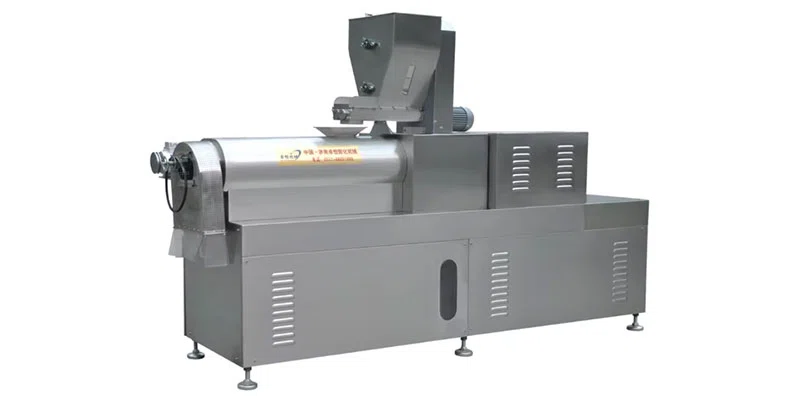
Twin Screw Extruder
The extruder is the core processing equipment in many extrusion-based applications.
A modern food extruder machine controls:
- Screw speed
- Barrel temperature
- Pressure
- Product shaping
Manufacturers select extrusion systems based on:
- Product type
- Capacity requirement
- Raw materials
- Desired texture
Industrial Dryer
Drying equipment removes moisture after product forming.
Dryer selection depends on:
- Product characteristics
- Production capacity
- Energy availability
Common heating methods include:
- Electricity
- Natural gas
- Steam
Seasoning System
Seasoning equipment applies flavor evenly to finished products.
Typical systems include:
- Rotary seasoning drum
- Oil spraying system
- Powder coating equipment
Packaging Equipment
Automatic packaging systems improve production efficiency by reducing manual packaging operations.
Main Types of Food Production Lines
Different food industries require different production line configurations.
Puffed Snack Production Line
A puffed snack production line is designed for products such as:
- Corn puffs
- Cheese balls
- Snack pellets
- Filled snack pillows
Typical equipment includes:
- Mixer
- Extruder
- Dryer
- Seasoning system
- Packaging machine
The main technical requirements are:
- High expansion rate
- Stable product shape
- Consistent texture
Breakfast Cereal Production Line
A breakfast cereal production line produces:
- Corn flakes
- Cereal loops
- Grain-based snacks
The system may include:
- Extrusion cooking
- Flaking rollers
- Roasting equipment
- Coating systems
Pet Food Production Line
A pet food production line is designed for manufacturing:
- Dog food kibble
- Cat food
- Animal nutrition products
The process usually includes:
Raw materials → Mixing → Conditioning → Extrusion → Drying → Coating → Packaging
Fish Feed Production Line
A fish feed production line produces floating and sinking aquaculture feed.
Important technologies include:
- Density control
- Extrusion processing
- Drying
- Oil coating
Pasta Production Line
A pasta production line is used for manufacturing:
- Macaroni
- Fusilli
- Short-cut pasta
The system focuses on:
- Dough consistency
- Precise shaping
- Controlled drying
Production Line Capacity Planning and Factory Layout
Selecting the correct production capacity is one of the most important decisions before investing in a food manufacturing system.
A production line that is too small may limit future growth, while excessive capacity can increase unnecessary investment and operating costs.
Manufacturers should consider:
- Current market demand
- Expected sales growth
- Factory space availability
- Daily operating hours
- Labor costs
- Future product expansion
Typical capacity ranges for extrusion-based food production systems include:
| Production Scale | Capacity Range | Suitable Application |
|---|---|---|
| Pilot / R&D Scale | 100-150 kg/h | Recipe development, product testing, startup factories |
| Commercial Scale | 200-300 kg/h | Growing brands and regional production |
| Industrial Scale | 500-1000+ kg/h | Large factories and continuous mass production |

A professional production line design should consider not only machine selection but also:
- Material flow direction
- Equipment placement
- Operator movement
- Maintenance space
- Energy supply
- Future expansion possibilities
For manufacturers planning a complete facility, working with an experienced supplier of industrial food processing equipment can help optimize the factory layout and production efficiency.
Food Production Line Cost: What Determines the Investment?
The cost of a food production line depends on many technical factors. There is no universal price because every production system is customized according to product requirements and factory conditions.
Small production systems may require an investment of tens of thousands of dollars, while large industrial turnkey solutions can reach several hundred thousand dollars.
The main cost factors include:
Production Capacity
Capacity is one of the biggest factors affecting investment.
Higher-output systems require:
- Larger motors
- Stronger mechanical structures
- Bigger drying systems
- Higher automation levels
For example, a 100 kg/h startup system and a 1000 kg/h industrial production line require completely different engineering designs.
Automation Level
Automation influences both initial investment and long-term operating costs.
Advanced systems may include:
- Automatic feeding
- PLC control systems
- Automated weighing
- Packaging integration
Although automation increases initial costs, it can reduce manual labor requirements and improve production consistency.
Product Type and Processing Requirements
Different products require different configurations.
For example:
Snack production may require:
- High expansion extrusion
- Seasoning systems
- Special shaping dies
Pet food production may require:
- Pre-conditioning
- High-pressure extrusion
- Fat coating systems
Pasta production may require:
- Vacuum extrusion
- Precision drying control
Equipment Materials and Hygiene Standards
Food processing equipment commonly uses stainless steel construction because of:
- Corrosion resistance
- Easy cleaning
- Food safety requirements
- Long service life
The final cost depends on:
- Stainless steel grade
- Contact surface requirements
- Machine structure
- Sanitation design
Energy Configuration
Drying and heating systems can be designed according to local energy conditions.
Common options include:
- Electricity
- Natural gas
- Steam heating
The best solution depends on:
- Local energy costs
- Factory infrastructure
- Production requirements
Example Engineering Application: 500kg/h Puffed Snack Production Line
A typical industrial snack manufacturer may require a production system capable of producing multiple expanded snack products with stable quality and high efficiency.
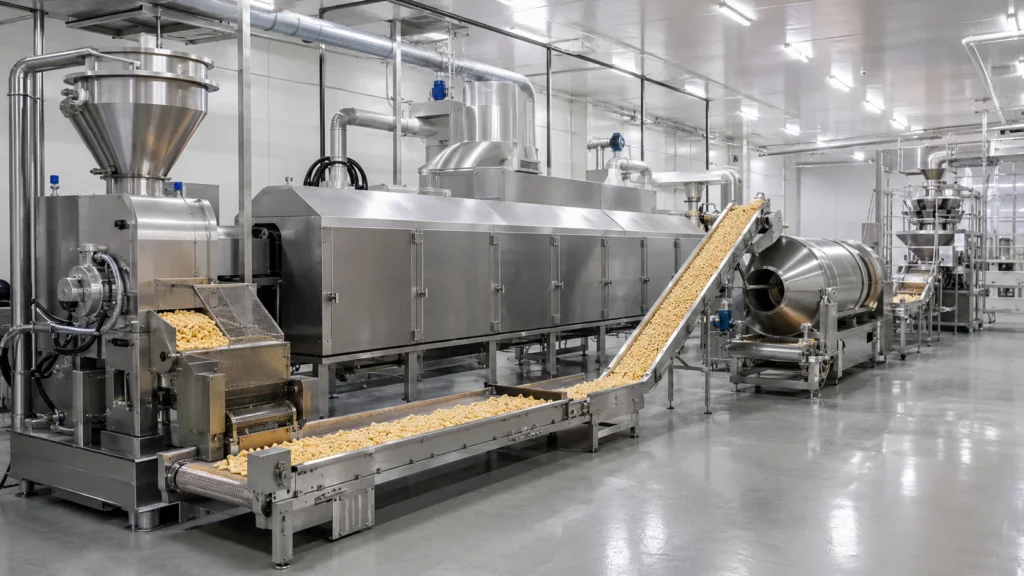
Product Application
Production of:
- Core-filled snack pillows
- Corn puffs
- Cheese balls
Target Capacity
400-500 kg/hour
Typical Equipment Configuration
Engineering Requirements
Typical factory requirements include:
- Higher production capacity
- Reduced manual handling
- Stable product quality
- Flexible product changeover
A customized production system can be configured according to:
- Product formula
- Output requirements
- Factory space
- Energy availability
How to Choose the Right Food Production Line Manufacturer?
Selecting the right supplier is an important step because a production line is a long-term investment.
A reliable manufacturer should provide more than individual machines. They should understand production processes, factory requirements, and long-term operation needs.
Check Manufacturing Experience
Important evaluation factors include:
- Years of equipment manufacturing experience
- Previous installation projects
- Industry knowledge
- Engineering capability
A supplier with experience across multiple food industries can provide more suitable recommendations.
Evaluate Complete Engineering Capability
A professional production line manufacturer should support:
- Production process design
- Equipment configuration
- Factory layout planning
- Installation guidance
- Operator training
A complete turnkey approach reduces integration problems between different suppliers.
Consider Customization Ability
Every factory has different requirements.
A customized solution should consider:
- Raw materials
- Product specifications
- Production capacity
- Factory dimensions
- Automation goals
For example, a snack factory and a pet food factory may both use extrusion technology, but their equipment configuration is completely different.
Review After-Sales Support
Long-term operation requires technical support.
Important services include:
- Spare parts supply
- Remote troubleshooting
- Maintenance guidance
- Production optimization support
Why Choose Zhuoheng for Food Production Solutions?
Zhuoheng focuses on designing customized extrusion-based food processing systems for global manufacturers.
With more than 15 years of experience in food extrusion technology, Zhuoheng provides engineering support covering:
- Production line design
- Equipment manufacturing
- Factory layout assistance
- Installation guidance
- Technical training
Instead of supplying only standalone machines, Zhuoheng develops complete solutions based on:
- Product requirements
- Production capacity
- Factory conditions
- Business goals
Manufacturers looking for customized food production line solutions can work with Zhuoheng to develop a suitable processing system for their products.
Frequently Asked Questions About Food Production Lines
What is the difference between a food production line and individual machines?
A standalone machine completes one processing step, while a complete production line connects multiple machines into an automated workflow.
A production line integrates:
- Material preparation
- Processing
- Forming
- Drying
- Packaging
This reduces manual handling and improves production consistency.
How much does a food production line cost?
The cost depends on:
- Production capacity
- Product type
- Automation level
- Equipment configuration
- Factory requirements
Small systems may require tens of thousands of dollars, while large industrial production lines may require several hundred thousand dollars.
A customized quotation is necessary because each project has different technical requirements.
What equipment is included in a food production line?
A complete system may include:
- Mixer
- Conveyor system
- Extruder
- Dryer
- Seasoning equipment
- Cooling system
- Packaging equipment
The exact configuration depends on the final product.
Can one production line make different food products?
Yes, many modern extrusion-based production systems use modular designs.
Manufacturers can change:
- Dies
- Screw configurations
- Processing parameters
to produce different product shapes and textures.
How many workers are needed for an automated food production line?
The required workforce depends on:
- Automation level
- Product type
- Packaging method
A highly automated system usually requires only several operators for:
- Monitoring production
- Loading materials
- Checking quality
- Managing packaging
How long does it take to install a food production line?
The timeline depends on:
- Equipment complexity
- Factory preparation
- Shipping distance
- Installation requirements
The general process includes:
- Equipment manufacturing
- Factory testing
- Shipping
- Installation
- Commissioning
- Operator training
How do I choose the right production line capacity?
Capacity selection should be based on:
- Current production demand
- Future growth expectations
- Factory space
- Investment budget
Startups often choose smaller systems for market validation, while established manufacturers usually select larger continuous production lines.
Learn More About Food Production Line Solutions
A successful food manufacturing project requires the right combination of processing technology, equipment configuration, and engineering support.
By understanding workflow, equipment requirements, capacity planning, and cost factors, manufacturers can make better decisions when investing in a new production system.
To explore customized options, learn more about Zhuoheng: