Understanding the Pasta Manufacturing Landscape
Before you spend a single dollar on machinery, you need to understand the market you’re entering. The global pasta market is mature but far from stagnant. What’s driving growth today isn’t the cheap, mass-produced dry pasta on supermarket shelves—it’s the premium fresh and artisanal segments. Consumers are willing to pay more for pasta that tastes homemade, has a rough bronze-drawn texture, and is made with clean ingredients.
The beauty of pasta manufacturing is its scalability. You can start with a small tabletop extruder and expand to a fully automated line when demand justifies the investment. But the key is to choose equipment that won’t hold you back as you grow.
The Golden Rule: Match Equipment to Your Stage
There are three typical entry points into this business. Each comes with its own cost structure, production capacity, and target market.
- Home Micro-Business – Production under 5 kg per hour, typically for farmers’ markets and local delis. Setup cost: $800–$1,500.
- Small Commercial Workshop – Production between 10 and 30 kg per hour, serving restaurants and specialty grocers. Setup cost: $15,000–$40,000.
- Industrial Production Line – Production exceeding 100 kg per hour, targeting supermarket chains or export. Setup cost: $100,000+.
Knowing which tier you belong to will save you from over-investing or under-equipping. Most of this guide focuses on the second and third tiers—the spaces where serious profit margins live.
Essential Equipment for Your Pasta Plant Setup
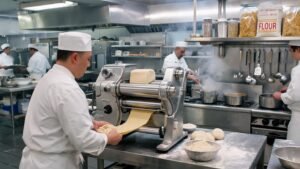
The heart of any pasta factory is the extruder. While sheeters (rollers) work well for flat pasta like lasagna sheets or tagliatelle, an extruder is the workhorse for shapes like macaroni, fusilli, rigatoni, and spaghetti. Here’s what you need to know.
The Extruder: Why It Matters
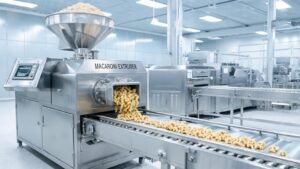
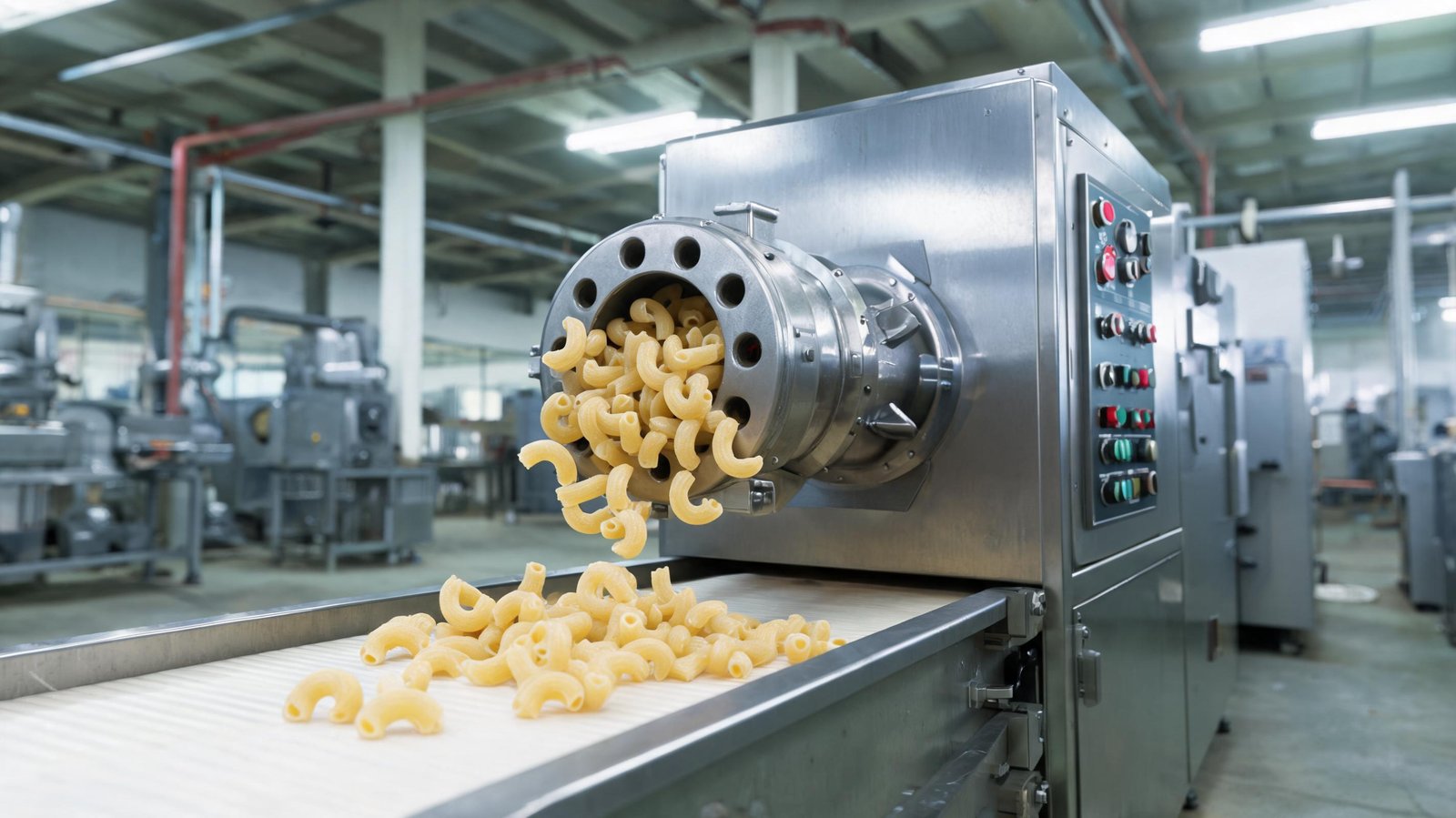
A pasta extruder forces dough through a metal die under high pressure. This method allows you to produce dozens of different shapes by simply swapping the die. For a commercial operation, an extruder is non-negotiable. It delivers consistent density, uniform shape, and the ability to handle low-hydration dough (around 30–32% moisture) that yields a firmer, better-cooking pasta.
When you’re shopping for an extruder, look for these features:
- Motor power and torque – Low-power machines struggle with dense semolina dough, especially if you plan to make gluten-free or alternative-grain pasta.
- Water-cooling jacket – Friction generates heat. If the extrusion barrel gets too hot (above 45°C), the gluten degrades, and your pasta becomes mushy. A water-cooling system lets you run production for hours without quality loss.
- Die compatibility – Make sure the machine accepts standard bronze dies, which are preferred for premium pasta.
At Zhuohengextruder, our commercial pasta extruders are built with heavy-duty motors and integrated cooling circuits. We’ve seen too many startups buy cheap machines that fail after three months of daily use.
Bronze vs. Teflon Dies: The Secret to Sauce Cling
This choice defines your product’s character. Bronze dies produce pasta with a rough, porous surface—think sandpaper texture. Sauce clings to it beautifully, and food critics love it. The downside: extrusion is slower, and the pasta appears paler (more off-white than bright yellow).
Teflon dies, on the other hand, create a slick, shiny surface. The pasta looks vibrant and yellow, and production is faster. But sauce tends to slide off. For retail packaging, Teflon-drawn pasta often looks more appealing on the shelf, while bronze-drawn pasta sells better in premium restaurants.
Many serious pasta makers keep both types of dies on hand, offering different product lines.
Drying Systems: Static vs. Tunnel Dryers
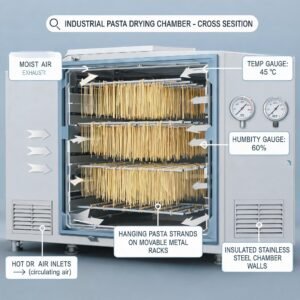
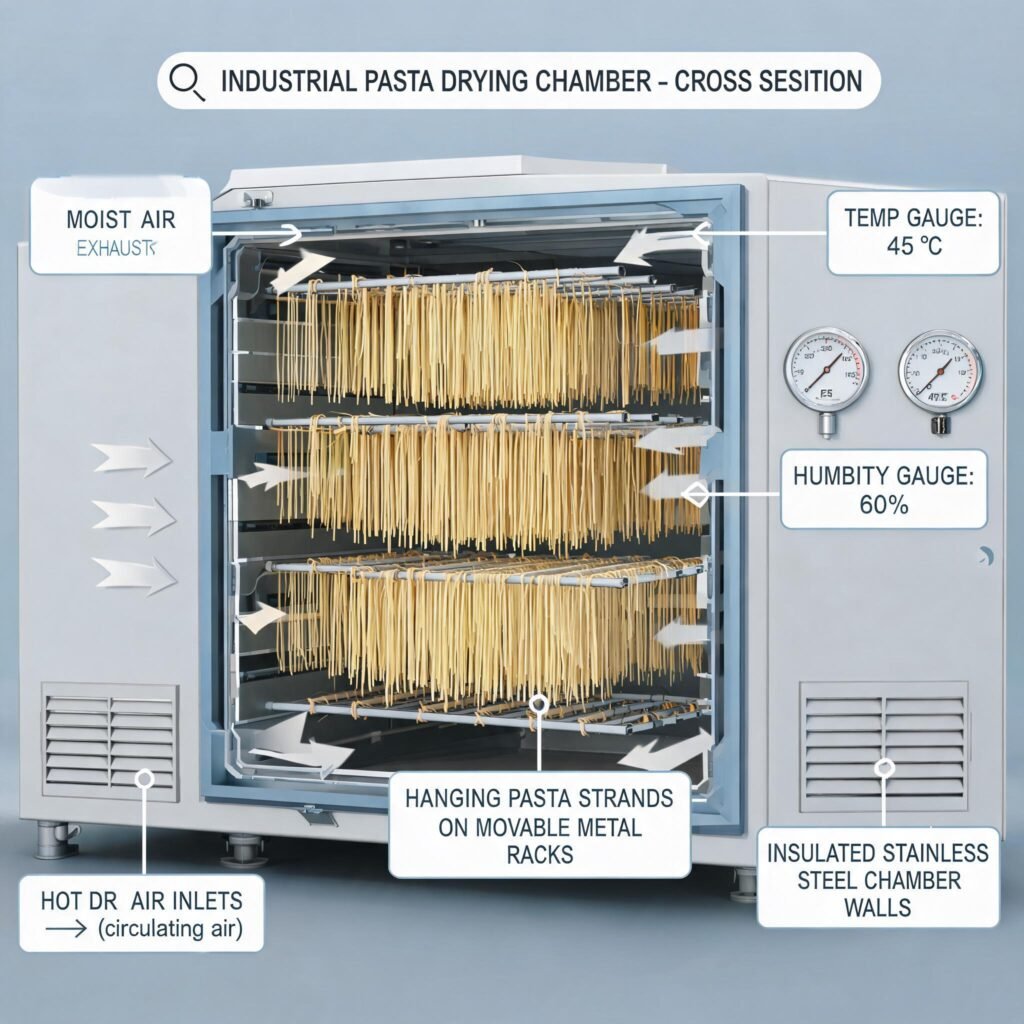
Drying is where most beginners stumble. Fresh pasta has a moisture content of around 30%. To make it shelf-stable (dry pasta), you need to reduce that to 12.5% slowly and evenly. If you rush it, the pasta cracks. If you take too long, mold grows.
- Static dryers – Ideal for small workshops (under 50 kg per batch). Pasta is loaded onto trays or sticks and left to dry in a controlled environment for 8–12 hours. These are affordable and give you flexibility.
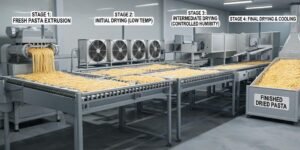
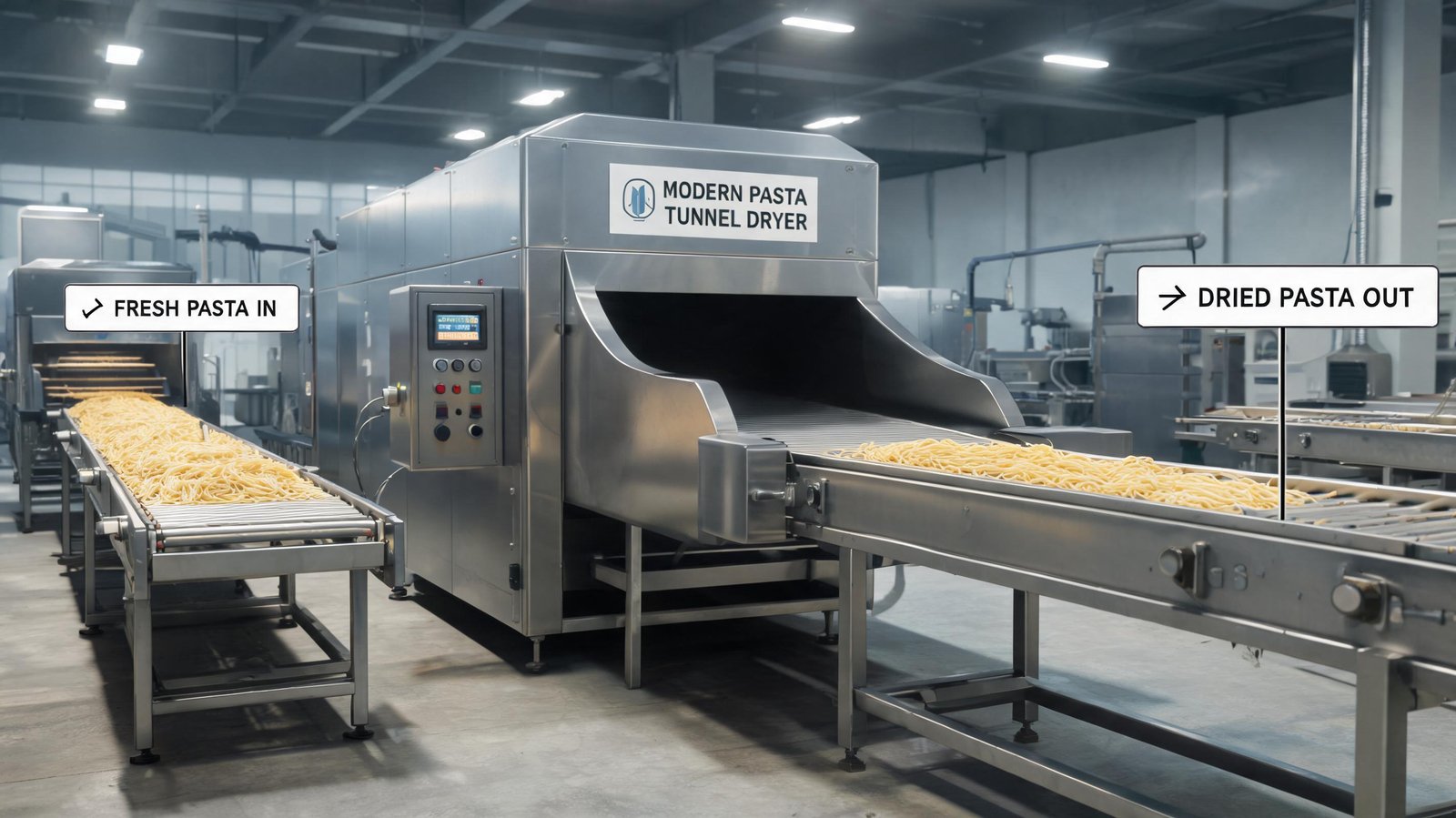
- Tunnel dryers – For industrial volumes (100+ kg per hour). Pasta moves through a series of temperature and humidity zones on a conveyor belt. The process is automated and consistent, but the investment is significant.
A common mistake is thinking you can skip a proper dryer and just air-dry pasta. That works for fresh pasta (sold refrigerated) but not for dry pasta that must meet legal moisture standards for a 2–3 year shelf life.
Packaging and Sealing
For dry pasta, a simple vertical form-fill-seal machine works, but industrial producers usually invest in automated weighing, filling, and cartoning systems to improve speed and reduce labor costs.
When selecting packaging equipment, consider:
Packaging material compatibility – Pasta packaging must protect against moisture, oxygen, and physical damage during transportation. Common materials include laminated plastic films, paper-based packaging, and recyclable mono-material solutions.
Filling accuracy – Small weight variations may seem insignificant, but at industrial scale, inaccurate filling creates thousands of dollars in annual product loss.
Production speed – A small workshop may only require 20–40 bags per minute, while large pasta factories often need packaging systems capable of 80–120+ bags per minute.
Shelf-life requirements – Export markets often require stronger moisture barriers and longer shelf stability compared with local fresh pasta sales.
For growing pasta businesses, packaging should not be treated as an afterthought. A well-designed production line considers extrusion, drying, and packaging as one connected system.
Designing Your Pasta Production Workflow
A successful pasta factory is not just a collection of individual machines. It is a coordinated production system where each stage affects the final product quality.
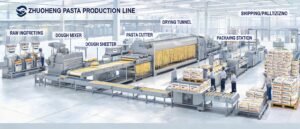
A typical commercial pasta production process includes:
1. Raw Material Preparation
High-quality pasta begins with the right ingredients. Traditional Italian-style pasta uses durum wheat semolina because it provides excellent elasticity, golden color, and firm texture after cooking.
However, modern manufacturers are expanding into alternative categories:
- Gluten-free pasta made from rice, corn, or legumes
- High-protein pasta using chickpeas, peas, or soy
- Functional pasta enriched with vitamins, fiber, or minerals
- Organic pasta targeting premium consumers
Each formulation creates different processing challenges. High-protein and gluten-free recipes often require stronger extrusion systems because they behave differently from traditional wheat dough.
2. Mixing and Hydration
Unlike bread dough, pasta dough contains relatively little water. The typical hydration level is around 30–32%, creating a stiff, granular dough rather than a soft elastic mass.
A commercial pasta mixer must achieve:
- Uniform water distribution
- Consistent dough particle size
- Complete ingredient blending
- Stable feeding into the extruder
Poor mixing creates problems later, including uneven color, surface cracks, and inconsistent cooking performance.
Many small producers underestimate the importance of this stage and focus only on the extruder. In reality, pasta quality depends on the entire process chain.
3. Vacuum Extrusion
Professional pasta factories increasingly use vacuum extrusion technology because removing trapped air improves product quality.
During normal mixing, microscopic air bubbles can become trapped inside the dough. These bubbles may cause:
- White spots inside pasta
- Surface cracks during drying
- Reduced mechanical strength
- Poor cooking resistance
A vacuum pasta extruder removes these air pockets before shaping, producing denser and more transparent pasta with better texture.
For premium retail brands and export-oriented factories, vacuum extrusion has become a standard feature rather than an optional upgrade.
How Much Does It Cost to Start a Pasta Manufacturing Business?
The investment required depends heavily on your production target, automation level, and product positioning.
Here is a realistic cost breakdown:
| Business Scale | Production Capacity | Main Equipment | Estimated Investment |
|---|---|---|---|
| Small Workshop | 10–30 kg/hour | Mixer + Extruder + Small Dryer + Packaging | $15,000–$40,000 |
| Medium Factory | 50–100 kg/hour | Automatic Extrusion Line + Continuous Dryer + Packaging System | $50,000–$150,000 |
| Industrial Plant | 200–500+ kg/hour | Complete Automated Pasta Production Line | $200,000–$1 million+ |
The biggest mistake new investors make is buying equipment based only on today’s demand.
A machine that perfectly matches your first six months of production may become a bottleneck when you win larger customers.
A better approach is to evaluate:
- Expected sales growth over 3–5 years
- Potential export opportunities
- Future product expansion
- Available factory space
- Labor availability
Choosing scalable equipment allows your business to grow without replacing your entire production system.
Common Mistakes When Setting Up a Pasta Factory
Many new pasta entrepreneurs fail not because the market is difficult, but because they underestimate the technical requirements.
Mistake 1: Buying Equipment Based Only on Price
The cheapest pasta extruder is rarely the most economical choice.
Low-cost machines often compromise on:
- Motor durability
- Screw strength
- Cooling performance
- Spare parts availability
- Continuous operating capability
A machine that breaks frequently creates hidden costs through downtime, maintenance, and missed orders.
For commercial production, reliability is usually more valuable than a lower purchase price.
Mistake 2: Ignoring Drying Technology
Extrusion gets attention because it is the most visible part of pasta production, but drying determines whether your product succeeds.
Improper drying can cause:
- Cracked pasta
- Uneven color
- Poor cooking quality
- Short shelf life
Professional pasta manufacturers carefully control:
- Temperature
- Humidity
- Air velocity
- Drying time
A good drying system protects the investment made in every previous production step.
Mistake 3: Choosing the Wrong Production Capacity
A 20 kg/hour machine and a 200 kg/hour industrial line serve completely different business models.
Before purchasing equipment, calculate:
Required production capacity = Expected daily sales ÷ Available production hours
For example:
If your target is producing 800 kg of pasta per day and your factory operates 8 hours:
800 kg ÷ 8 hours = 100 kg/hour required capacity
This simple calculation prevents both over-investment and production shortages.
Fresh Pasta vs Dry Pasta Manufacturing: Which Business Model Is Better?
Before building your factory, decide what type of pasta business you want to operate.
Fresh Pasta Business
Advantages:
- Lower initial investment
- Faster product development
- Premium pricing opportunities
- Strong local restaurant demand
Challenges:
- Short shelf life
- Refrigerated storage required
- Limited shipping distance
Fresh pasta works well for:
- Restaurants
- Specialty food stores
- Local delivery businesses
- Boutique food brands
Dry Pasta Business
Advantages:
- Long shelf life
- Easier transportation
- Export-friendly
- Suitable for large-scale production
Challenges:
- Higher equipment investment
- More complex drying requirements
- Stronger competition
Dry pasta is ideal for:
- Supermarket brands
- Private label manufacturing
- International distribution
Many successful pasta companies eventually operate both models: fresh pasta for local premium customers and dry pasta for scalable retail growth.
Choosing the Right Pasta Extruder Manufacturer
Selecting a machine supplier is one of the most important decisions when starting a pasta manufacturing business.
A reliable supplier should provide more than equipment. Look for a partner who understands your complete production process.
Important evaluation criteria include:
Engineering Capability
A professional manufacturer should be able to recommend:
- Suitable extrusion capacity
- Die configurations
- Drying solutions
- Packaging integration
- Production layout design
Customization Options
Every pasta business is different. Your supplier should adapt equipment based on:
- Factory space
- Product types
- Local electrical standards
- Production targets
Technical Support
Before purchasing, ask about:
- Installation guidance
- Operator training
- Spare parts supply
- Remote troubleshooting
- Maintenance recommendations
A pasta production line is a long-term investment. The right equipment partner can significantly reduce operational risks.
Final Thoughts: Building a Profitable Pasta Manufacturing Business
Starting a pasta manufacturing business requires more than purchasing a machine and producing noodles. The most successful manufacturers combine market understanding, reliable equipment, efficient production processes, and strong product positioning.
The ideal setup depends on where you are starting:
- A small entrepreneur may begin with a compact pasta extruder and grow gradually.
- A restaurant supplier may need a medium-capacity commercial line.
- An established food company may require a fully automated industrial pasta production system.
The key is choosing equipment that matches your current needs while leaving room for future expansion.
At Zhuohengextruder, we help pasta manufacturers design production solutions from individual commercial extruders to complete automated pasta production lines. With the right technology and planning, pasta manufacturing can become a scalable food business serving both local and international markets.
Frequently Asked Questions About Starting a Pasta Manufacturing Business
How much does it cost to start a small pasta manufacturing business?
The cost of starting a pasta manufacturing business depends mainly on production capacity, automation level, and product type.
A small commercial pasta workshop usually requires an investment of approximately $15,000–$40,000 for basic equipment, including:
- Commercial pasta extruder
- Dough mixer
- Cutting system
- Small drying equipment
- Basic packaging equipment
This type of setup is suitable for supplying:
- Local restaurants
- Specialty food stores
- Farmers’ markets
- Regional distributors
A larger factory producing pasta for supermarkets or export markets requires significantly more investment because it needs:
- Automatic feeding systems
- Continuous drying tunnels
- Advanced packaging machines
- Quality control equipment
- Material handling systems
The best investment strategy is usually to start with equipment that matches your expected sales volume while allowing future expansion.
What equipment is needed for a complete pasta production line?
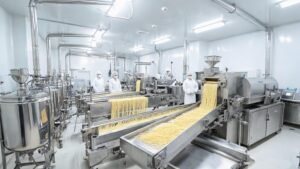
A complete pasta manufacturing line normally includes several connected systems:
Raw Material Handling System
Responsible for transferring and measuring ingredients such as:
- Durum wheat semolina
- Flour
- Water
- Additives or functional ingredients
Large factories often use automatic dosing systems to improve accuracy and reduce labor.
Pasta Mixing System
The mixer combines flour and water into a uniform dough.
A good industrial mixer should provide:
- Stable mixing performance
- Short processing time
- Low heat generation
- Easy cleaning
The mixing stage directly affects extrusion stability and final pasta texture.
Vacuum Pasta Extruder
The extruder is the core machine of the production line.
It performs three important functions:
- Compresses the dough under controlled pressure
- Removes air through vacuum treatment
- Shapes pasta through interchangeable dies
Modern commercial extruders can produce:
- Spaghetti
- Macaroni
- Penne
- Fusilli
- Shell pasta
- Custom pasta shapes
By changing dies, manufacturers can create different product lines without replacing the main machine.
Cutting and Pre-Drying System
After extrusion, pasta must be cut into specific lengths and prepared for drying.
This stage controls:
- Product appearance
- Shape consistency
- Drying efficiency
For short-cut pasta such as macaroni and fusilli, automatic cutting systems improve production speed and reduce waste.
Drying System
Drying is one of the most technically important parts of pasta production.
Industrial dryers maintain controlled:
- Temperature
- Relative humidity
- Air circulation
The goal is to remove moisture gradually while maintaining:
- Pasta strength
- Cooking quality
- Color stability
Packaging System
The final stage prepares pasta for:
- Retail shelves
- Wholesale distribution
- Export shipping
Depending on production scale, packaging may include:
- Semi-automatic weighing systems
- Vertical packaging machines
- Cartoning systems
- Palletizing systems
Small Pasta Factory Layout Design
A well-designed factory layout improves efficiency, reduces labor requirements, and prevents unnecessary movement of materials.
A typical pasta production workflow follows a linear arrangement:
Raw Material Storage
↓
Ingredient Mixing Area
↓
Vacuum Extrusion Section
↓
Cutting Area
↓
Drying Tunnel
↓
Quality Inspection
↓
Packaging Area
↓
Finished Product WarehouseThe layout should consider:
- Production flow direction
- Food hygiene requirements
- Worker movement
- Maintenance access
- Future expansion space
A common mistake is designing a factory based only on current equipment dimensions. A better approach is to reserve additional space for:
- Larger dryers
- Additional packaging machines
- Extra storage
- Future automation upgrades
Pasta Production Capacity Planning
Before selecting equipment, manufacturers should calculate their actual production requirements.
Capacity depends on:
- Working hours per day
- Number of production shifts
- Product type
- Drying time
- Packaging speed
For example:
A factory producing:
- 1,000 kg/day
- Operating 10 hours/day
requires approximately:
1,000 ÷ 10 = 100 kg/hour production capacity
However, real factories should include additional capacity margins because production rarely operates at 100% efficiency.
A practical calculation is:
Required machine capacity = Target output ÷ 80% efficiency factor
Using the previous example:
100 kg/hour ÷ 0.8 = 125 kg/hour recommended capacity
This allows room for:
- Machine cleaning
- Product changes
- Maintenance
- Production fluctuations
Manual vs Automatic Pasta Production Lines
Choosing between manual and automated production depends on business goals.
Manual or Semi-Automatic Production
Suitable for:
- Small businesses
- Restaurants
- Local brands
Advantages:
- Lower investment
- Easier operation
- Flexible production
Disadvantages:
- Higher labor cost
- Lower output
- Less consistency
Fully Automatic Pasta Production Line
Suitable for:
- Large manufacturers
- Export companies
- Private label suppliers
Advantages:
- Higher productivity
- Stable quality
- Reduced labor dependency
- Easier scaling
Disadvantages:
- Higher initial investment
- More complex maintenance
- Requires trained operators
For businesses planning long-term growth, automation often provides better return on investment.
Energy Consumption in Pasta Manufacturing
Energy efficiency has become an increasingly important factor in food manufacturing.
The main energy-consuming stages are:
Extrusion
The extruder motor requires significant power because it compresses dense pasta dough under high pressure.
Energy consumption depends on:
- Motor size
- Production capacity
- Dough formulation
- Extrusion pressure
Drying
Drying is usually the largest energy expense in pasta production.
Modern drying systems improve efficiency through:
- Heat recovery systems
- Optimized airflow
- Multi-stage temperature control
Although energy-efficient dryers require higher initial investment, they can significantly reduce operating costs over years of production.
Quality Control Standards for Commercial Pasta Production
Professional pasta manufacturers need consistent quality control from raw materials to finished products.
Important quality indicators include:
Moisture Content
Dry pasta usually requires moisture control around the industry standard range to ensure:
- Long shelf life
- Reduced microbial risk
- Stable storage
Cooking Quality
Premium pasta should maintain:
- Firm texture
- Low cooking loss
- Good shape retention
Testing typically includes:
- Cooking time measurement
- Texture evaluation
- Water absorption analysis
Appearance
Visual inspection checks:
- Color consistency
- Surface texture
- Shape accuracy
- Cracking or deformation
Bronze-die pasta is often preferred in premium markets because its rough surface improves sauce adhesion.
Future Trends in Pasta Manufacturing
The pasta industry continues to evolve as consumer preferences change.
Growth of Functional Pasta
Demand is increasing for pasta products containing:
- Higher protein
- More fiber
- Plant-based ingredients
- Added nutrition
This creates opportunities for manufacturers who can adapt extrusion technology to new formulations.
Sustainable Production
Modern pasta factories are focusing on:
- Lower energy consumption
- Reduced packaging waste
- Efficient water usage
- Environmentally friendly materials
Sustainability is becoming an important purchasing factor for both consumers and large retailers.
Smart Manufacturing
Industry 4.0 technologies are entering pasta production through:
- Digital production monitoring
- Automated quality tracking
- Remote equipment diagnostics
- Data-based maintenance scheduling
Smart production systems help manufacturers reduce downtime and improve efficiency.