Good snack flavor does not come from seasoning powder alone.
In real snack production, the same cheese powder, barbecue seasoning, chili blend, or sweet coating can perform very differently on two production lines. One factory may produce crispy, evenly coated snacks with a strong aroma and clean bite. Another factory may use a similar flavor formula but still struggle with weak taste, uneven color, seasoning dust, oil spots, soft texture, or powder falling to the bottom of the bag.
The difference is usually not just the recipe.
Flavor performance depends on the complete process: extrusion, drying, cooling, oil spraying, powder dosing, tumbling, conveying, and packaging. If the snack base is not properly dried, the seasoning system has to fight against unstable moisture. If the product enters the seasoning drum at the wrong temperature, oil may not spread evenly. If the oil spray is not controlled, the seasoning powder may not attach well. If the drum speed is too high, fragile puffed snacks may break. If the drum speed is too low, coating may be incomplete.
For food processing companies, snack flavor should be treated as a production-line result, not a single-machine result.
This is especially true for puffed snacks. A puffed snack is light, porous, and fragile. Its internal structure affects crispness. Its surface texture affects oil absorption. Its moisture level affects shelf life. Its shape affects seasoning coverage. A good flavoring system can only perform well when the snack base is ready to carry flavor.
For factories planning to produce corn puffs, cheese balls, rice snacks, cereal snacks, pellet snacks, fried extruded snacks, or baked puffed products, a well-designed Puffed Food Machine system should be planned around both texture and flavor. The final product consumers taste is not created only in the seasoning drum. It starts much earlier in the process.
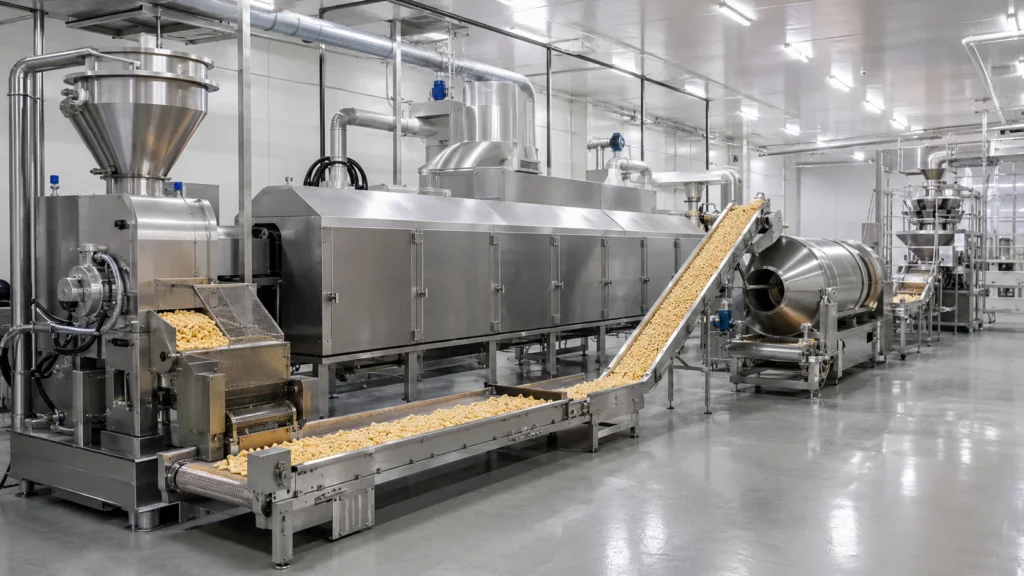
Why Snack Flavor Depends on More Than Seasoning Powder
When snack flavor is weak or inconsistent, many factories first blame the seasoning powder supplier. Sometimes that is the right place to start. Poor seasoning powder may have unstable flavor oil, uneven particle size, weak aroma retention, poor anti-caking performance, or too many coarse salt crystals.
In daily factory operation, however, many flavor problems come from process instability.
A seasoning powder needs the right surface to attach to. That surface is created by moisture control, puffing structure, drying quality, cooling time, and oil distribution.
A puffed snack with good flavor potential usually has:
- stable expansion
- low but controlled final moisture
- porous internal structure
- slightly textured surface
- uniform size and shape
- enough strength to survive tumbling
- consistent temperature before seasoning
If any of these points are unstable, the seasoning result will also be unstable.
A common mistake is to add more seasoning powder when the flavor seems weak. That may increase cost, but it does not always solve the real issue. If the snack surface does not have enough oil, the extra powder will simply fall off. If the product is still too wet after drying, the powder may clump. If the product is too hot, volatile flavor notes may disappear too quickly. If the drum is poorly adjusted, some pieces will be over-seasoned while others remain almost plain.
In industrial snack production, stronger flavor is not only about adding more powder. It is about helping the powder attach evenly and stay on the product until the customer opens the bag.
The Complete Flavor-Building Process for Puffed Snacks
A typical puffed snack production line may include:
- Raw material mixing
- Moisture adjustment or pre-conditioning
- Extrusion and puffing
- Cutting and shaping
- Continuous drying or baking
- Cooling and moisture stabilization
- Oil spraying or slurry coating
- Dry powder seasoning
- Tumbling and flavor absorption
- Final cooling or conditioning
- Weighing and packaging
Each step changes the final eating experience.
Raw material mixing affects extrusion stability. Extrusion affects expansion and pore structure. Drying affects crispness. Cooling affects oil behavior. Oil spraying affects powder adhesion. Tumbling affects coating uniformity. Packaging protects the final texture.
On many production lines, flavor problems are actually drying problems. The seasoning drum may look like the problem because that is where the flavor is added, but the root cause may be earlier in the line.
For example, if one batch leaves the dryer at 3.5% moisture and the next batch leaves at 6.5%, the same seasoning recipe will not behave the same way. The drier product may taste crisp but lose powder more easily. The wetter product may hold powder at first but become soft after packaging.
A stable production line keeps moisture, temperature, flow rate, oil ratio, and seasoning ratio under control. Once those basics are stable, flavor development becomes much easier.
Build the Right Snack Base Before Seasoning
Before choosing a seasoning drum or powder feeder, the first question should be simple:
Is the snack base good enough to season?
A good puffed snack base should have stable shape, controlled density, and enough surface area to carry flavor. If the snack is too dense, it may not absorb oil well. If it is over-expanded, it may break during conveying or tumbling. If the surface is too smooth, seasoning adhesion becomes difficult. If the shape is inconsistent, flavor distribution becomes uneven.
Raw materials also matter. Corn flour, rice flour, wheat flour, potato starch, tapioca starch, and mixed grains all behave differently during extrusion. Starch-based snacks usually create a lighter structure. Protein-rich formulas may need more careful moisture and temperature control. High-fiber formulas may create rougher textures and may require different screw configurations.
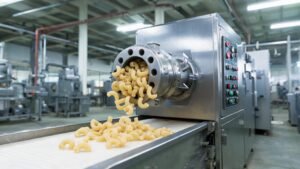
From a manufacturer’s point of view, the extruder should not be selected only by motor power or output capacity. It should be matched to the target product. Screw design, barrel temperature, feeding stability, cutter speed, mold shape, and dryer connection all affect the final snack.
A Snack Puffing Machine used for cheese balls may not have the same configuration as a line used for cereal rings or protein puffs. The base product decides how the later drying and seasoning sections should be designed.
Moisture Control: The Foundation of Crispness and Flavor
Moisture is one of the most important variables in snack production.
Before extrusion, moisture affects cooking, starch gelatinization, expansion, and product shape. After extrusion, moisture affects crispness, seasoning adhesion, shelf life, and mouthfeel.
If the raw material moisture is too high, the snack may puff poorly or require longer drying. If it is too low, expansion may become uneven, and the product may turn hard or rough. After puffing, most products still contain too much moisture for final packaging, so drying is required.
The goal is not only to reach a moisture number. The real goal is moisture uniformity.
Uneven moisture creates many quality problems:
- Some pieces absorb more oil than others.
- Powder sticks heavily to wetter areas.
- Drier pieces may taste weak.
- Wet pieces may become soft after packaging.
- Flavor intensity varies from bite to bite.
- Powder may clump on the product surface.
- Shelf life becomes less predictable.
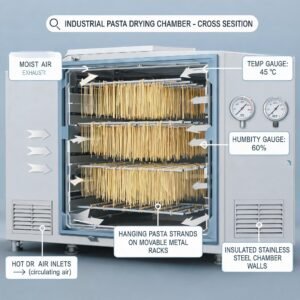
For industrial production, a snack drying system continuous setup is usually more stable than manual or batch-style drying. A continuous dryer can control belt speed, temperature zones, airflow direction, product bed thickness, and residence time. These controls help the factory produce snacks with more consistent moisture and better flavor performance.
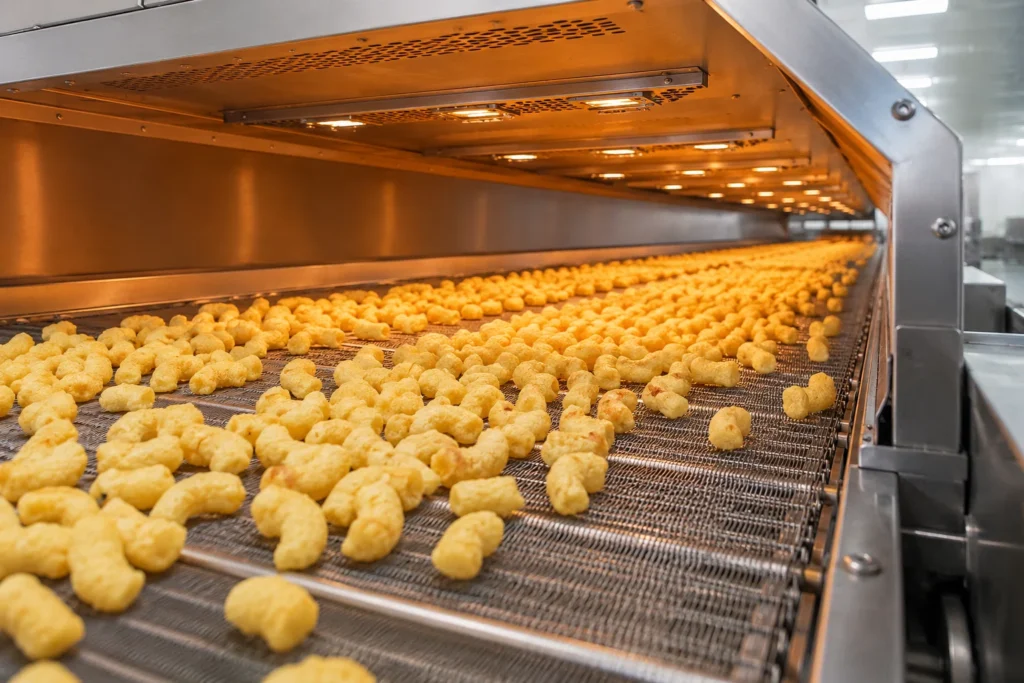
Traditional Batch Drying vs. Continuous Belt Drying
Many small factories start with batch drying because the initial investment is lower. For trial production or small local batches, this can be acceptable. As production grows, batch drying often becomes a bottleneck.
Continuous belt drying is more suitable for factories that need stable output, consistent flavor, and repeatable quality. It allows the product to move through controlled heating zones instead of relying heavily on manual loading, unloading, and operator judgment.
The following comparison gives a practical view for decision-makers.
| Comparison Item | Traditional Batch Drying | Continuous Belt Drying |
|---|---|---|
| Typical production mode | Manual loading and unloading | Continuous automatic feeding and discharge |
| Suitable capacity | Small batch production | Medium to large industrial production |
| Moisture uniformity | Medium, depends heavily on operator skill | High, controlled by belt speed, airflow, and temperature zones |
| Labor requirement | Higher | Lower |
| Production continuity | Intermittent | Continuous |
| Flavor consistency after seasoning | Less stable because moisture may vary by batch | More stable because product moisture is more uniform |
| Energy use | Often higher per kg due to repeated heating cycles | Usually more efficient in continuous operation |
| Product handling damage | Higher risk during manual transfer | Lower risk with proper conveyor connection |
| Process data control | Limited | Easier to connect with PLC and temperature monitoring |
| Cleaning and maintenance | Simple structure but more manual handling | Requires planned cleaning access but supports industrial hygiene design |
| Best application | Small trial batches, low output | Commercial snack factories, export-oriented production, stable large-scale output |
For buyers comparing equipment, capacity should not be the only factor. Moisture uniformity is just as important because it directly affects seasoning quality. If the product leaves the dryer with uneven moisture, the seasoning system will never perform at its best.
A continuous belt dryer made with SUS304 stainless steel food-contact parts, adjustable mesh belt speed, multi-zone hot air circulation, and PLC temperature control gives the factory a much stronger foundation for flavor stability.
How Proper Drying Improves Snack Texture
Drying removes water, but that is only part of the story.
For puffed snacks, drying also shapes the bite. A good drying process creates a crisp texture without burning the surface or collapsing the internal structure. Poor drying can make the product hard, brittle, soft, dark, or uneven.
A common production mistake is using high temperature to shorten drying time. This may look efficient, but it can create case hardening. The outside of the snack dries too quickly while the inside still contains moisture. Later, that internal moisture moves outward, and the product becomes soft after packaging.
Better drying usually means controlled drying, not simply faster drying.
A well-designed dryer should help achieve:
- crisp and clean bite
- stable internal moisture
- low breakage rate
- consistent product color
- good surface condition for oil and seasoning
- predictable shelf life
- lower risk of softening after packaging
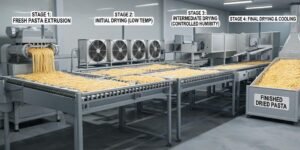
For puffed snacks, multi-zone drying is often useful. The first zone can remove surface moisture, while later zones stabilize internal moisture more gently. Airflow should reach the product evenly, especially when the product bed is thick.
For fragile snacks, the dryer discharge and transfer conveyors should also be designed carefully. A product can be perfectly dried but still break before seasoning if the drop height is too high.
Choosing the Right Continuous Dryer Configuration
There is no universal dryer setting for all snacks.
A cheese puff, corn curl, cereal ball, rice snack, protein puff, and 3D pellet snack may require different drying conditions. Product density, shape, formula, expansion ratio, and target texture all affect dryer design.
When choosing a dryer, factories should pay close attention to the following points.
Product Bed Thickness
If the product layer is too thick, hot air cannot pass through evenly. The top and bottom layers may dry at different speeds. This creates moisture variation and unstable seasoning performance.
Belt Speed
Belt speed controls residence time. If the belt moves too fast, the product may leave the dryer with excess moisture. If it moves too slowly, the product may become too dry, dark, or brittle.
Temperature Zones
A dryer with multiple heating zones gives better process control. Different zones can use different temperatures depending on product moisture and structure.
Airflow Direction
Top air, bottom air, cross-flow air, or combined airflow designs can be used. The best option depends on product shape and bed depth.
Exhaust Humidity
Wet air must be removed efficiently. If the exhaust system is weak, drying becomes slow and inconsistent.
Material and Hygiene
For food production, the product-contact area should be made from SUS304 stainless steel. For higher hygiene requirements or corrosive seasoning environments, SUS316L stainless steel can be selected for certain parts.
Control System
A Siemens PLC control system or Schneider electrical components can make operation more stable and easier to manage. VFD control allows operators to adjust belt speed, fan speed, and conveyor speed according to the product recipe.
A strong snack drying system continuous solution is not just a hot air box. It is a controlled moisture management system.
Cooling: The Step Many Factories Underestimate
Cooling looks simple, but it has a major impact on flavor.
After drying, baking, or frying, snacks may be too hot for stable seasoning. If oil is sprayed onto a product that is too hot, it may spread too quickly or carry away some volatile flavor notes. If the product is too cold, oil may become less fluid and fail to spread evenly.
The goal is to reach the right surface temperature before flavoring.
In many snack factories, a cooling conveyor is placed between the dryer and the seasoning drum. The conveyor allows moisture and heat to stabilize before oil and powder are applied. For some products, seasoning is applied while the snack is still slightly warm. For others, more cooling is needed before coating.
Cooling also protects packaging quality. If snacks are packed while still hot, steam and condensation may form inside the bag. Once condensation appears, crispness quickly declines.
A proper cooling system should:
- reduce product temperature evenly
- prevent condensation
- avoid excessive product drop
- maintain stable product flow
- prepare the surface for oil spraying
- connect smoothly with the seasoning drum
For fragile puffed products, gentle conveying matters as much as cooling time.

Oil as the Flavor Carrier
Oil is often the bridge between the snack and the seasoning powder.
In many savory puffed snacks, oil works as a binding layer. It helps dry powder attach to the product surface. It also improves mouthfeel and supports flavor release during eating.
Too little oil causes weak adhesion. Powder falls off during tumbling, conveying, packaging, or shipping. Too much oil makes the snack greasy, heavy, and less crisp.
Good oil application requires control over:
- oil temperature
- spray pressure
- nozzle angle
- droplet size
- spray width
- pump stability
- product flow rate
- oil-to-product ratio
In real production, uneven oil spray is one of the most common reasons for uneven flavor. If oil only reaches part of the product bed, powder will only stick well to that area. Some pieces become strongly flavored, while others remain plain.
A fine, controlled spray pattern usually performs better than large droplets. For low-fat snacks, this is even more important. The factory may not want to increase total oil content, so the oil that is used must be distributed as efficiently as possible.
Oil flow should also match production capacity. If the line runs at 300 kg/h, the oil and powder dosing must match that output. If capacity increases to 500 kg/h, seasoning input should adjust accordingly. Manual adjustment is possible, but automation gives more stable results.
How to Season Puffed Snacks Correctly
Many buyers ask the same practical question: how to season puffed snacks so the flavor is strong, even, and stable.
The answer is not a secret formula. It is a controlled sequence.
A reliable process usually looks like this:
- Produce a stable puffed base.
- Dry the snack to a consistent moisture level.
- Cool the product to the correct surface temperature.
- Feed the product into the seasoning drum at a steady rate.
- Spray oil evenly across the moving product bed.
- Add seasoning powder at a controlled dosing rate.
- Allow enough tumbling time for full coating.
- Transfer the finished product gently to packaging.
- Pack the product quickly with moisture-proof packaging.
A common mistake is feeding product into the drum unevenly. When snacks enter in waves, the oil and powder cannot match the real product flow. One moment there is too much product and not enough seasoning. The next moment there is too much seasoning and not enough product.
Another common mistake is adjusting powder first and ignoring oil. If powder does not stick, adding more powder only increases waste.
During product trials, factories should record:
- product moisture after drying
- product temperature before seasoning
- oil percentage
- powder percentage
- drum speed
- drum angle
- residence time
- powder loss rate
- breakage rate
- finished product flavor score
These records help the factory repeat successful production instead of depending only on operator experience.
Choosing an Industrial Snack Flavoring Machine
The seasoning drum is where flavor becomes visible.
For small test batches, manual seasoning may be acceptable. For commercial production, a dedicated industrial snack flavoring machine gives much better control.
A good flavoring machine should not only rotate. It should control the relationship between product movement, oil spray, powder dosing, residence time, and coating uniformity.
Important selection points include:
Drum Diameter and Length
The drum must be large enough to handle the target output while giving the product enough time to tumble.
Drum Angle
The drum angle affects residence time. A steeper angle moves product faster. A lower angle increases tumbling time.
Drum Speed
If speed is too high, puffed snacks may break or slide instead of rolling. If speed is too low, coating may be incomplete.
Internal Flights
Flights help lift and mix the product. For fragile snacks, the internal design must be gentle.
Oil Spray System
Nozzle position, spray width, oil pressure, and pump stability all affect flavor coverage.
Powder Feeding System
A screw feeder or vibration feeder can be used depending on powder flowability. For high-accuracy production, a weighing system can be added.
Material
Food-contact parts should use SUS304 stainless steel. For high-salt, acidic, or special hygiene applications, SUS316L stainless steel may be used in selected areas.
Electrical Control
A Siemens PLC, Schneider inverter, or similar industrial control system can improve recipe management, speed adjustment, and production repeatability.
Cleaning Design
The seasoning drum, powder hopper, oil pipeline, and spray nozzles should be easy to access and clean.
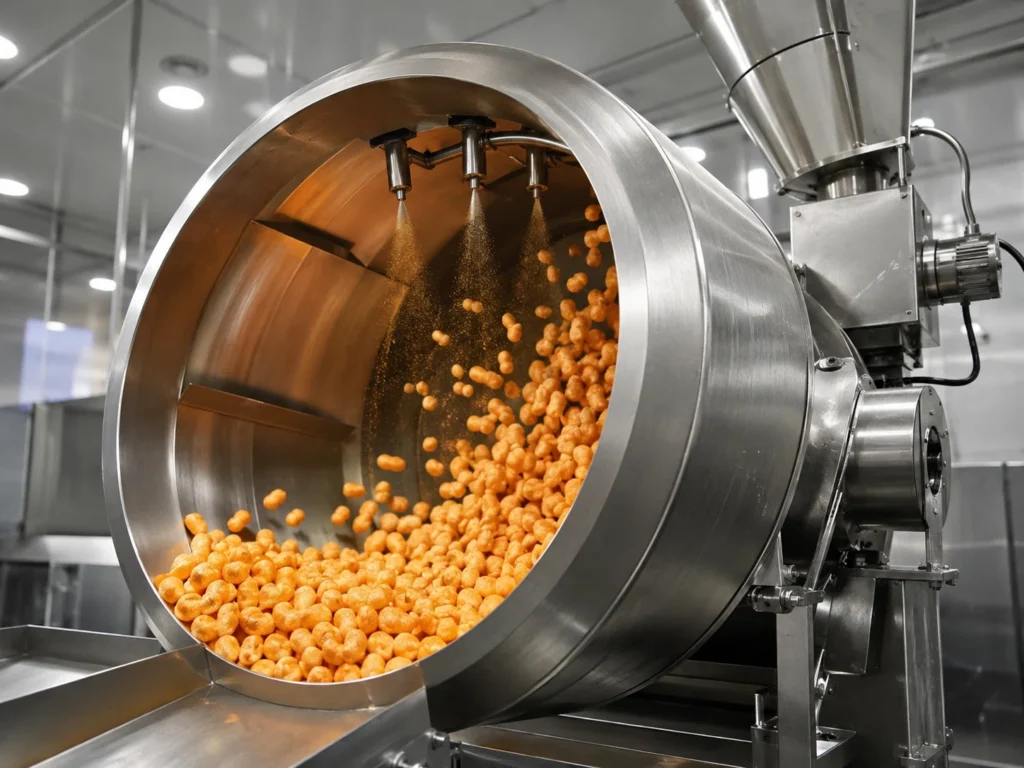
Powder Particle Size and Seasoning Formula
Seasoning powder is not only a flavor ingredient. It is also a physical material.
Particle size affects adhesion, dust, appearance, and taste release. Very coarse particles may not attach well to small puffed snacks. Very fine particles may create dust and clumping.
A balanced seasoning formula may include:
- fine powder for full surface coverage
- medium particles for visual appeal
- salt or sugar crystals for quick taste impact
- encapsulated flavors for longer aroma release
- anti-caking agents for better flowability
- dairy-based powders for richer mouthfeel
Cheese powders, barbecue powders, chili blends, sour cream flavors, and sweet coatings all behave differently. Some powders absorb moisture easily. Some flow poorly in hoppers. Some become sticky when exposed to oil mist.
Powder storage is also important. If seasoning powder is stored in a humid area, it may clump before reaching the machine. Once clumping begins, dosing becomes unstable.
To improve powder performance, factories should control:
- storage humidity
- hopper design
- screw feeder speed
- powder density
- anti-bridging devices
- powder exposure time
- cleaning frequency
In some cases, the powder is not the problem. The way the powder is stored and fed is the problem.
Preventing Uneven Seasoning Coverage
Uneven seasoning is one of the most common issues in puffed snack production.
The product may look yellow on one side and pale on another. Some pieces may taste too salty, while others taste plain. Sometimes the first bags after startup are strong, and later bags become weak.
Typical causes include:
- unstable product flow
- poor oil distribution
- incorrect drum speed
- wrong drum angle
- powder falling in one narrow area
- inconsistent product shape
- too much airflow around powder feeding
- drum residence time too short
In real-world operation, the first step is to observe how the product moves inside the drum. The product should form a rolling bed, not a sliding pile. If snacks are sliding instead of tumbling, coating will be poor. If they are bouncing aggressively, breakage may increase.
Oil spray should cover the product bed evenly before powder is added. Powder should enter the drum in a position where it can contact oiled product, not dry product.
For higher-capacity lines, automatic product flow control and synchronized dosing are strongly recommended. They help keep the seasoning ratio stable even when line speed changes.
Preventing Seasoning From Falling Off
If seasoning falls to the bottom of the bag, the issue is usually adhesion.
The snack may look properly coated at the drum outlet, but after conveying, weighing, packaging, transportation, and shelf display, the powder separates.
Common causes include:
- not enough oil or binding agent
- uneven oil spray
- powder particle size too coarse
- product surface too dry or smooth
- too much vibration after seasoning
- excessive product drop height
- over-tumbling after powder application
- strong airflow near the seasoning area
The solution is not always to increase seasoning powder. More powder may create more dust if there is not enough oil to hold it.
A better approach is to improve the oil film. A thin, even oil layer often gives better results than a heavy but uneven spray. For low-fat products, a precise spray system is especially valuable because every gram of oil must work effectively.
Packaging transfer also matters. If the finished product drops from a high conveyor into the weigher, powder loss and product breakage may increase. Gentle conveying after seasoning helps protect the coating.
Preventing Clumping and Sticky Coating
Clumping usually comes from moisture, oil concentration, or poor powder flow.
If the snack is still too wet after drying, seasoning powder absorbs moisture and forms lumps. If oil is sprayed too heavily in one location, powder may turn into paste on the product surface. If powder is stored in a humid room, it may clump inside the hopper.
To reduce clumping:
- control final moisture after drying
- avoid over-spraying oil
- use proper spray nozzle design
- store powder in dry conditions
- use anti-bridging hopper design
- clean powder feeders regularly
- avoid long powder exposure to humid air
- match the powder formula to the snack surface
Factories producing cheese, dairy, or sweet flavors should pay extra attention because these powders are often more sensitive to moisture and temperature.
Clumping is not only a product defect. It can also cause machine downtime, cleaning difficulty, and customer complaints.
Reducing Seasoning Waste
Seasoning powder can be expensive, especially cheese, meat, seafood, chili, and custom flavor blends.
If powder is lost as dust, collects under the machine, sticks inside the drum, or remains in the hopper, the factory loses money every hour.
Reducing waste requires both equipment design and process discipline.
Useful methods include:
- accurate powder dosing
- stable oil spray
- enclosed seasoning area
- reduced airflow around powder feeding
- correct drum speed and angle
- smooth internal drum surface
- fewer dead corners
- regular cleaning
- synchronized product flow and seasoning flow
For larger production lines, weighing systems can help control powder usage more precisely. Recipe memory in a Siemens PLC system can also help operators repeat the same settings for different flavors.
From a cost-control perspective, better seasoning adhesion is often more valuable than simply buying cheaper powder. If more powder stays on the snack, less powder is wasted.
Matching Seasoning Systems to Different Snack Types
Different snacks need different flavoring strategies.
Corn Puffs and Cheese Balls
These products are light, porous, and usually require strong seasoning coverage. Oil spray plus dry powder seasoning is widely used. Drum movement must be gentle to avoid breakage.
Corn Curls
Corn curls have irregular shapes and rough surfaces, which help hold seasoning. However, the shape can make uniform coating more difficult. Drum angle and flight design are important.
Rice Snacks
Rice-based puffed snacks may have a harder surface and lower oil absorption. Fine powder and controlled oil spray help improve flavor coverage.
Fried Pellet Snacks
Fried pellet snacks often already contain surface oil after frying, so dry seasoning may attach more easily. The main challenge is avoiding excess oil and greasy mouthfeel.
Baked Snacks
Baked snacks usually have lower surface oil. They often need controlled oil spraying or slurry coating before dry powder application.
Protein Puffs
Protein-rich snacks can be harder and less porous than starch-based puffs. Drying must be controlled carefully to avoid a tough bite.
Sweet Coated Snacks
Sweet snacks may require syrup coating, sugar application, cooling, or secondary drying. Temperature and viscosity control are important.
A customized Puffed Snack Machine line should be planned according to the product category. A system designed for cheese puffs may not be ideal for sweet cereal balls or protein puffs without proper adjustment.
Automation Helps Keep Flavor Consistent
As production grows, manual control becomes less reliable.
Operators may adjust powder by eye, open oil valves manually, or change drum speed based on experience. Skilled operators are valuable, but even good operators may produce different results across shifts.
Automation helps stabilize the process.
A modern snack production line can use:
- Siemens PLC control
- Schneider VFD/inverter control
- temperature sensors
- speed adjustment
- recipe storage
- automatic oil pump control
- powder dosing control
- emergency protection
- synchronized conveyor speed
The main benefit is repeatability. Once a flavor recipe is successful, the factory can save key settings and use them again. This is important for export factories, private-label production, and brands that require consistent quality across multiple shipments.
Automation also reduces training pressure. New operators can follow stored process settings instead of relying entirely on memory.
Hygiene, Material, and Cleaning Design
Food machinery must be easy to clean.
Snack seasoning systems handle oil, powder, crumbs, salt, sugar, spices, and sometimes sticky coatings. If equipment has dead corners or poor access, residue builds up quickly. This can affect flavor, food safety, and machine performance.
A hygienic design should include:
- SUS304 stainless steel food-contact parts
- optional SUS316L stainless steel for special applications
- smooth internal surfaces
- easy-open covers
- removable spray nozzles
- accessible powder hoppers
- cleanable screw feeders
- simple drum access
- safe electrical cabinet placement
- reasonable dust control
For factories that produce multiple flavors, cleaning convenience is critical. Cheese flavor, barbecue flavor, spicy chili, seafood seasoning, and sweet coating should not contaminate each other.
Flavor changeover time also affects production efficiency. If cleaning takes too long, the factory loses output. A good equipment design should reduce cleaning difficulty without compromising hygiene.
Avoiding Product Breakage During Seasoning
Puffed snacks are fragile. Once the product breaks, flavor quality also changes.
Broken pieces absorb more oil and powder. Small fragments may become over-seasoned. Crumbs collect at the bottom of bags. The finished product looks less professional.
Breakage may happen during:
- dryer discharge
- elevator transfer
- seasoning tumbling
- cooling
- weighing
- packaging
To reduce breakage:
- avoid excessive drop height
- use gentle conveyors
- control drum speed
- avoid aggressive internal flights
- prevent over-drying
- synchronize machine speed
- reduce unnecessary transfer points
A good line layout is important. Sometimes the machine itself is fine, but the connection between machines causes damage. For puffed snacks, smooth transfer is part of product quality control.

Packaging Protects the Flavor You Worked Hard to Build
The flavor process does not end at the seasoning drum.
If packaging is poor, the snack may lose crispness, aroma, and shelf life. Puffed snacks are sensitive to moisture and oxygen. Once humidity enters the package, the product softens. Once oil oxidizes, the flavor becomes stale.
Good packaging should protect:
- crispness
- aroma
- oil freshness
- seasoning stability
- product shape
- shelf life
Many puffed snacks use moisture-proof packaging film and nitrogen flushing to protect quality. The sealing temperature, sealing pressure, and packing speed must also be stable.
The product should not be packed while too hot. Warm snacks can create condensation inside the package. Cooling before packaging is a small step that prevents many shelf-life problems.
Production line balance also matters. If the seasoning system produces faster than the packaging machine can handle, finished snacks may sit exposed to factory air for too long.
Practical Troubleshooting Guide
Problem 1: The Snack Tastes Weak
Possible causes:
- not enough oil
- poor powder adhesion
- powder dosing too low
- product too cold before seasoning
- powder particle size too coarse
- seasoning lost during conveying
Recommended action:
Check oil spray first. If oil is uneven, increasing powder may only increase waste.
Problem 2: Some Pieces Are Too Salty
Possible causes:
- unstable product flow
- powder falling in one area
- drum speed incorrect
- powder clumping
- product size variation
Recommended action:
Adjust powder feeding position, product flow, drum speed, and drum angle.
Problem 3: Product Becomes Soft After Packaging
Possible causes:
- moisture too high after drying
- product packed while hot
- poor packaging barrier
- weak sealing
- humid storage environment
Recommended action:
Improve dryer settings, add cooling time, and check packaging material.
Problem 4: Powder Falls to the Bottom of the Bag
Possible causes:
- not enough oil
- poor oil spray distribution
- product surface too dry
- powder too coarse
- excessive vibration after seasoning
Recommended action:
Improve oil film uniformity and reduce harsh transfer after seasoning.
Problem 5: Snack Looks Oily
Possible causes:
- too much oil
- uneven spray
- low powder absorption
- product not porous enough
- oil temperature not suitable
Recommended action:
Reduce oil flow, improve spray pattern, and check extrusion expansion quality.
Problem 6: Too Many Broken Pieces
Possible causes:
- drum speed too high
- product over-dried
- drop height too high
- internal flights too aggressive
- residence time too long
Recommended action:
Adjust drum speed, dryer moisture target, and conveyor transfer design.
How Our Equipment Solution Supports Better Snack Flavor
For snack manufacturers, improving flavor is not about buying one seasoning drum and hoping it solves everything. The better approach is to design the whole production process around the final product.
Our customized food processing line solution can include:
- raw material mixer
- screw conveyor
- twin-screw extruder
- shaping and cutting system
- continuous belt dryer
- cooling conveyor
- oil spray system
- rotary seasoning drum
- powder dosing system
- bucket elevator or inclined conveyor
- PLC control cabinet
- packaging machine connection
For food-contact areas, SUS304 stainless steel is commonly used. For higher hygiene or special corrosion-resistance requirements, SUS316L stainless steel can be selected for key parts. Electrical systems can be configured with Siemens PLC, Schneider inverter, and VFD speed control according to customer requirements.
A complete Puffed Food Machine solution is useful for factories that want to produce different puffed snacks on one production platform. By changing molds, adjusting extrusion parameters, modifying dryer settings, and selecting the right seasoning method, manufacturers can produce a wide range of products.
Typical products include:
- cheese corn puffs
- spicy corn curls
- rice puff snacks
- cereal balls
- sweet coated snacks
- protein puff snacks
- 2D and 3D pellet snacks
- baked puffed snacks
The equipment should be selected according to product quality goals, not only hourly capacity.
For more information and a quotation regarding our automated production lines, please feel free to contact us.
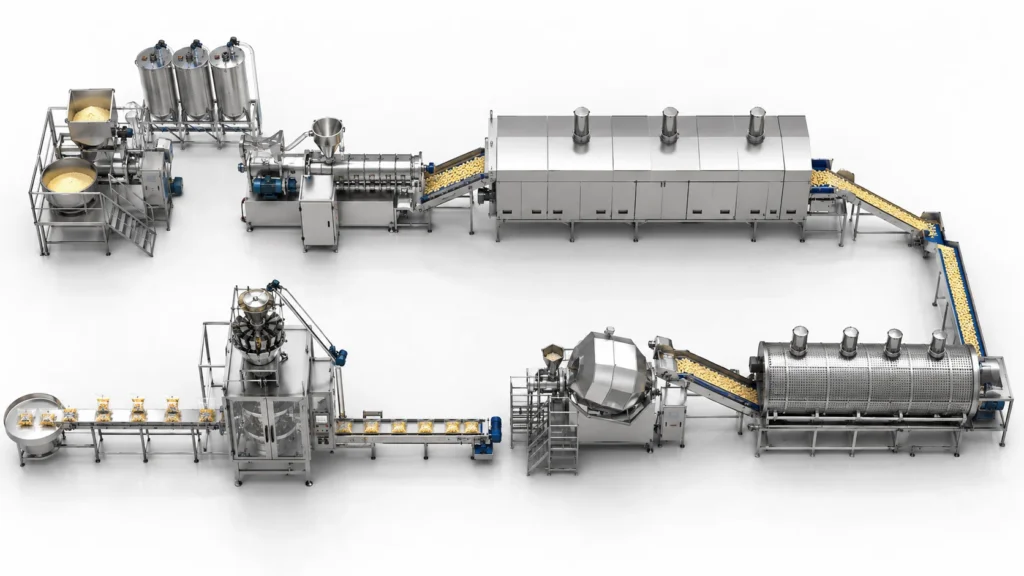
Recommended Line Layout for Better Flavor Control
A practical puffed snack line for stable drying and seasoning may include the following sections.
1. Mixing Section
Raw materials are mixed with water and minor ingredients. Stable mixing improves extrusion quality.
2. Extrusion Section
The extruder cooks and expands the material. Screw design, barrel temperature, feeding speed, and moisture control affect puffing quality.
3. Cutting and Shaping Section
The product is cut into the required shape. Uniform size helps drying and seasoning consistency.
4. Drying Section
The snack drying system continuous section reduces moisture evenly and builds crispness.
5. Cooling Section
Snacks are cooled to the proper temperature before oil and powder application.
6. Oil Spraying Section
Oil is applied evenly to improve flavor adhesion.
7. Powder Seasoning Section
Powder is dosed according to product flow and target flavor intensity.
8. Tumbling Section
The snack rolls inside the drum until the coating becomes even.
9. Packaging Connection
The finished snack is transferred gently to weighing and packaging.
What Buyers Should Confirm Before Purchasing Equipment
Before purchasing a drying and seasoning system, buyers should clarify the following information.
Product Type
Will the line produce corn puffs, rice snacks, pellet snacks, cereal snacks, protein puffs, or sweet coated snacks?
Target Capacity
Is the required capacity 100 kg/h, 300 kg/h, 500 kg/h, or higher?
Heating Source
Will the dryer use electricity, gas, steam, or thermal oil?
Final Moisture Target
What crispness and shelf life are required?
Flavor Type
Will the product use dry powder, oil spray, slurry, syrup, or sugar coating?
Automation Level
Does the factory need manual control, semi-automatic control, or Siemens PLC recipe management?
Material Requirement
Is SUS304 stainless steel enough, or does the project require SUS316L for specific contact parts?
Factory Layout
Is the available space suitable for a straight line, U-shape layout, or multi-level layout?
Cleaning Requirement
How many flavors will be produced every day? How often will the line need cleaning?
Packaging Connection
Will the line connect with a multihead weigher, vertical packaging machine, or manual packing station?
Clear answers help the equipment manufacturer design a practical and cost-effective system.
Why Customization Matters for Export-Oriented Snack Factories
Many buyers ask for a standard machine, but snack production is rarely completely standard.
A low-oil baked corn puff needs a different flavoring setup from a heavily seasoned cheese ball. A protein puff may need different drying control from a rice snack. A factory producing three flavors per day needs easier cleaning than a factory producing one flavor for a full week.
Customization can include:
- extruder screw configuration
- mold and cutter design
- dryer length and layer number
- heating method
- cooling conveyor size
- oil spray system
- seasoning drum diameter
- powder feeder type
- Siemens PLC control
- Schneider VFD control
- stainless steel grade
- dust control design
- factory layout
- packaging connection
For international buyers, customization is often the difference between simply buying machines and building a reliable production system.
A well-planned Puffed Food Machine line helps factories develop products with better texture, more stable flavor, and stronger market competitiveness.
Final Thoughts
Better snack flavor comes from better process control.
Seasoning powder matters, but it cannot fix unstable drying, poor cooling, uneven oil spray, inaccurate dosing, or harsh product handling. If a snack is too wet, too dry, too hot, too fragile, or poorly expanded, the seasoning system will struggle.
A good production line controls every step:
- raw material mixing
- extrusion and puffing
- drying moisture
- cooling temperature
- oil spray uniformity
- powder dosing accuracy
- drum tumbling action
- gentle conveying
- packaging protection
When these factors work together, the finished snack becomes more consistent. The flavor is stronger. The texture is crisper. The powder waste is lower. The product looks better in the package.
For food processing companies, especially export-oriented snack manufacturers, proper drying and seasoning design is not an optional upgrade. It is one of the most important parts of building a stable snack business.
Q&A: Snack Drying and Seasoning Systems
-
How does drying affect snack flavor?
Drying affects flavor by controlling crispness, moisture stability, oil absorption, and seasoning adhesion. If the snack is too wet, powder may clump. If it is too dry, seasoning may fall off more easily. A stable drying process creates a better surface for flavor application.
-
What is the best moisture level for puffed snacks before seasoning?
There is no single moisture level for all puffed snacks. The ideal target depends on product formula, shape, expansion ratio, oil level, and shelf-life requirement. The most important point is moisture consistency across the whole batch or continuous production flow.
-
How to season puffed snacks evenly?
To season puffed snacks evenly, control product flow, oil spray, powder dosing, drum speed, drum angle, and tumbling time. The product should be properly dried and cooled before entering the seasoning drum.
-
Why does seasoning fall off puffed snacks?
Seasoning may fall off because there is not enough oil, the oil spray is uneven, the powder is too coarse, the snack surface is too dry, or the product is handled too roughly after seasoning.
-
Why do snacks become soft after packaging?
Snacks may become soft if moisture is too high after drying, if the product is packed while hot, or if the packaging film and seal do not block moisture properly.
-
What equipment is needed for a puffed snack seasoning line?
A typical puffed snack seasoning line includes a cooling conveyor, oil spray system, powder feeder, rotary seasoning drum, control cabinet, and connection conveyors. Larger lines may also use automatic weighing and PLC recipe control.
-
Is oil necessary for seasoning puffed snacks?
For most savory puffed snacks, oil helps powder attach to the product surface. It also improves mouthfeel and flavor release. The oil amount should be controlled carefully to avoid greasy texture.
-
What is the difference between dry seasoning and slurry coating?
Dry seasoning usually applies oil first and then powder. Slurry coating mixes liquid, oil, and seasoning into one coating material. Dry seasoning is flexible and common. Slurry coating can create stronger coverage but requires more cleaning and viscosity control.
-
How can factories reduce seasoning waste?
Factories can reduce seasoning waste by improving oil spray coverage, using accurate powder dosing, reducing airflow around the seasoning area, controlling drum speed, and matching seasoning flow with product flow.
-
Which is better: batch drying or continuous belt drying?
Batch drying is suitable for small production or trials. Continuous belt drying is better for commercial production because it offers more stable moisture control, higher capacity, lower labor requirement, and better consistency for seasoning.
-
What stainless steel material is suitable for snack processing equipment?
SUS304 stainless steel is commonly used for food-contact parts. For special hygiene requirements, acidic ingredients, high-salt environments, or customer-specific standards, SUS316L stainless steel can be used for selected parts.
-
Can one production line make different flavored puffed snacks?
Yes. One line can produce different flavors if the extrusion molds, dryer settings, seasoning system, and cleaning process are designed properly. Easy-clean seasoning equipment and recipe-based control are especially useful for multi-flavor production.