I’ve spent over 15 years on factory floors, watching raw flour transform into crispy, golden snacks. One thing I’ve learned? You can have the most expensive extruder in the world, but if your mixing is off or your moisture is inconsistent, you’re just making expensive waste.
Many factory owners focus on the “cooking” temperature, but the real battle for quality is won or lost in the first ten minutes of the process. In this guide, we’ll dive into why how to mix raw materials for snacks and maintaining precise flour moisture control extrusion are the two pillars that separate market leaders from struggling startups.
Why Mixing Uniformity is the "DNA" of a Consistent Snack
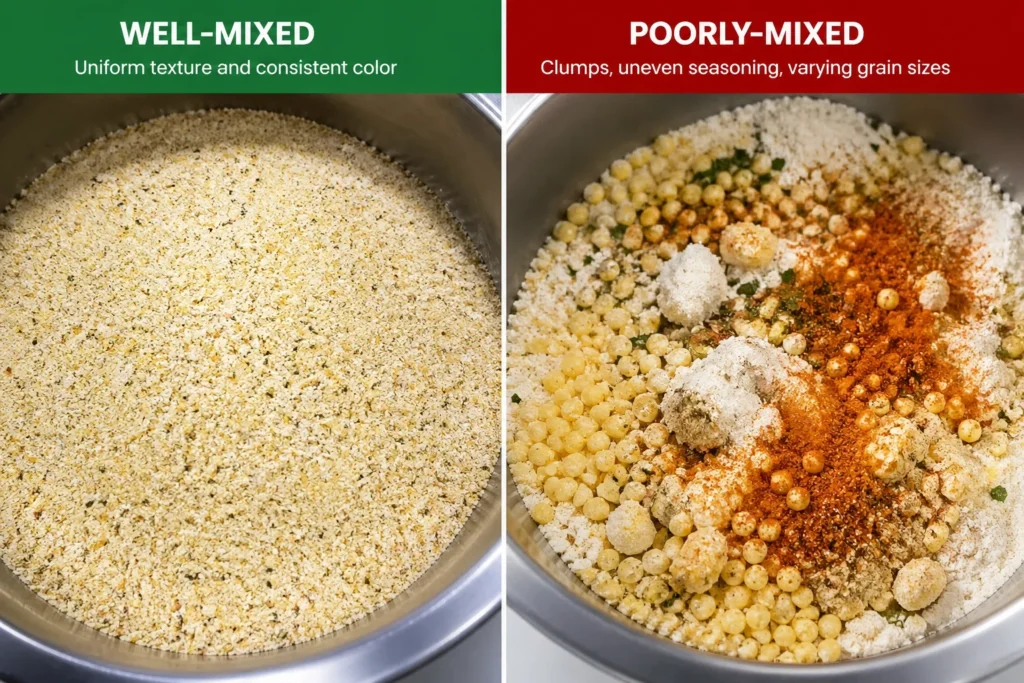
We often see factories over-correct their expansion issues by messing with the extruder settings. But more often than not, the problem started in the mixer. If your dry mix—corn grits, rice flour, and seasonings—isn’t a perfect blend, the machine simply cannot do its job.
The Hidden Danger of Particle Size
When you’re researching how to mix raw materials for snacks, you have to look beyond just the “blend.” You have to look at particle size. Imagine trying to bake a cake with half coarse sand and half fine powder—it won’t rise evenly.
In an extruder, different-sized particles absorb water at different speeds. Small particles over-hydrate and turn into “glue,” while large grits stay dry at the core. This leads to what we call “hard spots” in the final product.
Pro Tip: In our experience, using a high-intensity ribbon blender before the material hits the Puffed Food Machine (Link to Product Page) is non-negotiable for high-capacity lines.
How Moisture Control Directly Affects Puff Snack Expansion
I always tell our clients: Water is the “fuel” for the puff. In technical terms, it acts as a plasticizer—meaning it makes the starch soft and stretchy. But in simple terms, it’s the “steam engine” that blows the snack up.
The “Soggy vs. Glassy” Trap
Managing flour moisture control extrusion is a balancing act that many managers ignore until it’s too late.
The 14% Sweet Spot: This is where the magic happens. The starch turns into a flexible melt that can hold a bubble.
Too much water (>18%): We’ve seen factories add too much water to try and make the dough “easier” to process. The result? Beautiful dough inside the barrel, but as soon as it hits the air, the bubbles collapse. You get a dense, chewy snack that sticks to the teeth.
Too little water (<11%): The friction inside the machine goes through the roof. It’s like trying to push dry sand through a needle. The snack comes out scorched, tasting burnt and feeling hard as glass.
Real-World Data: The Moisture vs. Texture Matrix
To help your operators, we’ve compiled this quick-reference table based on hundreds of test runs in our lab.
| Parameter | 10% Moisture | 14% Moisture (Optimal) | 18% Moisture |
|---|---|---|---|
| Expansion Ratio | Low (Small, dense) | High (Large, airy) | Medium (Collapses after exit) |
| Texture | Glassy / Brittle | Crispy / Crunchy | Soggy / Leather-like |
| Color | Darker (Scorched) | Golden / Natural | Pale / Under-cooked |
| Machine Load | Extremely High | Stable | Very Low |
Case Study: Reducing Waste for a Middle Eastern Snack Factory
Last year, a client in Egypt reached out to us. They were losing nearly 15% of their daily production to “density defects”—snacks that were either too hard or too small.
The Diagnosis: Their manual mixing process was inconsistent, and they were adding water by “feel” rather than by flow meter.
The Solution: We replaced their old setup with a high-precision Snack Puffing Machine integrated with an automated liquid dosing system. We also implemented a formal preconditioning food extrusion process.
The Result: By pre-hydrating the grains, the starch was already “relaxed” before entering the extruder. Their waste dropped from 15% to just 2.2% in the first month.

The Secret Weapon: Preconditioning Food Extrusion Process
Surprisingly, many buyers ignore the pre-conditioner to save on initial costs. This is a mistake.
The preconditioning food extrusion process is essentially a “warm-up” for your flour. It uses steam and water to start the hydration process early.
It saves your machine: Your screws and barrels will last 40% longer because they aren’t fighting dry, abrasive grits.
It improves flavor: Heat and moisture have more time to unlock the natural sweetness of the corn or rice.
If you are aiming for the “Premium” snack market, you shouldn’t just be looking for a basic Puffed Food Machine ; you should be looking for a complete system that includes a high-speed pre-conditioner.
Twin-Screw vs. Single-Screw: Which Handles Moisture Better?
One question we get every day is: “Do I really need a twin-screw machine?”
If you are working with complex recipes (like high-protein lentil snacks or multi-grain rings), the answer is almost always yes. A Puffed Snack Machine with twin-screws provides “positive displacement.” This means it forces the material forward regardless of how sticky or dry it is. Single-screw machines are much “pickier” about moisture; if your flour moisture control extrusion is off by even 1%, a single-screw machine might stop feeding entirely.
Expert Check-List: 3 Things to Check Today
If your snack quality is dipping, don’t just turn up the heat. Check these three things first:
The Mixer Time: Are your operators cutting the mixing time short to keep up with the extruder? (Consistency starts here).
The Water Pump: Is your flow meter calibrated? Even a small lime-scale buildup in the pipe can reduce water flow and ruin a batch.
The Raw Material Storage: Is your flour sitting in a humid warehouse? Raw grain is like a sponge; it might already have 2% more water than it did last week.
Q&A: Troubleshooting Your Puffed Snack Line
-
Why does my snack feel "oily" even though it's not fried?
A: This usually happens when the expansion is too low. If the moisture was incorrect during the preconditioning food extrusion process, the internal structure becomes dense. When you apply the seasoning oil later, it sits on the surface instead of being "trapped" in the pores.
-
Can I use the same machine for corn puffs and rice crackers?
A: Yes, but you must adjust the flour moisture control extrusion settings. Rice usually requires slightly more hydration and a different screw configuration to achieve the same "crunch" as corn.
-
How often should I calibrate my moisture sensors?
A: We recommend a weekly check. At our factory, we provide training for all Puffed Food Machine (Link to Product Page) buyers to ensure they can perform these "quick-checks" without needing a technician.
-
Does the "shape" of the snack affect how much water I need?
A: Absolutely. Thin, intricate shapes (like stars or rings) are more sensitive. If the moisture is too high, the "arms" of the star will collapse. If it's too low, they will snap off during the flavoring process.
Need Help Solving Texture Issues?
If you’re tired of inconsistent batches and high waste, let’s talk. Send us your current raw material formula, and our engineers will provide a customized machinery recommendation within 24 hours.