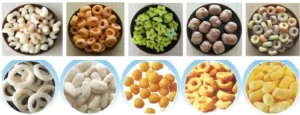
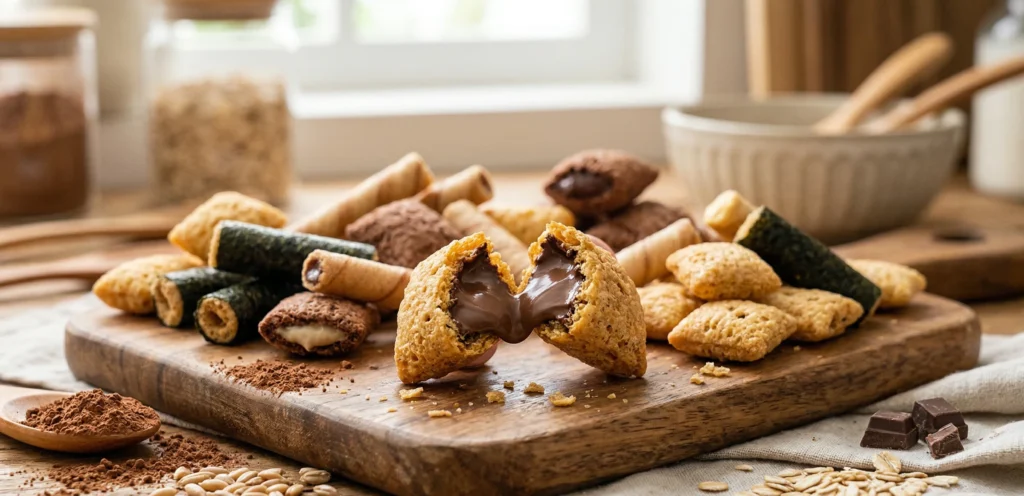
In the competitive landscape of the global snack industry, the “core-filled” category represents the pinnacle of engineering and culinary fusion. Whether you are browsing a supermarket in Dubai, London, or Shanghai, you will find chocolate-filled pillows and cream-stuffed cereal sticks occupying the most profitable shelf spaces. For a food processing factory, moving into this segment is a strategic leap from commodity snacks to premium, high-margin products.
However, as any plant manager can tell you, the journey from a simple corn puff to a perfectly sealed, rich-centered snack is paved with technical hurdles. It’s not just about “stuffing” a shell; it’s about mastering the physics of expansion and the rheology of fillings. In this guide, we draw on our decades of experience as a factory specializing in food processing production lines to reveal the professional secrets of the trade.
Market Intelligence: The Rise of the "Experiential" Snack
Before diving into the hardware, we must understand the “why.” Today’s Business buyers and consumers aren’t just looking for salt and crunch. They want a multi-textural experience. This demand has transformed the standard Puffed Food Machine from a simple extruder into a complex, synchronized system capable of handling delicate ingredients.
Market data suggests that core-filled snacks have a 35% higher perceived value than their non-filled counterparts. For a processing enterprise, this means a significantly faster ROI on a Snack Puffing Machine if the output can meet international quality standards—specifically, the perfect ratio of shell to filling without leakage.
The Physics of the Shell: Starch Gelatinization and Expansion
The secret to a great core-filled snack starts with the shell. If the shell is too dense, the snack feels “hard”; if it’s too airy, the filling will leak or shatter the structure.
The Role of Raw Materials
Most producers use a blend of corn, rice, and wheat flour. The technical secret lies in the ratio of Amylose to Amylopectin. High amylose content provides structural strength, while amylopectin drives the expansion. At our factory, we often recommend a specific moisture content of 12.5% to 14% for the raw mix to ensure that the Snacks Core Filled Puffed Processing Extruder can reach the necessary pressure for “instant flash” expansion at the die head.
Temperature and Pressure Control
Inside the twin-screw extruder, the material undergoes a process called α-gelatinization. This turns the granular starch into a plasticized melt. For core-filled products, the temperature must be strictly controlled in zones. If the final zone is too hot, the shell will expand too much, creating a “hollow” feeling where the filling just rattles around inside.
Technical Mastery: The Snacks Core Filled Puffed Processing Extruder
The heart of your factory is the Snacks Core Filled Puffed Processing Extruder. Unlike standard extruders, this machine must handle “Dual-Stream” processing.
Twin-Screw Stability
We exclusively utilize twin-screw technology for core-filled lines. Why? Because the twin screws offer “positive displacement” and self-cleaning capabilities. This ensures that the pressure at the die head remains constant. Any fluctuation in pressure results in an uneven shell thickness, which is the #1 cause of “filling blowouts” during the drying process.
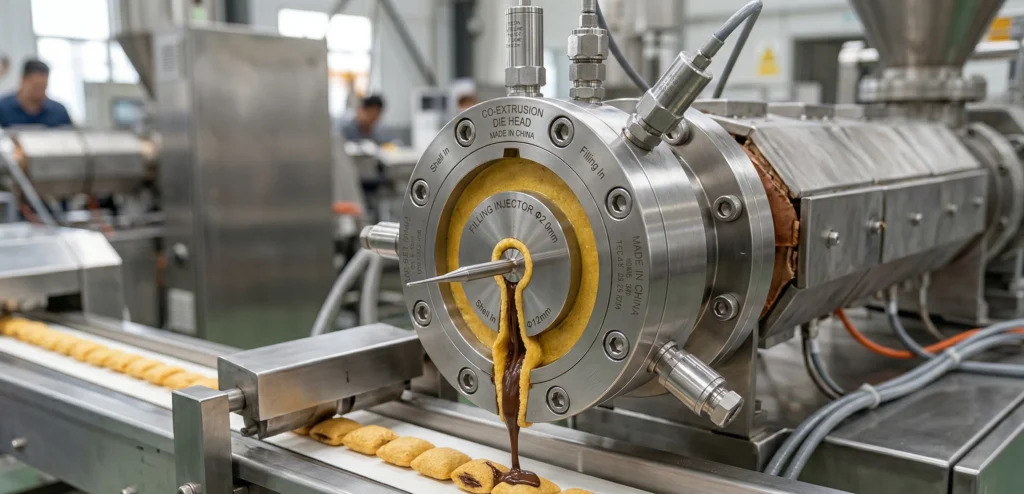
The Co-Extrusion Die Assembly
The die head is where the cereal shell and the core material meet. A high-quality die must be engineered with high-grade stainless steel to prevent corrosion from flavorings. The internal injection needle must be precisely centered. If the needle is even 0.5mm off-center, the filling will sit closer to one side of the shell, leading to breakage during shipping.
The Science of the Center: The Chocolate/cream Core Filling Machine
The filling isn’t just “chocolate” or “cream”—in the world of industrial production, it is a non-Newtonian fluid that must be managed with extreme care. This is where the Chocolate/cream Core Filling Machine comes into play.
Viscosity and Temperature Management
The filling must be fluid enough to be pumped but thick enough to stay inside the snack. This is called Yield Stress. Professional production lines use jacketed, temperature-controlled hoppers. By maintaining the filling at a constant 35°C to 40°C, you ensure a consistent flow rate.
The Precision of Servo Drives
Older machines used simple gear pumps, which often “pulsed.” Modern, high-end Chocolate/cream Core Filling Machine units utilize servo-motor-driven pumps. These allow you to adjust the filling volume by 0.1-gram increments. This precision is vital for cost control; over-filling by just 5% can erase your profit margins over a month of high-volume production.
Advanced Barrier Science: co-extrusion food processing technology
The biggest enemy of a core-filled snack is Moisture Migration. If you put a water-based strawberry jam inside a crispy corn shell, the moisture will move into the shell within 48 hours, leaving the snack soggy.
The Lipid-Barrier Secret
The industry-standard solution involves co-extrusion food processing technology using lipid-based fillings. By using fats (like cocoa butter or palm oil) as the carrier for flavor, you create a natural moisture barrier. At our facility, we help clients formulate fillings that have a Water Activity ($a_w$) level similar to the shell, effectively stopping the migration process and keeping the snack crispy for up to 12 months.
Preventing Fat Bloom
If the chocolate filling isn’t handled correctly, the oils can separate and rise to the surface of the shell, causing a white, dusty appearance known as “bloom.” The technical secret here is the cooling stage. The snack must be cooled rapidly enough to “lock” the fats in a stable crystalline form but slowly enough to prevent the shell from cracking.
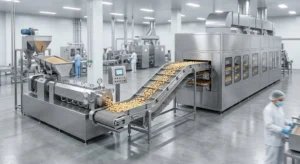
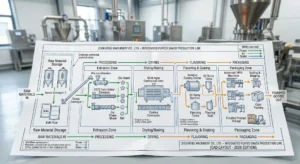
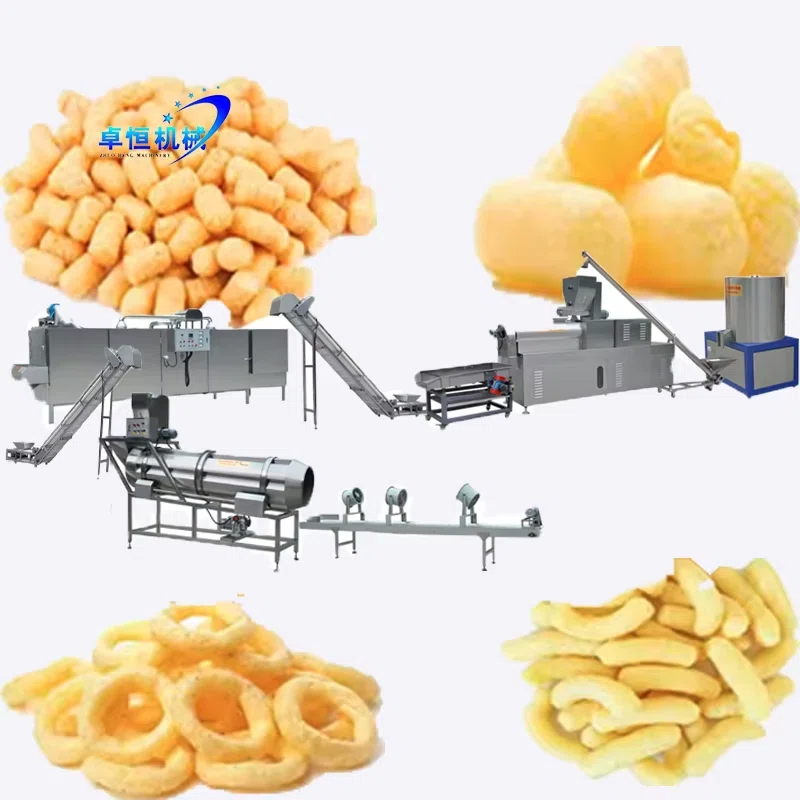
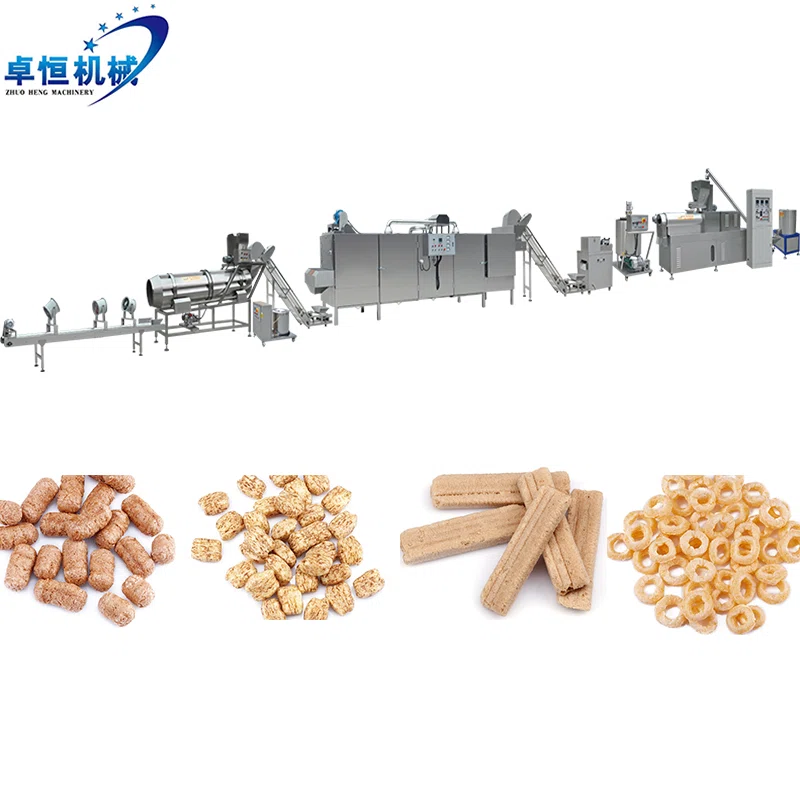
The Workflow: A Professional core filled snack production line
A successful processing enterprise needs a balanced core filled snack production line. One bottleneck can halt the entire factory. Here is the optimized workflow:
Automatic Raw Material Mixing: Using a high-speed ribbon blender to ensure uniform moisture.
Extrusion and Co-Injection: The Snacks Core Filled Puffed Processing Extruder and the filling pump work in perfect PLC-controlled synchronization.
High-Speed Shaping & Cutting: A multi-function shaper “pinches” the filled tube into pillows, triangles, or bars. The “pinch” must be strong enough to seal the ends hermetically.
Multi-Layer Drying: This is where the final texture is set. A 5-layer or 7-layer dryer is used to remove moisture from the shell without overcooking the filling.
Rotary Seasoning: Adding the final exterior flavor (salt, sugar, or savory powders).
Cooling & Packaging: A vibration cooler brings the product to room temperature before it enters the nitrogen-flushed packaging machine.
Operational Excellence: Troubleshooting for Factory Managers
As a factory owner, you know that downtime is the “profit killer.” Here are the “factory-insider” solutions to common problems we see in the field:
Problem: The snacks are unevenly filled.
Solution: Check the “Back Pressure” in the extruder. If the cereal melt is too thin, it won’t push back against the filling needle, causing gaps.
Problem: The shell is “dusty” or shatters easily.
Solution: Increase the screw speed of your Puffed Snack Machine to increase shear, which develops a stronger “cell structure” in the starch.
Problem: The cutter is getting sticky with chocolate.
Solution: Your filling is likely too hot at the point of cutting. Install a small air-cooling fan at the exit of the die head to “skin over” the shell before it hits the blades.
Why Customization Matters for the Modern Factory
No two markets are the same. A client in Africa might require a high-output, low-cost corn pillow line, while a client in the USA might need a Puffed Food Machine capable of processing “ancient grains” like quinoa or amaranth for a health-conscious demographic.
When we design a core filled snack production line, we don’t just sell a machine; we configure the screw elements. We can change the “kneading blocks” and “transport elements” of the screw to handle higher protein or fiber contents, ensuring that your factory stays flexible and ahead of market trends.
ROI Analysis: The Business Case for Upgrading
Investing in a high-quality Puffed Food Machine is a long-term play. While cheaper machines exist, they often suffer from “Screw Wear” within six months. Our factory uses nitrided 38CrMoAl alloys, which can run for over 5,000 hours before requiring maintenance.
By reducing waste (leakers) from 8% down to 1% and increasing energy efficiency through induction heating on the extruder barrel, a medium-sized factory can save upwards of $25,000 per year in operational costs alone.
Conclusion: Partnering for Success
The technical secrets of core-filled snacks are no longer hidden, but they do require the right partner to implement. By mastering co-extrusion food processing technology and investing in a precision Chocolate/cream Core Filling Machine, your enterprise can transition from a simple manufacturer to a market leader in the snack world.
At our factory, we provide the full ecosystem: from recipe consultation and raw material testing to the installation of a 24/7 core filled snack production line. The future of snacking is filled with potential—literally.
FAQ: Expert Answers for Processing Enterprises
-
1. Can we use the same line for both savory (cheese) and sweet (chocolate) fillings?
Yes. However, the cleaning protocols are different. Savory fillings often contain salt, which requires higher-grade stainless steel in the Chocolate/cream Core Filling Machine to prevent corrosion. Our machines are built with food-grade SUS304/316 to handle both.
-
2. What is the ideal output for a medium-sized factory?
Most of our clients start with a capacity of 200-250kg/h. This provides a balance between manageable labor costs and high enough volume to fulfill large retail contracts. We can scale our Puffed Food Machine designs up to 1,000kg/h for industrial giants.
-
3. How do we prevent the "fat bloom" (white coating) on chocolate fillings?
This is a cooling issue. If the snacks are bagged while still warm, the fats in the chocolate will migrate to the surface. Our core filled snack production line includes a specialized vibration cooler that ensures the fats are "set" before packaging.
-
4. Is it difficult to change shapes (e.g., from pillows to sticks)?
Not at all. With a modern Snacks Core Filled Puffed Processing Extruder, you only need to change the die head and the cutting rollers. Our "Quick-Change" design allows your team to switch products in under 45 minutes, minimizing downtime.
-
5. What technical support do you provide for international clients?
We provide full 3D factory layouts, remote PLC diagnostics, and on-site commissioning. Since we are a factory-direct provider, you get engineering-level support, not just sales talk.
Ready to take your production to the next level? Contact our engineering team to discuss your custom core filled snack production line layout today.