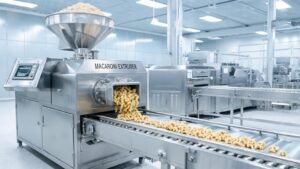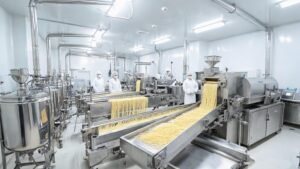
If you have ever stood in your kitchen, hands covered in semolina flour, wondering if there is an easier way to roll out perfect sheets of dough, you are not alone. Making fresh, homemade pasta is one of the most rewarding culinary arts, but the tools you choose will completely shape your experience.
When choosing a pasta maker, the ultimate debate always comes down to: hand cranked vs electric pasta machine. Should you stick with the classic, nostalgic manual roller, or invest in a motorized powerhouse?
This comprehensive guide breaks down the pros, cons, costs, and key differences of both options based on real kitchen testing. Plus, we’ll look at when domestic machines become too small, and when it’s time for growing businesses to transition to a commercial pasta extruder.
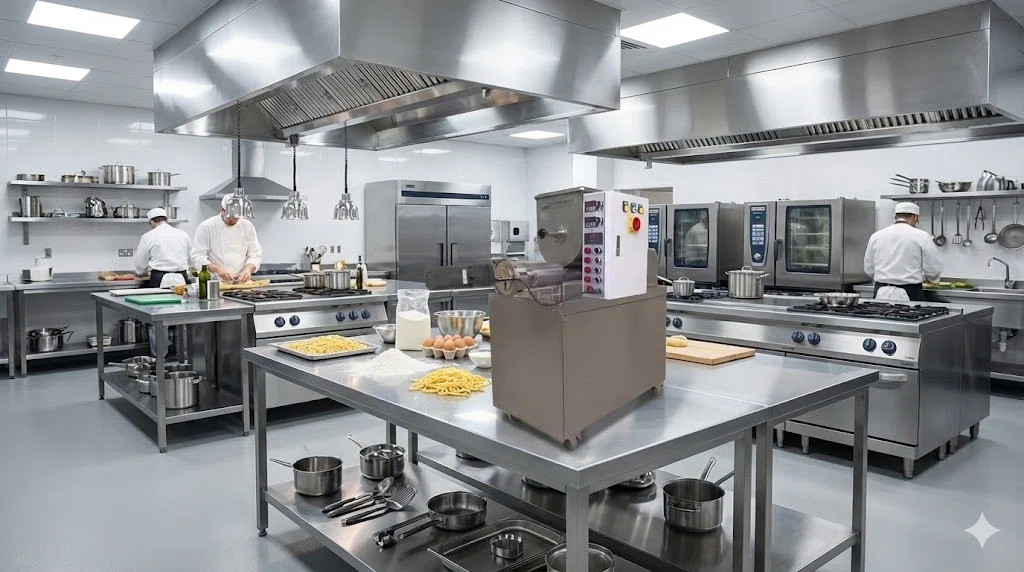
TL;DR: Which Pasta Machine Should You Choose?
Which pasta machine fits your cooking style and production volume? Here is the quick answer:
| If you are a... | Your Goal / Scenario | Best Machine Choice |
|---|---|---|
| Beginner | Learning the basics of dough hydration and simple rolling. | Electric Pasta Machine |
| Traditional pasta lover | Enjoying the slow, rhythmic art of classic Italian cooking. | Hand Cranked Pasta Machine |
| Small family | Occasional weekend cooking for 2 to 4 people. | Manual / Hand Cranked Machine |
| Large family | Regular pasta dinners without the arm workout. | Electric Pasta Machine |
| Daily cooking | Preparing fresh meals multiple times a week. | Electric Pasta Machine |
| Occasional homemade pasta | A fun Sunday afternoon project with the kids. | Manual / Hand Cranked Machine |
| Small restaurant / Cafe | Fresh pasta on the menu, serving 10–50 kg daily. | Commercial Pasta Extruder |

Hand Cranked vs Electric Pasta Machine at a Glance
How do they compare on paper? This 15-point matrix breaks down the practical differences:
| Feature | Hand Cranked (Manual) | Electric Pasta Machine |
|---|---|---|
| Purchase Cost | Very Low ($30 - $90) | Moderate to High ($100 - $350) |
| Speed | Slow (Manual cranking speed) | Fast (Continuous motor-driven speed) |
| Output | Low (Best for 1-4 servings) | Medium (Best for 4-10+ servings) |
| Effort Required | High (One hand cranks, one hand guides) | Very Low (Both hands free to guide dough) |
| Dough Thickness | Excellent micro-adjustments via dial | Excellent micro-adjustments via dial |
| Pasta Shapes | Flat sheets, Fettuccine, Tagliolini | Sheets, ribbons, or hollow shapes (extrusion models) |
| Consistency | Varies with cranking rhythm and arm fatigue | Extremely consistent motor speed and torque |
| Cleaning | Easy (Dry brush or wipe, no water) | Moderate (Motor or electrical parts cannot touch water) |
| Maintenance | Virtually zero (Occasional gear oiling) | Low (Wiping down, avoiding motor water contact) |
| Noise | Silent | Moderate buzzing motor hum (50 - 70 dB) |
| Durability | Extremely High (No electrical components to fail) | Moderate (Dependent on motor life and gear material) |
| Learning Curve | Steep (Requires hand-eye coordination) | Short (Allows you to focus purely on the dough) |
| Portability | High (Lightweight, needs no electrical outlet) | Low (Heavier motor, bound to a wall plug) |
| Long-term Cost | Virtually zero | Low (Electricity, potential motor wear over years) |
| Best User | Traditionalists, hobbyists, budget kitchens | Busy families, frequent cooks, elderly, small cafes |
What Is a Hand Cranked Pasta Machine?
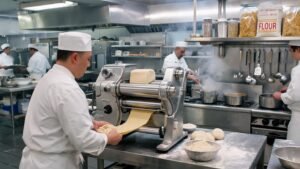
Manual pasta machines use a hand crank to rotate steel rollers, allowing you to flatten dough gradually without electricity. It is the classic heirloom tool you clamped to the counter in a traditional kitchen, relying on simple gears and human effort.
Pros:
✔ Extremely durable: No motor to fail, no electronics to short circuit.
✔ Excellent dough control: You feel the thickness and resistance instantly through your hands.
✔ Works without electricity: Perfect for cooking anywhere, including outdoor workspaces.
✔ Silent operation: Quiet enough for early morning prep without waking the household.
Cons:
✘ Labor intensive: Demands physical arm work, which gets tiring during bulk batches.
✘ Requires coordination: One hand is busy cranking, leaving only one free to guide the dough.
✘ Countertop dependent: Must be firmly clamped to a flat table edge to stay upright.
Who Is It Best For?
If you only make pasta on Sunday afternoons with your children, a hand-cranked machine is often the most enjoyable choice. The slower process becomes a fun part of the experience rather than a disadvantage. It’s also the go-to tool for budget kitchens and culinary purists who love classic utensils like the Marcato Atlas 150 or Imperia Manual Roller.
Common Types of Electric Pasta Machines
Electric pasta machines take the muscle work out of dough preparation. Instead of uniform templates, home cooks typically choose between three distinct formats:
1. Motor Attachment Systems
These are classic manual rollers fitted with a detachable plug-in motor on the side (like the Marcato Pastadrive). They give you the flexibility of manual control when you want a quiet, slow roll, and motor assistance when preparing larger batches.
2. Integrated Roller & Cutter Machines
All-in-one motorized units designed purely for rolling and cutting. They feature built-in electric rollers, a sleek casing, and dual-cutting blades. Since you never have to turn a handle, both hands remain free to guide long pasta sheets smoothly.
3. Automatic Mixing & Extruding Machines
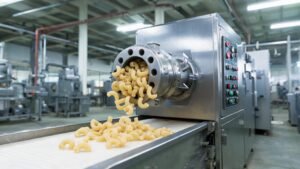
Self-contained kitchen appliances (like the Zhuoheng Pasta Maker). You pour dry ingredients in, and the built-in paddle mixes, kneads, and automatically extrudes structural shapes (such as penne, macaroni, and rigatoni) directly through specialized shaping dies.
Pros:
✔ Hands-free convenience: Both hands can catch, dust, and fold the stretching dough sheet.
✔ Incredible speed: Cuts down dough preparation time by more than half.
✔ Physical accessibility: Perfect for anyone suffering from wrist fatigue or joint pain.
✔ Shape versatility: Extruder models make hollow, tubular shapes manual rollers can’t.
Cons:
✘ Motor noise: Creates a constant, buzzing hum in the kitchen during operation.
✘ Electrical failure points: Motors, switches, and plastic internal gears can wear down over time.
✘ Cleaning complexity: You must be careful to avoid wetting electrical components.
Who Is It Best For?
If pasta appears on your dinner table every week, saving 15–20 minutes each cooking session quickly adds up over a year. An electric machine is ideal for busy families, larger dinner gatherings, and individuals who want consistent fresh pasta with minimal physical effort.
Hand Cranked vs Electric Pasta Machine: Detailed Comparison
Price & Value Comparison
Manual rollers are extremely cheap up front. Standard steel models cost between $35 and $80. Because they have zero electrical components, they last for decades, offering incredible long-term value.
Electric machines are a larger investment, starting around $120 and reaching $350 for premium extruder models. However, if your time is valuable, the motor quickly pays for itself by turning a tiring 45-minute manual project into a quick, effortless 15-minute prep session.
Ease of Use & Learning Curve
As a beginner, coordinating a hand crank while managing a long, thin sheet of dough is surprisingly tricky. It is very common for beginners to tear the dough sheet because they cannot turn the handle at the exact same pace they feed the dough.
Electric rollers eliminate this coordination challenge. Because the motor turns at a constant, unyielding speed, you can use both hands to center and catch the dough sheet, preventing tears and making your very first batch feel successful.
Processing Speed
Imagine making fresh pasta for a family gathering. After rolling dough manually for the fifth batch, most people begin to notice arm fatigue. This is exactly where an electric machine starts to justify its higher price. A motor processes kilograms of dough in minutes, maintaining constant speed without stopping, while a human arm naturally slows down and takes breaks.
Cleaning & Maintenance
Manual machines are beautifully simple: you wait for the remaining dough to dry, brush it off, and wipe down the steel frame. They require almost zero maintenance besides a drop of mineral oil on the gears once a year.
Electric machines require a bit more care. The motor assembly must be detached, and automated extruder models have multiple mixing chambers, paddles, and shaping disks that trap wet dough and require deep, meticulous washing after each use.
Durability & Lifespan
A classic hand-cranked model such as the Marcato Atlas 150 is often considered the benchmark for durability—many are handed down through generations because there are simply no electronic elements to break. Electric units have a finite lifespan governed by the motor brushes, plastic gears, and electrical connections which can eventually burn out under heavy use.
Which One Makes Better Homemade Pasta?
The texture of fresh pasta depends 90% on your dough recipe (hydration ratio and flour choice) and only 10% on the roller.
However, there is one small mechanical detail: electric motors generate mild ambient heat, which can transfer to the metal rollers during long cooking sessions. This warmth can slightly soften the butter or egg fats in enriched doughs, reducing elasticity. A manual machine keeps the dough completely cool. But for standard semolina-and-water doughs, both machines roll identical, delicious sheets. The “better” pasta is simply the one made with the correct recipe and hydration.
When Does an Electric Pasta Machine Become Too Small?
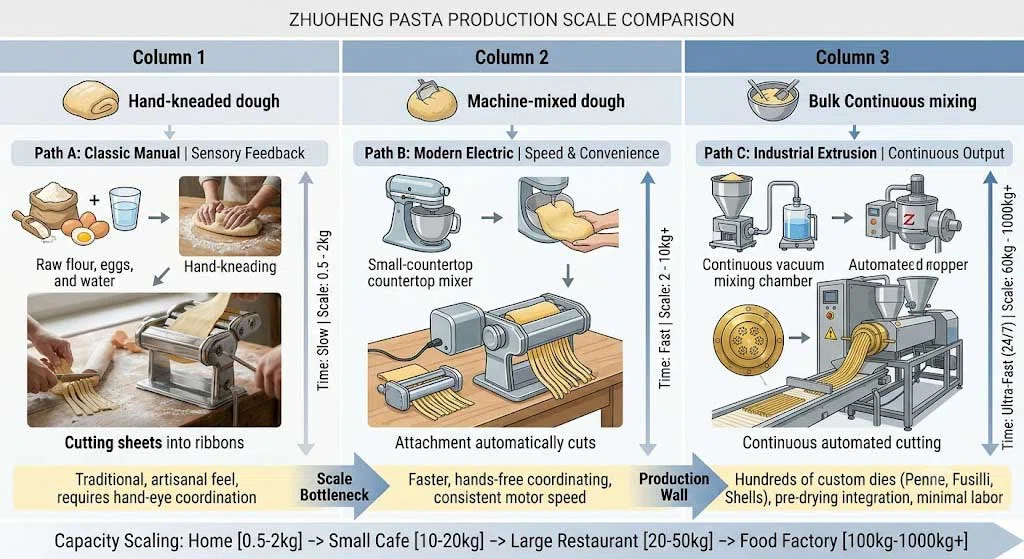
There is a hidden wall that every small food business or restaurant runs into. When home cooks transition to opening a boutique restaurant, cafe, or packaging their own brand of dry pasta, they often try to scale up production using consumer electric pasta machines.
They quickly realize that home-use electric machines are only built to run for 15 to 30 minutes before requiring a cool-down. Pushing them past this limit leads to serious bottlenecks:
Motor Burnout: Residential motors lack internal cooling fans, meaning they overheat and fail under daily continuous use.
Labor Costs: Rolling and cutting sheets strand-by-strand is incredibly slow when you need to prepare 20 kg of pasta every morning.
Quality Bottlenecks: Small machines force you to mix multiple tiny batches, leading to noticeable variations in dough hydration and texture between plates.
When Should You Upgrade to a Commercial Pasta Extruder?
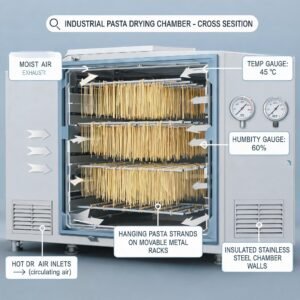
If your daily demand moves past occasional family dinners to commercial quantities, it is time to upgrade to a commercial pasta extruder. This machine shifts your workflow from a rolling style to continuous high-pressure extrusion, automating your entire kitchen prep process.
How does your production demand translate to machine scale? Look at the typical daily output requirements:
| Operational Scale | Daily Production Demand | Recommended Machine Class |
|---|---|---|
| Home Cooking | 0.5 – 2 kg / day | Hand Cranked or Home Electric Roller |
| Small Cafe / Boutique Bistro | 10 – 20 kg / day | Small Commercial Extruder / Heavy-Duty Roller |
| Busy Italian Restaurant | 20 – 50 kg / day | Commercial Extrusion Machine with Brass Dies |
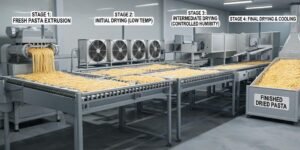
| Food Factory / Wholesale Brand | 100 kg – 500+ kg / day | Fully Automatic Industrial Pasta Production Line |

Commercial Pasta Extruder vs Electric Pasta Machine
If you are trying to scale your business, here is how a commercial-grade extruder compares to a premium domestic electric machine:
| Performance Metric | Domestic Electric Machine | Commercial Pasta Extruder (Zhuoheng) |
|---|---|---|
| Hourly Output | 1 - 2 kg per hour | 60 kg to 500+ kg per hour |
| Automation | Requires active manual feeding and sheet cutting | Fully automatic mixing, vacuum extrusion, cutting, and pre-drying |
| Labor Costs | High (Requires constant staff supervision) | Extremely Low (One operator can run a continuous line) |
| Run Time | 15 - 30 minutes (Requires frequent motor cooling) | 24/7 continuous industrial operation |
| Shape Customization | Limited to 2-4 flat cutter settings | Hundreds of brass dies (Penne, Fusilli, Shells, Custom Shapes) |
Frequently Asked Questions
Is an electric pasta machine worth buying?
Yes, if you cook pasta regularly or host dinners for more than 4 people, the hands-free convenience and massive time savings make it highly worth the cost.
Is a hand crank pasta machine better?
It is better if you cook occasionally, enjoy the classic culinary process, or want a robust, all-metal kitchen tool that will never break down or require a wall plug.
Which pasta machine lasts longer?
Hand crank models last far longer. Lacking any electronic parts, motors, or wiring, a manual steel roller is practically indestructible and often outlasts its owner.
Do professional chefs prefer manual or electric pasta machines?
For small, food-menu testing or classic preparation, some chefs prefer the tactile feel of manual rollers because they don’t generate heat, keeping delicate egg-dough cool. However, for active dinner services, professional kitchens rely on commercial motorized gear or heavy-duty extruders to meet real-time orders efficiently.
Can an electric pasta machine replace a commercial pasta extruder?
No. Domestic electric machines are designed for short, low-pressure batches. A commercial extruder uses massive vacuum pressure, heavy brass dies, and continuous motors to produce durable, high-density commercial pasta day in and day out without overheating.
Are electric pasta machines hard to clean?
Automatic extruder models require more effort because you must clean the mixing paddle, chamber, and shaping dies. Motorized home rollers are easier; you simply detach the motor and brush away any dried flour.
Can beginners use manual pasta machines?
Yes, but expect a learning curve. Beginners often find it easier to use an electric model first so they can focus on guiding the dough with both hands instead of cranking.
Design Your Custom Pasta Production Line with Zhuoheng
If you are making pasta only for your family, a hand-cranked or electric pasta machine is usually enough to create delightful weekend meals.
However, if your business needs to produce fresh pasta continuously with consistent quality, a commercial pasta extrusion line becomes a more practical, profitable, and long-term investment.
At Zhuoheng Extruder, we help food manufacturers, commercial kitchens, and pasta startups design customized pasta production lines based on production capacity, pasta type, and factory layout.
Ready to scale up your output? Explore our professional pasta manufacturing machinery.