In the high-stakes world of professional catering, the difference between a “good” pasta dish and a “legendary” one often comes down to two things: the quality of the ingredients and the precision of the equipment. For a small catering business, you are constantly walking a tie-rope between maintaining that “handmade” artisanal quality and meeting the grueling demands of high-volume service.
As a manufacturer of food production lines, I’ve seen many entrepreneurs start their journey in a home kitchen. The question I am most frequently asked isn’t just “which machine is the best,” but “which machine will help me grow without breaking?” In this guide, we will dissect the top-rated machines on the market—from iconic manual rollers to professional-grade solutions—and help you understand when it is time to transition from a kitchen gadget to a Small Commercial Pasta Machine.
The "Growth Wall": Why Your Current Equipment is Costing You Money
Most catering startups begin with a high-end consumer machine. It’s a logical first step. However, there is a hidden phenomenon I call the “Growth Wall.” This happens when your labor costs to produce pasta manually exceed the monthly payment of a professional machine.
The Labor Math of Catering: A Deep Dive
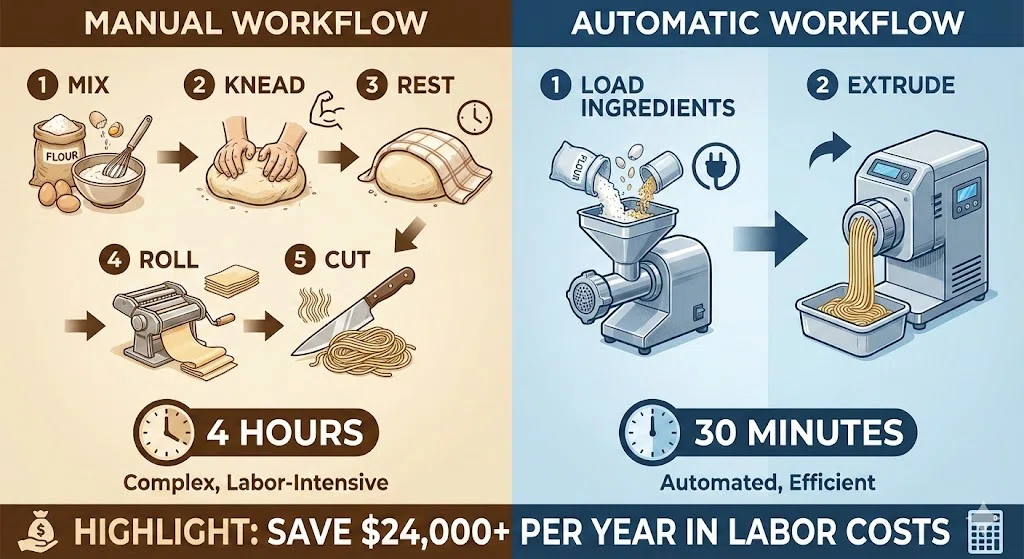
Let’s break down the economics. If a chef or a highly skilled prep cook spends 4 hours a day hand-cranking a manual roller to produce just 10kg of pasta, you are paying for more than just muscle. You are paying for the inconsistency of fatigue.
The Manual Cost: At $25/hour, your labor cost is $100 per day. Over a 22-day working month, that is $2,200.
The Opportunity Cost: In those 4 hours, your chef could have been developing new sauces, managing plating, or optimizing the menu—tasks that actually drive revenue.
A Professional Pasta Machine for Small Business can produce that same 10kg in under 30 minutes, including setup and cleaning time. This isn’t just an equipment purchase; it’s a strategic reallocation of your most expensive resource: human labor.
Technical Analysis of Market Leaders (The "Factory Eyes" Review)
When we look at brands like Marcato or Philips, we don’t just see “pasta makers.” We see mechanical assemblies. Here is how they stack up when pushed to a commercial limit.
The Artisanal Gold Standard: Marcato Atlas 150
The Marcato Atlas 150 remains the undisputed king of manual rollers.
The Technical Edge: It utilizes anodized aluminum alloy rollers. From a metallurgical factory perspective, this is vital. Unlike chrome-plated steel found in cheap replicas, anodized aluminum does not flake or peel. This prevents heavy metal contamination in your dough—a critical factor for passing food safety audits in a commercial catering environment.
Catering Context: It is perfect for “Live Action” stations. However, for a catering business, the manual crank is a bottleneck. I always recommend the 1200W motor attachment. This converts the unit into a Semi-Automatic Noodle Machine, freeing up one of your hands to guide the dough sheet, which ensures a uniform thickness (Consistency) that is impossible to maintain manually for hours.
The Versatility Powerhouse: Philips Pasta Maker 7000 Series
For businesses that require a wide variety of shapes—Penne on Tuesday, Fusilli for a Wednesday wedding—this Tabletop Pasta Extruder is a common entry point.
Automation Efficiency: It mixes, kneads, and extrudes in under 10 minutes. For a solo caterer, this machine is essentially a digital prep assistant.
The Industrial Limit: Here is the factory truth: the mixing chamber and front faceplate are often made of high-impact plastic or light alloys. These are not designed for “Continuous Duty Cycles.” In a factory, we measure the “Duty Cycle”—how long a machine can run before it needs to cool down. The Philips is a 20% duty cycle machine. If you attempt to run it for an 8-hour shift, the internal thermal fuse will likely trip, or the plastic gears will warp under the heat of friction.
What Makes a Machine "Commercial Grade"? (Engineering Specs)
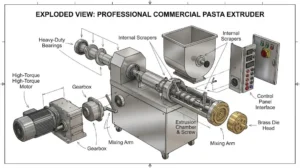
As a factory specializing in custom food lines, we evaluate equipment differently than a food critic. We look at the “Mean Time Between Failure” (MTBF). Here is what defines a true Small Commercial Pasta Machine:
Material Science: Why 304 Stainless Steel is Mandatory
In a commercial kitchen, hygiene is non-negotiable. 304-grade stainless steel contains 18% chromium and 8% nickel. This specific chemistry makes it resistant to the organic acids found in eggs and the alkaline salts sometimes used in noodle making.
Durability: It can withstand high-pressure hosing and harsh sanitizing chemicals (like quaternary ammonium) without pitting.
Safety: It is non-porous, meaning bacteria cannot hide in microscopic surface cracks. This is a standard requirement for any Heavy Duty Pasta Maker for Home that claims “Professional” status.
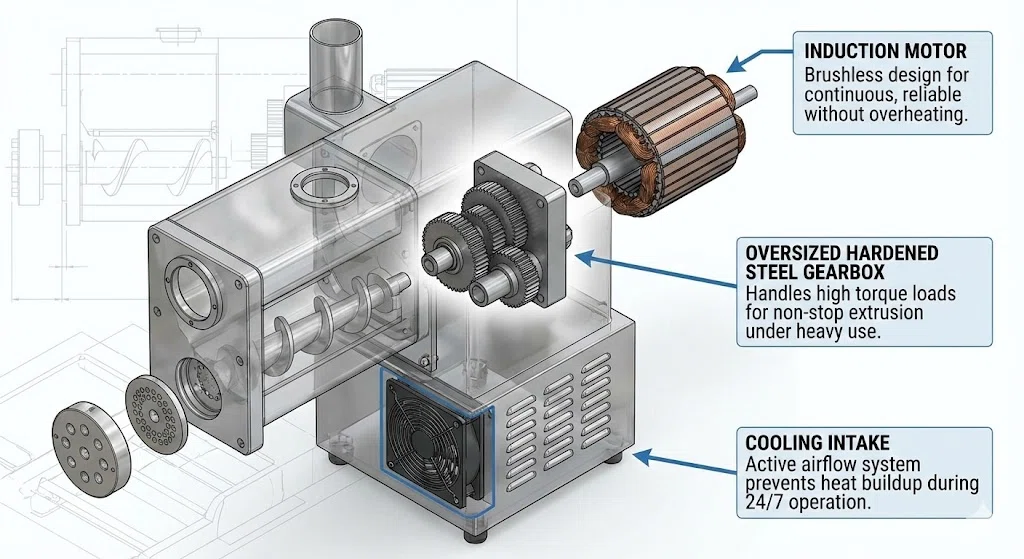
The Heart of the Machine: Induction Motors vs. Universal Motors
Most kitchen appliances use Universal Motors. They are light and cheap but loud and prone to overheating. A professional Automatic Pasta Machine uses an Induction Motor.
Constant Torque: Induction motors maintain the same “pushing power” regardless of the dough’s resistance. If your semolina dough is a bit dry, an induction motor won’t bog down; it will push through.
Quiet Operation: In an open kitchen catering environment, noise levels matter. Induction motors hum at a lower decibel, keeping the workspace professional.
The Secret to Sauce Adherence: Bronze vs. Teflon Dies
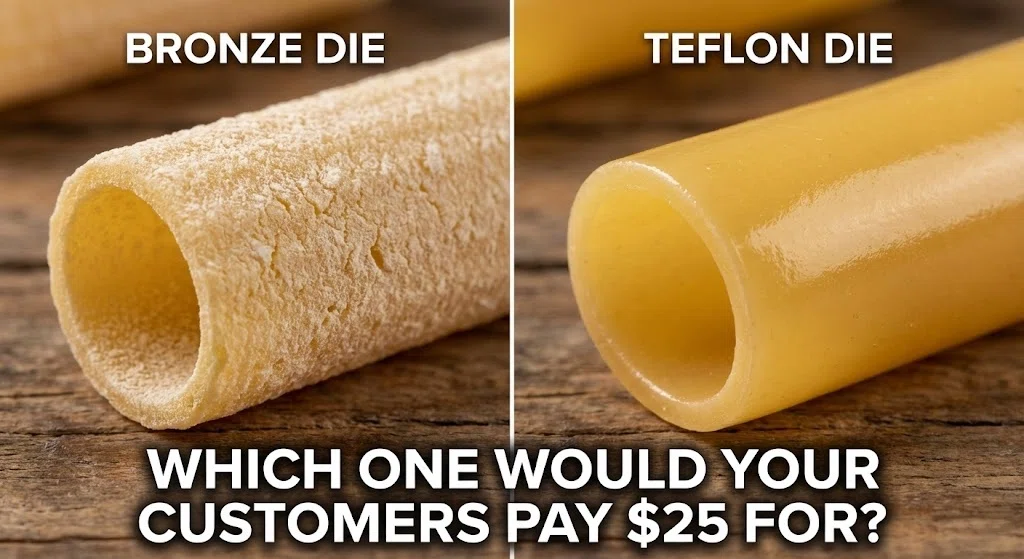
In the catering industry, the texture of your pasta determines how much you can charge per plate. This texture is created at the “Die”—the extrusion plate.
The Bronze Die (The Artisanal Choice)
Bronze dies (usually made of a specific lead-free tin-bronze alloy) are the gold standard.
The Physics: As the dough is forced through the bronze, the friction creates a microscopically torn, “shaggy” surface.
The Result: This rough surface is what allows the sauce to “velcro” to the pasta. In high-end catering, this is called “Sauce Adherence.” When a guest lifts a fork of your Rigatoni, the sauce stays on the noodle rather than sliding to the bottom of the bowl.
The Teflon Die (The High-Volume Choice)
Teflon dies are used for mass production.
The Physics: Teflon is “non-stick,” so the dough slides out with zero resistance.
The Result: The pasta is smooth, shiny, and yellow. While it looks pretty in a box, it has poor sauce adherence. However, Teflon dies are easier to clean and allow for faster extrusion speeds.
As a factory, we specialize in providing Tabletop Pasta Extruder units with interchangeable bronze dies, allowing caterers to offer a premium, “sauce-clinging” product that justifies a higher menu price.
Maintenance: The Industrial Standard for Longevity
A machine in a factory that isn’t running is a liability. For a caterer, a broken machine on the morning of a 500-guest wedding is a catastrophe.
The "Dry Cleaning" Rule for Rollers
For manual or motorized rollers like the Marcato, water is the enemy. Water seeps into the side-bearings and creates “dough-sludge” that eventually goes rancid and seizes the rollers.
Pro Tip: Use a stiff pastry brush and compressed air. If the machine is used for 4+ hours, we recommend a “mid-shift purge” where you run a scrap piece of dough through to pick up any loose flour.
The Die Maintenance Protocol
For any Automatic Pasta Machine, the dies must be managed with care.
Immediate Soaking: Once the shift ends, dies must be placed in a warm water bath immediately. If semolina dough dries inside a bronze die, it becomes as hard as concrete, often requiring ultrasonic cleaning to remove.
Food-Grade Lubrication: Every month, the internal gears should be checked. Only use NSF-H1 certified food-grade grease. Never use vegetable oil—it oxidizes and turns into a sticky “varnish” that will eventually destroy your motor.
Global Standards: Navigating Power and Safety for International Buyers
As an international manufacturer, one of the most common hurdles our catering clients face isn’t the machine’s price—it’s the technical compatibility with their local infrastructure. If you are a caterer in the USA buying from a global supplier, or a UK-based business scaling up, you must look beyond the “Buy Now” button.
Voltage and Frequency (The 110V vs. 220V Debate)
For a Small Pasta Maker, the power supply is the lifeblood of the motor.
North America (110V-120V/60Hz): Most high-end “prosumer” machines are built for this. However, for a true Professional Pasta Machine for Small Business, we often recommend installing a dedicated 220V line. Why? Because 220V allows the motor to draw less current (amperage) while producing the same torque, which keeps the internal components significantly cooler during a 4-hour production run.
Europe/Asia/Australia (220V-240V/50Hz): These regions have a natural advantage for heavy machinery. The 50Hz frequency requires slightly different gearing in the gearbox to maintain the same RPMs as a 60Hz machine. At our factory, we calibrate the internal gear ratios based on the client’s destination country to ensure the extrusion speed remains consistent.
Certification Standards: NSF, CE, and UL
When you are running a catering business, a “kitchen fire” or a “sanitation fine” can end your dream.
NSF (National Sanitation Foundation): This is the gold standard for North America. It ensures there are no “harborage points” where bacteria can grow.
CE (Conformité Européenne): Mandatory for the EU, focusing on electrical safety and shielding.
UL (Underwriters Laboratories): Focuses on fire safety. A Small Commercial Pasta Machine worth its salt should come with a full technical dossier and international certifications to ensure it passes your local health department’s inspection on day one.

Scaling Your Operation: The 3-Stage Equipment Roadmap
Success in catering often comes faster than expected. You start with one wedding, and suddenly you have three. How do you scale without wasting money on “stepping-stone” equipment?
Stage 1: The Boutique Setup (0-15kg per week)
At this stage, a Semi-Automatic Noodle Machine like the motorized Marcato or a high-end KitchenAid attachment is sufficient. Your focus is on “Craft” over “Volume.” You are charging a premium for the “handmade” story.
Stage 2: The Established Caterer (15kg-75kg per week)
This is where the “Growth Wall” hits. You need a dedicated Tabletop Pasta Extruder. You should look for a machine with a 1.5kg to 3kg mixing hopper capacity. This allows you to mix one batch while the previous one is extruding. At this stage, you transition from “Sheet-and-Cut” to “Extrusion,” which opens up shapes like Rigatoni and Penne that are much more profitable for bulk events.
Stage 3: The Wholesale & Central Kitchen (75kg-500kg+ per week)
Now, you aren’t just a caterer; you are a food processor. You need a Small Commercial Pasta Making Machine integrated with a drying rack system and perhaps a vacuum sealer. At this level, we recommend machines with water-cooled barrels to ensure the dough remains at a constant temperature for 8 hours of production.
The "Dough Factor": How Ingredients Impact Machine Longevity
As an engineer, I can tell you that not all dough is created equal. The “stiffness” of your recipe directly impacts the “Mean Time Between Failure” of your machine.
High-Protein Semolina vs. All-Purpose Flour
Commercial Italian pasta is made from 100% Durum Semolina. This flour is “gritty” and has a high protein content. It requires significantly more extrusion pressure than soft “00” flour. If you use a Heavy Duty Pasta Maker for Home with a weak motor to process 100% Semolina, the internal drive belt will likely snap within months. True commercial machines use chain-driven or direct-gear systems to handle this resistance.
The Gluten-Free Challenge
Gluten-free doughs (made from rice, corn, or chickpea flour) are notorious in our factory testing labs. They are “short”—meaning they have no elasticity—and are incredibly sticky.
The Trap: Sticky dough creates a vacuum inside the extrusion chamber, forcing the motor to work 30% harder.
The Solution: If your catering business specializes in GF pasta, you need a machine with a Teflon-coated mixing paddle and extrusion screw to prevent the “cementing” effect.

Customization: The Factory Advantage for B2B Clients
This is where the “Expert” advice separates from the “Reviewer” advice. When you buy a machine from a retail store, you get what is in the box. When you work with a factory, you get a solution.
Custom Die Milling: Do you want a pasta shape that looks like a flower for a garden-themed wedding? Or perhaps a shape that features a client’s logo for a corporate event? We can mill custom Bronze Dies to any CAD specification.
Voltage Customization: We can build the internal transformers to match specific regional grids, ensuring your machine lasts 10 years instead of 2.
Spare Parts Kits: Every Automatic Pasta Machine shipped from our factory includes a “Critical Spares Kit”—extra O-rings, a replacement drive belt, and a secondary fuse. In the catering world, being down for an hour is a problem; being down for a week while waiting for an international shipment is a bankruptcy risk.
Conclusion: Investing in Your Future
Choosing the best pasta machine for small catering business is not about finding the lowest price; it is about finding the lowest “Cost per Portion” over the life of the machine.
A manual machine tells a story of craft, but a Small Commercial Pasta Machine tells a story of a profitable, scalable business. As you move forward, evaluate your volume, calculate your labor costs, and don’t be afraid to invest in equipment that can grow with you.
FAQ: The Master Guide for Catering Professionals
-
Can I use the machine for Soba or Udon as well?
A: Yes, but with caution. Soba dough (buckwheat) is very abrasive. If you plan to do this frequently, you need a machine with hardened stainless steel extrusion screws to prevent the flour from "sanding down" the metal over time.
-
How do I handle "Rush Orders" for 500 guests?
A: The secret isn't a faster machine; it’s the "Batch and Freeze" method. Use a high-capacity Professional Pasta Machine for Small Business to produce the pasta 2 days early, flash-freeze it on trays, and then boil directly from frozen. This ensures perfect "Al Dente" texture even at scale.
-
What is the most common reason for motor failure?
A: Over-packing the mixing hopper. Many caterers think putting more dough in will make it faster. In reality, this starves the motor of air and increases friction. Always follow the factory-specified "Max Fill" line.
-
How do you support international warranties?
A: We use a "Modular Repair" philosophy. Every component of our Automatic Pasta Machine is designed to be replaced by a local technician using standard tools. We provide video-call support and overnight shipping for critical modules.
-
Why can't I just use a high-end home machine for my restaurant?
A: It's about the "Duty Cycle." Home machines are designed to run for 15-20 minutes. Commercial units are designed for 100% duty cycles, meaning they can run all day without the motor burning out.
-
Is it difficult to change the shapes on an automatic machine?
A: On a professional Automatic Pasta Machine, changing a die takes less than 60 seconds. You simply unscrew the ring nut, swap the die, and you're ready for a different pasta shape.
-
What is the ROI on a commercial unit?
A: Typically, if you are producing 15kg of pasta a week, a commercial unit pays for itself in labor and ingredient savings within 4 to 6 months.
-
Do you offer custom dies for unique shapes?
A: Yes, as a factory, we can mill custom bronze dies to match your brand's specific requirements, from unique logos to specialized regional shapes.