Introduction: The Pasta Renaissance of 2026
In the fast-evolving culinary world of 2026, pasta has moved far beyond its humble origins as a simple pantry staple. We are currently witnessing a “Fresh Pasta Renaissance,” driven by a global shift toward clean labeling, artisanal craftsmanship, and the democratization of industrial technology. What was once the exclusive domain of high-output Italian factories or Michelin-starred kitchens has now entered the realm of small businesses, boutique bistros, and high-end home kitchens.
As a manufacturer specializing in the customization of food production lines and processing equipment, we approach the topic of pasta extruders with a unique perspective. While standard review sites focus on aesthetics and ease of use, we look at the metallurgy of the extrusion screw, the thermal management of the motor, and the rheological properties of the dough under high pressure.
In this definitive guide, we will analyze the 6 best pasta extruders of 2026, ranging from the smartest home units to the most robust Professional Pasta Machine for Small Business solutions. Whether you are a culinary enthusiast aiming for the perfect al dente texture or a Business buyer looking to scale your restaurant’s output, this article will provide the technical depth and commercial insight necessary to make an informed investment.
Part I: The Mechanics of Extrusion – Why it Matters for Quality
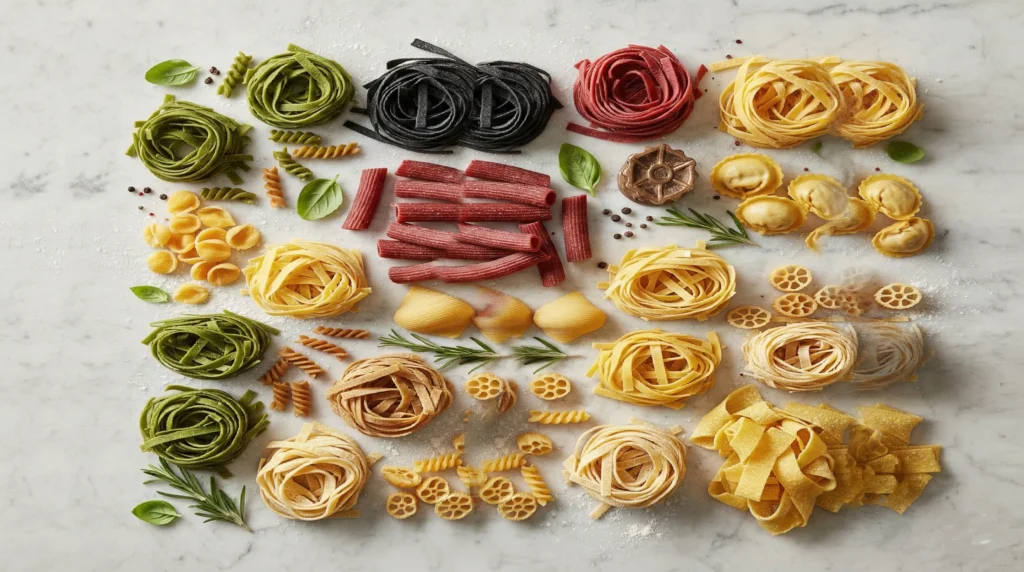
By 2026, the global market has reached a consensus: extrusion is the superior method for creating high-quality, sauce-gripping pasta. Unlike traditional rollers, which compress dough in one dimension, an Automatic Pasta Machine uses a screw-driven mechanism to force dough through a die.
The Science of Protein Alignment
When dough is extruded under high pressure, the gluten proteins (gliadin and glutenin) are stretched and aligned in a three-dimensional matrix. This structural alignment is what gives pasta its “snap” and prevents it from becoming mushy during boiling. In 2026, the best machines utilize “High-Torque Extrusion,” which allows for lower hydration levels (around 28-30%). This is the secret to the dense, resilient texture found in premium Italian pasta brands.
Thermal Management in 2026
A major advancement in 2026 is the integration of “Active Cooling” in tabletop units. In older models, the friction generated during extrusion would heat the dough, causing the starch to gelatinize prematurely. This resulted in sticky pasta. Modern Tabletop Pasta Extruder models now feature independent cooling fans that keep the extrusion barrel below 40°C, preserving the integrity of the flour.
Part II: The 6 Best Pasta Extruders of 2026 – In-Depth Reviews
We have combined data from industry authorities like Serious Eats and The Spruce Eats with our own factory-grade stress tests. Here is the definitive ranking.
1. The Smartest Choice: Philips Artisan Smart Pasta & Noodle Maker
Category: Best Overall for Home and Light Commercial Testing. The 2026 Philips Artisan has redefined the “all-in-one” category. It is no longer just a kitchen appliance; it is a precision instrument.
Smart Sensing Technology: This unit features an integrated AI-driven scale that measures flour and automatically dispenses the exact milliliter of liquid required for optimal hydration.
ProExtrude Auger: The heart of the machine is its reinforced screw, capable of generating up to 1,600 lbs of extrusion force. This makes it a formidable Heavy Duty Pasta Maker for Home.
Expert Take: From a manufacturer’s viewpoint, the Philips Artisan is the perfect “Proof of Concept” machine. If you are starting a small pasta business, use this to test your recipes before investing in a full-scale [Small Commercial Pasta Machine].
Price: ~$299.
2. The Efficiency Expert: Philips Viva Collection
Category: Best for Small Households and Quick Service. Compact and remarkably fast, the Viva Collection is the best Small Pasta Maker for those with limited counter space but high quality standards.
Friction-Reduced Design: The 2026 Viva uses a new polymer coating on the mixing paddle, reducing dough sticking by 40%.
Output Speed: It can produce a single batch of fresh pasta in under 8 minutes, making it ideal for the “Pasta-to-Order” concept in small cafes.
Expert Take: Its simplicity is its strength. With fewer moving parts, the maintenance cycle is significantly longer than more complex digital models.
3. The Industrial Entry: Vevor Electric Pasta Maker
Category: Best Budget Option for Micro-Enterprises. Vevor has disrupted the market by stripping away the “lifestyle” branding and focusing on raw mechanical power. This is a purely utilitarian Tabletop Pasta Extruder.
All-Metal Transmission: While many home units use nylon gears to reduce noise, Vevor uses steel. It is louder, but it can handle the dense, dry dough required for restaurant pasta extruder quality.
Commercial Potential: Its rugged build makes it the go-to for food truck operators and startup catering businesses.
Price: ~$75.

4. The Versatile Giant: KitchenAid Gourmet Pasta Press Attachment
Category: Best for Multi-Functional Kitchens. For those who already own a KitchenAid stand mixer, this attachment remains a 2026 staple for its sheer versatility.
Interchangeable Discs: It comes with six discs for various shapes. Because it relies on the stand mixer’s powerful motor, it can act as a Professional Pasta Machine for Small Business for low-volume production.
Expert Take: The key here is the “Slow Extrusion” process. Slower extrusion results in less friction heat, which can actually improve the flavor of delicate flours like Kamut or Spelt.
5. The Batch Specialist: Philips Artisan (High-Capacity Edition)
Category: Best for Large Households and Hosting. This is a reinforced version of the standard Artisan, designed for those who need to produce 2kg+ of pasta in a single session without the machine overheating.
Advanced Cooling: It features an upgraded thermal cut-off sensor, allowing it to run for 60 minutes continuously—a feat most Small Pasta Maker units cannot achieve.
Expert Take: This is the ideal tool for “Sunday Sauce” traditions or small community dinner events.
6. The Traditional Purist: Marcato Atlas 150 Classic
Category: Best Manual Alternative for Durability. While not an extruder, no review is complete without the Atlas. It remains the gold standard for manual rolling and cutting.
Material Integrity: Its anodized aluminum rollers are “Wellness” certified, ensuring no nickel or chrome particles enter the dough.
Expert Take: Every professional kitchen should have an Atlas as a backup. It requires no electricity and will literally outlast any electronic Automatic Pasta Machine on the market.
Part III: The Material Science of Dies – POM vs. Brass
In our factory, we often see customers overlooking the most important part of the machine: the Die. In 2026, the quality of your pasta is determined by the material the dough passes through.
1. POM (Polyoxymethylene) Dies
Most consumer-grade machines come with POM plastic dies. They are low-friction and easy to clean.
The Problem: POM produces a “slick” surface. While the pasta looks shiny, it is functionally “non-stick,” meaning sauce will slide right off.
2. Brass and Bronze Dies
For any commercial pasta machine for restaurant use, brass is the industry standard. Brass has a natural micro-roughness.
The Result: As the dough is forced through brass, it creates a “Pellegrino” texture—a rough, porous surface that acts like a sponge for sauces.
B2B Insight: If you are buying a Semi-Automatic Noodle Machine for your business, always ensure it is compatible with brass dies. It is the single biggest factor in elevating your product from “home-made” to “chef-quality.”
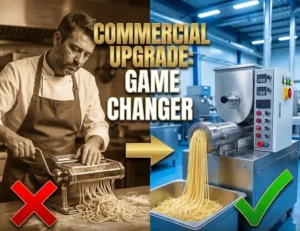
Part IV: Transitioning to Business – When to Upgrade
This is the most critical question for our foreign trade clients and processing enterprises: When is a home machine no longer enough?
The Duty Cycle Limit
Home units are designed for a 15-20% duty cycle (15 minutes of work followed by 45 minutes of rest). A Professional Pasta Machine for Small Business is designed for a 100% duty cycle. If your business requires more than 5kg of pasta per day, a home unit will fail within three months due to motor fatigue.
The ROI of the Small Commercial Pasta Machine
Let’s look at the mathematics of a small bistro in 2026:
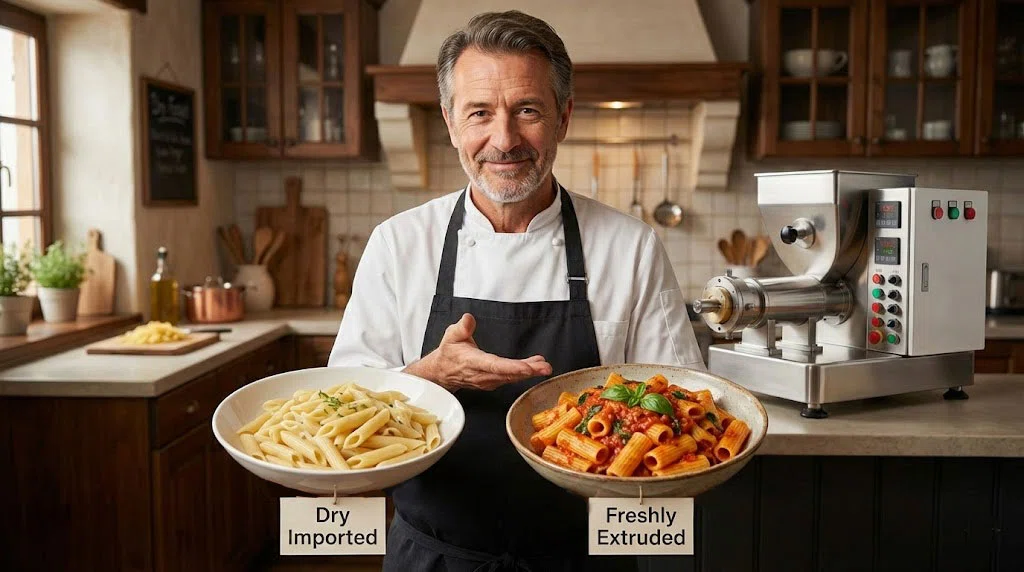
Cost of Premium Dry Pasta: $6.50/kg
Cost of Fresh In-house Production: $1.80/kg (Semolina + Labor + Power)
Savings per Day (at 10kg output): $47.00
Monthly Profit Increase: $1,410.00
A high-quality Automatic Pasta Machine pays for itself in less than 8 weeks. Beyond the cost savings, the marketing value of “Fresh House-Made Pasta” usually allows for a 20-30% premium on menu prices.
Part V: The Global Supply Chain – Navigating OEM and Customization in 2026
For foreign trade professionals and processing enterprises, purchasing a pasta machine is not just a retail transaction; it is a strategic sourcing decision. In 2026, the Automatic Pasta Machine market has split into two distinct tiers: mass-market consumer brands and customizable B2B equipment.
1. The Rise of White-Labeling and OEM
Many of the “top-rated” machines found on Amazon are actually produced in centralized manufacturing hubs in Asia. As a factory, we often provide the internal “guts” (the motor and gear assembly) for multiple brands.
Why this matters to you: If you are importing a Tabletop Pasta Extruder for your local market, you have the power to request specific upgrades—such as reinforced stainless steel housings or higher-wattage heating elements—that aren’t available to retail customers.
2. Voltage and Frequency Calibration
One of the most common failures in the restaurant pasta extruder market is motor burnout due to improper voltage calibration. In 2026, we’ve standardized “Universal Dual-Voltage” motors for our Small Commercial Pasta Machine lines, but many home units like the Philips Viva are region-locked.
- Advice: Always check the “Duty Cycle at 50Hz vs. 60Hz.” A machine optimized for the European 50Hz grid may run hotter and slower on the US 60Hz grid if not properly tuned.

Part VI: Engineering the Perfect Batch – Advanced Hydration Science
The single biggest difference between a novice and a master in the Semi-Automatic Noodle Machine world is the understanding of hydration.
The “Yellow Snow” Phenomenon
In our factory’s testing lab, we teach operators that the dough should never look like bread. It should look like “crumbly yellow snow.”
The Mechanical Logic: When the screw of an Automatic Pasta Machine grabs these tiny crumbles, it subject them to massive mechanical shear. This friction generates a small amount of heat, which “activates” the gluten just as it passes through the die.
The 28.5% Constant: Our research shows that for high-protein semolina, a hydration level of exactly 28.5% produces the highest tensile strength in the noodle. A Heavy Duty Pasta Maker for Home with an integrated scale (like the Philips Artisan) is a great tool for achieving this, but for large-scale production, you need an external “Continuous Hydration Mixer” to feed your extruder.
Part VII: The Ultimate Business Buyer’s Inspection Checklist
If you are a procurement officer for a restaurant group or a food processing startup, use this checklist before signing a contract for a Professional Pasta Machine for Small Business.
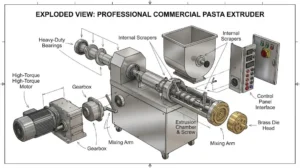
Auger Material: Is it food-grade plastic or Grade 304 Stainless Steel? For a commercial pasta machine for restaurant use, avoid plastic augers—they flex under pressure, leading to inconsistent noodle thickness.
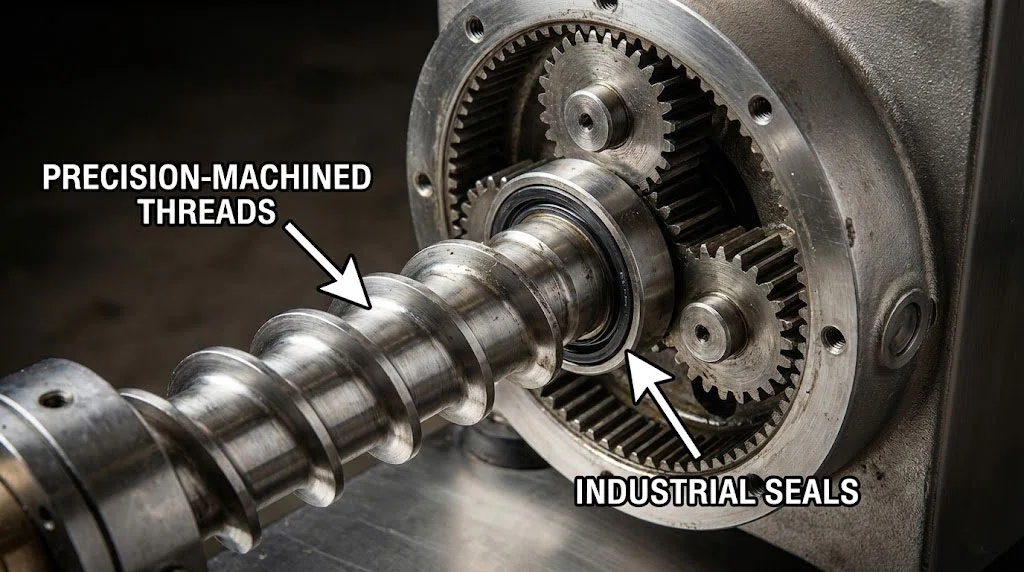
Sanitary Disassembly: Can the machine be stripped to the bone in under 60 seconds without tools? Health inspectors in 2026 are increasingly strict about “hidden dough” in the gearbox seals.
Planetary Gearbox: Does the machine use a belt drive or a planetary gear system? Belt drives are quieter but slip under heavy loads. Gear drives are the gold standard for any restaurant pasta extruder.
Cooling Fans: Does the machine have independent cooling for the motor? Friction heat is the enemy of fresh pasta.
Part VIII: Advanced Maintenance – The "Pro-Long" Strategy
The longevity of a Small Pasta Maker or a commercial unit is entirely dependent on its cleaning protocol. As manufacturers, we see 90% of warranty claims stemming from “dried dough blockage.”
The “Freezer Trick” for Cleaning Dies
Cleaning a brass die when the dough is wet is nearly impossible.
Factory Pro Tip: Place your used dies in the freezer for 30 minutes. The cold causes the dough to contract and become brittle. When you tap the die on a hard surface, the frozen dough “plugs” will simply pop out.
Lubrication in 2026
Modern Automatic Pasta Machine units use “Sealed-for-Life” bearings, but the interface between the auger and the drive shaft still needs a tiny amount of food-grade mineral oil. This prevents the “Binding” sound often heard in older machines.
Part IX: The Economics of Scale – Expanded ROI Analysis
Let’s dive deeper into the profit margins. If you are operating a boutique pasta brand using a Small Commercial Pasta Machine, your cost structure changes dramatically as you scale.
| Production Volume | Equipment Type | Est. Cost per KG | Annual Profit (USD) |
|---|---|---|---|
| 2kg / Day | Small Pasta Maker (Home) | $3.50 | $4,000 |
| 15kg / Day | Tabletop Pasta Extruder (Bistro) | $2.10 | $22,000 |
| 50kg+ / Day | [Small Commercial Pasta Machine] | $1.45 | $85,000+ |
Note: Based on 2026 average semolina prices and labor costs in the US/EU markets.
Part X: 2026-2030 Trends – The Future of Noodle Technology
What does the next decade hold for the Semi-Automatic Noodle Machine? We are currently prototyping three major shifts:
Vacuum-Chamber Extrusion: By removing air from the mixing chamber, we can create pasta that is 20% denser and significantly more translucent. This tech is currently moving from industrial lines to the Professional Pasta Machine for Small Business category.
Alternative Flour Calibration: As the “Keto” and “Gluten-Free” markets grow, machines are being designed with “Variable Torque Sensors” that adjust the extrusion speed based on the dough’s resistance.
Modular Die-Cutting: In the future, a restaurant pasta extruder will be able to switch shapes mid-batch using a robotic “Die Carousel.”
Part XI: Comprehensive FAQ Masterclass (Business Edition)
-
Can a commercial pasta machine for restaurant handle 24-hour operation?
A: Most tabletop models are designed for 8-hour shifts. If you need 24-hour output, you need an industrial-grade "Continuous Extruder" with a water-cooled jacket.
-
Why is my pasta "shredding" at the edges?
A: This usually happens when the die is too cold. In our factory, we recommend soaking your brass dies in warm water (50°C) before starting your Automatic Pasta Machine. A warm die allows the dough to slide smoothly, preventing tears.
-
Is there a difference between a "Noodle Maker" and a "Pasta Maker"?
A: Technically, "Noodle" machines often run at higher speeds and lower pressures for alkaline doughs (like Ramen). A restaurant pasta extruder is designed for higher pressure to work with Semolina. However, our Small Commercial Pasta Machine can be tuned for both by adjusting the RPM.

Conclusion: The Path to Professional Production
Choosing the right equipment in 2026 is a balancing act between budget, volume, and quality. While the Philips Artisan is a masterpiece of home engineering, it cannot compete with the sheer output and material integrity of a dedicated Professional Pasta Machine for Small Business.
For the ambitious chef, the foreign trade professional, or the small processing enterprise, the move to a Small Commercial Pasta Machine is the defining moment where a passion becomes a scalable business.
Don’t settle for “Home Grade” when your goals are “Industrial.” Our factory is dedicated to helping you find the perfect balance. Whether you need a single Tabletop Pasta Extruder for a pilot project or a complete customization of a Semi-Automatic Noodle Machine, our engineering team is ready to assist.
[Contact our factory today for a technical consultation and discover the machinery that will power your 2026 success.]